

Single-Pallet vs Twin-Pallet Machining Centers: Cost and Productivity
A single-pallet machining center is often the simpler investment when loading takes little time or production demand is limited. A twin-pallet machining center becomes more attractive when external loading can overlap machining and the released capacity has a measurable use. The right choice depends on the complete production cycle, fixture requirements, and annual net benefit.
This guide compares the operating principle, theoretical output, ownership costs, and acceptance checks. All numerical production and budget examples below are illustrative calculations, not reported ASIATOOLS customer results or machine performance guarantees.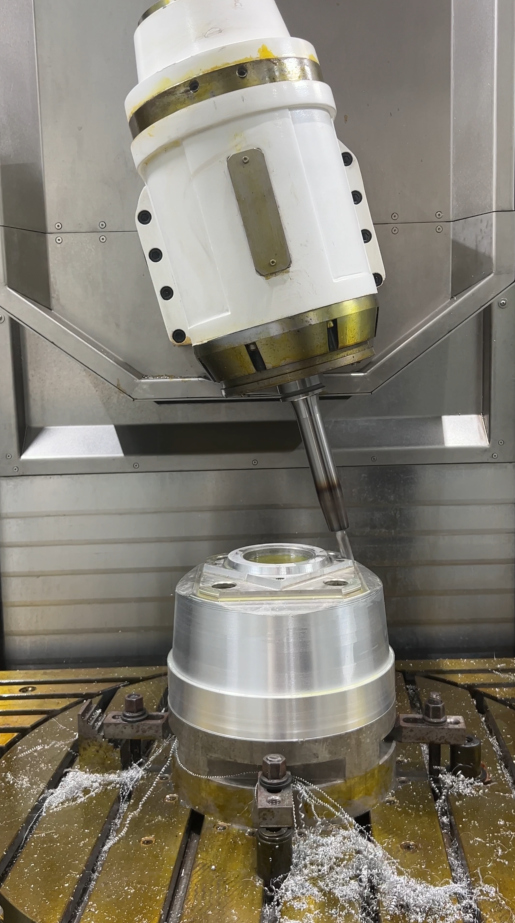
In this guide
What Is the Difference Between Single-Pallet and Twin-Pallet Machining Centers?
On a conventional single-pallet machine, the operator unloads and reloads the workholding in the machining area while machining is stopped. A twin-pallet machine uses an automatic pallet changer, or APC, to exchange two workholding pallets: one is in the machining area while the other is accessible at an external loading station.
The benefit comes from overlapping preparation with machining. The machine still needs time to exchange, locate, clamp, and confirm the next pallet. If the next pallet is not ready when machining finishes, it also waits for the operator.
| Factor | Single pallet | Twin pallet |
|---|---|---|
| Loading | Loading in the machining area interrupts production. | Loading at the external station can overlap machining. |
| Time between machining cycles | Unload, clean, load, clamp, and restart. | Pallet exchange and confirmation, plus any delay waiting for preparation. |
| Workholding | One fixture may support the planned operation. | Both pallets need suitable workholding for continuous alternating production. |
| Accuracy checks | Machine accuracy, workholding, and process capability. | The same checks, plus pallet relocation and differences between fixtures. |
| Layout | Allow loading and maintenance access. | Also allow for the external station, guarding, pallet movement, and material handling. |
| Maintenance | Normal machine and fixture maintenance. | Additional exchange, locating, clamping, and sensing components. |
Dual tool magazines and dual pallets are different features. A second tool magazine increases tool storage; it does not provide an external pallet-loading station. Confirm the actual APC configuration in the quotation and layout drawing.
Guarding must cover both machining and pallet movement. OSHA 1910.212 provides general machine-guarding requirements for US workplaces; it does not certify a particular APC installation. Verify the supplied guarding and interlocks against the applicable requirements for the installation location.[1]
How Much More Output Can a Twin-Pallet Machine Produce?
Start with measured cycle elements rather than a general productivity percentage. For an initial comparison, use:
- C: in-machine processing time per pallet, including programmed machining, tool changes, and in-cycle probing, but excluding pallet exchange.
- L: external preparation time per pallet, including unloading, cleaning, loading, clamping, and any checks required before the pallet is ready.
- S: complete exchange-related interruption, including any positioning, clamping, and confirmation time not already included in C.
Assuming equal processing time and parts per pallet, full overlap of external preparation, and no other losses:
- Single-pallet interval = C + L
- Twin-pallet interval ≈ max(C, L) + S
- Theoretical output = available minutes ÷ interval × parts per pallet
- Output gain = (single-pallet interval ÷ twin-pallet interval − 1) × 100%
Here, max(C, L) means whichever is longer: machining or preparation. Use actual observations if the machine sequence prevents full overlap or if the configurations require different processes.
Worked Examples: Short, Medium, and Long Cycles
The examples assume one part per pallet, 480 available minutes, and an illustrative complete exchange interruption of 9 seconds, or 0.15 minute. The exchange time is an input for this model, not a specification for all machines.
| Processing C | Preparation L | Single interval | Twin interval | Single output / 8 h | Twin output / 8 h | Gain |
|---|---|---|---|---|---|---|
| 2 min | 1.5 min | 3.50 min | 2.15 min | 137.1 | 223.3 | 62.8% |
| 8 min | 2.5 min | 10.50 min | 8.15 min | 45.7 | 58.9 | 28.8% |
| 65 min | 5 min | 70.00 min | 65.15 min | 6.86 | 7.37 | 7.4% |
Decimal outputs express equivalent production rates, not completed whole parts in a particular shift. Actual shift output depends on starting conditions, work in progress at the end, breaks, tool replacement, scrap, and other interruptions.
In the 8-minute example, the theoretical interval falls from 10.50 to 8.15 minutes, saving 2.35 minutes per part. The 65-minute example saves more time per exchange, but that saving is a much smaller share of the original interval.
When Loading Becomes the Bottleneck
If processing takes 2 minutes and preparation takes 3 minutes, a 9-second exchange gives a twin-pallet interval of approximately 3.15 minutes. The machine still waits because preparation is longer than processing. A second pallet cannot eliminate this imbalance.
Investigate fixture access, cleaning, clamping, and material presentation before assuming that a faster APC will solve the problem.
Spindle Utilization Is Not the Same as OEE
Define spindle utilization before comparing figures: spindle-on time, cutting time, and automatic-cycle time are different measurements. The processing time C above includes non-cutting program steps, so it must not be treated as pure cutting time.
OEE is availability × performance × quality.[2] Pallet automation can reduce loading-related losses, but its effect on each OEE component depends on the loss definitions and actual process. It does not establish a particular OEE percentage or guarantee fewer defects.
Single-Pallet vs Twin-Pallet Cost: Calculate the Incremental Investment
Compare quotations with equivalent travels, spindle capability, control, tooling, and required part quality. Separate the cost of pallet automation from differences in the underlying machine specification.
- Machine and APC: exchange mechanism, control integration, guarding, and any required options.
- Workholding: fixtures for both pallets, locating components, clamping connections, and fixture qualification.
- Installation: freight, rigging, foundations where required, utilities, commissioning, and training.
- Operating costs: maintenance, energy, compressed air, floor space, and replacement components.
- Commercial scope: taxes, warranty, local service, travel charges, and delivery terms.
Illustrative budget only: an additional CNY 100,000 for the machine/APC configuration, CNY 20,000 for extra workholding, and CNY 10,000 for additional integration would produce a CNY 130,000 incremental investment. These are planning inputs, not current ASIATOOLS prices or representative market averages.
Use Annual Net Benefit for the Payback Calculation
Simple payback in months = incremental investment ÷ annual net cash benefit × 12.
Annual net benefit can include contribution from additional saleable production and actual avoidable labor or outsourcing costs, less additional operating costs. Do not count the same benefit twice. Extra machine availability has no automatic cash value if there is no demand or another production step limits shipments.
| Annual net cash benefit | Simple payback |
|---|---|
| CNY 50,000 | 31.2 months |
| CNY 100,000 | 15.6 months |
| CNY 150,000 | 10.4 months |
These are sensitivity calculations, not observed returns. Simple payback also excludes financing, tax effects, and the time value of money.
Annual part volume alone is not a reliable purchase threshold. At 3,000 parts a year, the 8-minute example releases only 117.5 machine hours: 3,000 × 2.35 ÷ 60. Establish how those hours would create savings or additional contribution before assigning a payback period.
Check Five-Year Ownership Cost
Compare purchase and installation costs plus five years of labor, maintenance, energy, consumables, and downtime costs, less expected residual value. Use a common required output of acceptable parts. If one configuration needs overtime or outsourcing to meet that output, include those costs.
Measure energy per acceptable part as well as total consumption. Greater output can raise total electricity use while reducing energy per part, but the result depends on the machine and duty cycle. Neither a universal energy-saving percentage nor an automatic reduction in headcount should be assumed.
Which Configuration Fits Your Production?
| Situation | Configuration to investigate | Deciding evidence |
|---|---|---|
| Repeat parts with significant loading time | Twin pallet | Preparation overlaps processing and additional output can be sold or replaces a real cost. |
| Prototypes or irregular demand | Single pallet as a starting point | Compare fixture duplication and programming effort with the small number of repeated cycles. |
| Frequent changeovers | Either | Measure whether the next job can be safely prepared offline; check tool capacity, offsets, and first-off inspection. |
| Long mold or die cycles | Single pallet as a starting point | Loading savings may be small relative to processing, but offline setup or extended operation may still have value. |
| Multiple faces or heavy chip production | Compare suitable VMC and HMC processes | Evaluate access, rigidity, chip removal, and complete workholding rather than pallet count alone. |
| Limited operator coverage | Twin pallet or another automation option | Validate operator workload, preloaded work capacity, tool life, and unattended-operation provisions. |
For a machine-size reference, the ASIATOOLS LJ-855 VMC specification lists a BT40 spindle and 500 kg maximum table load. These specifications do not establish an APC option, pallet payload, or exchange time. Request a configuration-specific quotation.
For multi-face applications, compare the proposed process with a horizontal machining center. Confirm pallet equipment on the exact model; do not assume all HMCs have the same automation package.
Can One Operator Run Two Twin-Pallet Machines?
Possibly, but operator time must fit the production rhythm. Divide hands-on time per pallet by the pallet interval, then add the workload across all assigned machines. Include walking, inspection, deburring, replenishment, and routine interventions.
In the short-cycle example, loading alone requires 1.5 ÷ 2.15, or about 70% of one operator's time per machine. Two machines would require about 140%, before other tasks. One operator could not sustain both at their theoretical rates under those assumptions.
A workload below 100% is only an initial screening result. Simultaneous requests and normal variation still require a timed multi-machine trial.
How Long Can Two Pallets Run Without an Operator?
Two pallets provide a limited queue of preloaded work. Unattended time depends on how much machining remains on the active pallet and how much work is prepared on the second. Once both loads are complete, production stops unless another loading mechanism is available.
For example, one 8-minute part on each pallet provides roughly two processing cycles if both are ready at departure, not several hours. Longer coverage requires longer cycles, more parts per fixture, a pallet pool, or another automation arrangement. Validate tool monitoring, chip and coolant capacity, and the machine's suitability for the proposed operation.
Shop-Floor Trial: What to Measure Before Acceptance
A demonstration should use your drawing, material, workholding concept, and inspection requirements. A fast empty-pallet exchange does not establish the production rate or accuracy of a loaded system.
The following is a suggested trial procedure, not a report of completed factory or customer testing.
- Define a comparable process. Record material, stock allowance, parts per pallet, critical tolerances, tools, cutting conditions, and inspection method. Identify any differences between the proposed configurations.
- Confirm the loaded envelope. Include fixtures, clamps, workpieces, and accessories in the payload. Check center-of-gravity limits, exchange clearance, tool access, and operator reach against the supplier's documentation.
- Time complete cycles. Record processing time, external preparation, exchange interruption, and waiting separately. Start and stop the timer at consistent events; do not substitute brochure exchange time for observed production interruption.
- Label results by pallet. Measure critical dimensions from both fixtures and record pallet ID, offsets, clamp settings, tool condition, and temperature conditions. Compare both average differences and variation.
- Observe sustained operation. Include normal chip accumulation, cleaning, checks, and operator tasks. Record alarms and interventions rather than excluding them from the output calculation.
- Agree on acceptance criteria. Document acceptable part quality, throughput, test duration, and the supplied configuration. Agree with the supplier how guarding, interlocks, and recovery procedures will be demonstrated.
Twenty consecutive parts, split evenly between pallets where practical, can be an initial screening exercise. That sample alone does not establish long-term capability, thermal stability, or production reliability. Set the final sample size and test duration according to the part risk and acceptance agreement.
Separate Axis Accuracy from Pallet Relocation
ISO 230-2 addresses the positioning accuracy and repeatability of numerically controlled axes. ISO 10791-5 addresses positioning tests for work-holding pallets.[3][4] An axis accuracy specification or axis laser report does not by itself verify how a loaded pallet returns to its receiver.
Request the relevant test conditions, measurement results, and uncertainty information. Also verify the finished part: pallet repeatability, fixture differences, clamping distortion, thermal effects, and tool variation all contribute to the production result. Hydraulic clamping alone does not guarantee a particular tolerance.
Practical Checks When the Expected Gain Does Not Appear
| Observed symptom | Checks to investigate |
|---|---|
| Machine waits after processing | Time external cleaning, loading, inspection, walking, and any shared operator tasks. |
| Dimensions differ between pallets | Check fixture datums, seating cleanliness, work offsets, clamping consistency, and temperature before changing cutting parameters. |
| Exchange or seating alarms recur | Follow the manufacturer's diagnostic procedure for utilities, contamination, sensors, and clamping confirmation. |
| Output declines during the shift | Check tool replacement, chip removal, material supply, inspection queues, and operator workload. |
Perform cleaning and maintenance using the manufacturer's instructions and required safe-isolation procedures. Specify air pressure, air quality, lubrication, and maintenance intervals for the selected system rather than applying one universal value.
Frequently Asked Questions
Can a Pallet Changer Be Retrofitted to an Existing VMC?
Some external pallet systems can be retrofitted. MIDACO, for example, describes integration with existing VMCs.[5] This does not mean every machine is suitable. Check structural compatibility, control interfaces, access, guarding, payload, warranty, and total installed cost. Retrofitting an external system is different from adding an original factory-integrated twin-pallet mechanism.
Do Both Pallets Need Identical Fixtures?
Both need workholding appropriate to the scheduled work. Repeating the same operation normally calls for equivalent fixture capability on each pallet, with both qualified for the required result. Different jobs can use different fixtures if tools, programs, offsets, scheduling, and safe operation are properly managed.
Is a Twin-Pallet Machine Always Better for High Volume?
No. It is attractive when preparation creates a meaningful interruption and production can use the recovered time. A long process with brief loading may show a small percentage gain even at high annual volume. Calculate the interval and the economic benefit for the actual part mix.
Does a Second Pallet Improve Machining Accuracy?
Not automatically. It adds another locating interface and usually another fixture to control. Accuracy depends on the complete machine, pallet, fixture, tooling, and process. Verify parts from both pallets under agreed conditions.
What Should I Send for a Useful Machine Comparison?
Provide the drawing and revision, material, stock size, critical tolerances, current cycle breakdown, batch size, annual demand, parts per fixture, loaded weight, shifts, and operator arrangement. Include current quality or chip-removal problems and the required installation location.