

A 64-tool VMC starts to make sense when your full setup is already using around 45–50 tool positions, you keep rebuilding the magazine between repeat jobs, or longer runs need several sister tools. If your normal setup stays comfortably below 24 positions, a 24-tool magazine may be enough. Once you get close to 25, a 30-tool magazine usually gives you a bit more breathing room.
Count the whole setup: production tools + sister tools + probes + common tools + spare positions. Looking only at the tools called by one CNC program can give you a very misleading number.
| Required Positions | Capacity to Compare | Typical Fit |
|---|---|---|
| Up to 20 | 24–30 tools | Stable production |
| 21–30 | 30–40 tools | General machining |
| 31–45 | 40–48 tools | Complex parts or several recurring jobs |
| 46–55 | 60–64 tools | High-mix work or sister tooling |
| 56+ | 64 tools or larger | Large tool library or automated production |
These numbers are useful for planning, but they are not fixed industry rules. Large-diameter tools may block neighboring pockets, and tool-length or tool-weight limits can reduce the number of positions you can actually use.
What Does a 64-Tool Magazine Actually Mean?
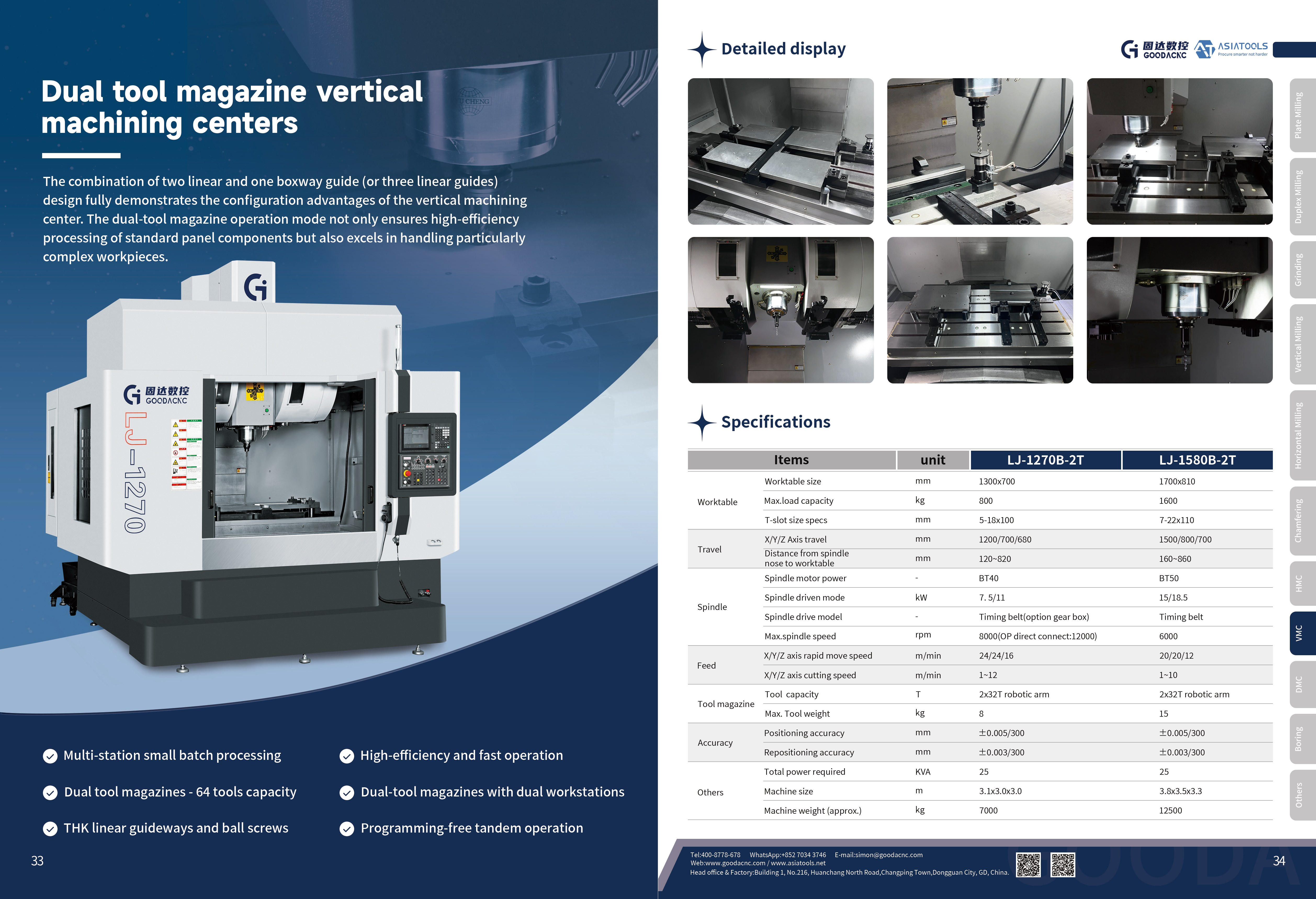
A 2 × 32 dual magazine gives you 64 nominal tool positions. ASIATOOLS uses this layout on its Dual Tool Magazine Vertical Machining Center platform.
A real 64-position setup might look like this:
- 25 production tools
- 8 sister tools
- 6 common drills, end mills and chamfer tools
- 2 probes
- 5 tools for another repeat job
- 6 free positions
That comes to 52 occupied positions.
The part itself does not need 52 separate cutting operations. The extra space is being used to keep backup tools and more than one job setup ready inside the machine. That is usually where a larger magazine earns its keep.
Compare 30, 48 and 64 Tools by Actual Utilization
A simple way to compare magazine sizes is:
Magazine utilization = required positions ÷ available positions × 100.
| Required Tools | 30-Tool Magazine | 48-Tool Magazine | 64-Tool Magazine |
|---|---|---|---|
| 20 | 67% used | 42% used | 31% used |
| 27 | 90% used | 56% used | 42% used |
| 40 | Does not fit | 83% used | 63% used |
| 46 | Does not fit | 96% used | 72% used |
| 50 | Does not fit | Does not fit | 78% used |
If you need 27 positions, a 30-tool magazine leaves only three empty pockets. At 46 positions, a 48-tool magazine leaves just two. It technically fits, but there is almost no room for another drill, a replacement cutter or a new repeat job.
For planning, leaving roughly 10–20% spare capacity can be useful. That is not an engineering standard. It is simply a practical allowance for future tools and backup positions.
- 40 tools + 10% reserve ≈ 44 positions
- 45 tools + 15% reserve ≈ 52 positions
- 50 tools + 20% reserve = 60 positions
So if your real setup already needs 45–50 positions, comparing a 64-tool machine with smaller options is reasonable.
Choosing between 48 and 64 tools?
Send your active tool count, number of sister tools, largest tool diameter and weight, workpiece size, material and batch size.
Send Your Tool ListHigh-Mix Production Is a Strong 64-Tool Use Case
Take four jobs that come back regularly:
| Part | Tools Used by Program |
|---|---|
| Valve body | 18 |
| Aluminum housing | 16 |
| Steel plate | 11 |
| Mold component | 21 |
Together, the programs contain 66 tool calls. Some of those tools are shared, though. The same face mill, drill, chamfer tool or probe may appear in several programs, bringing the physical tool library down to around 38 tools in this example.
Now add 7 sister tools, 2 probes and 5 common tools:
38 + 7 + 2 + 5 = 52 positions.
A 64-tool machine can leave all 52 in place. A 30-tool magazine clearly cannot.
The real gain here is usually setup time rather than faster metal cutting. ASIATOOLS' guide to improving CNC machining efficiency also separates actual cutting time from tool changes, clamping, inspection and other non-cutting work.
Use your own shop numbers. If replacing 10 tools takes 30 minutes and you do that three times a day, you are spending:
30 minutes × 3 = 90 minutes per day.
If both job toolsets can stay in the magazine, much of that repeated rebuilding disappears from the changeover.
Complex Parts and Sister Tools Fill Magazines Quickly
A fairly involved housing might need:
| Operation | Tools |
|---|---|
| Facing and rough milling | 3 |
| Finish milling | 3 |
| Spot drilling and drilling | 7 |
| Reaming and boring | 3 |
| Tapping | 4 |
| Chamfering and deburring | 2 |
| Long-reach or special tools | 3 |
| Total | 25 |
Put that job in a 30-tool magazine and only five positions remain.
One probe, two backup end mills, one backup drill and one backup tap will use all five.
Sister tooling fills a magazine just as quickly. A job with 19 unique tools and five wear-sensitive cutters reaches 24 positions if each critical cutter gets one backup. Give each of those cutters two backups and the requirement rises to 29.
NIST has demonstrated CNC milling tool-condition monitoring using machine-controller, vibration and audio data, showing that cutting-tool condition changes during production and can be monitored rather than assumed to stay constant.[2]
Material and operation matter too. ASIATOOLS' guide to choosing cutting tools for carbon steel looks at how material, hardness and machining operation affect tool choice.
64 Tools Can Support Longer Unattended Runs
A larger magazine solves one problem: having enough tools available. It does not make unattended machining reliable by itself. You still need stable workholding, coolant, chip removal, process monitoring and sensible tool-life control.
Say a job uses 22 production tools. Eight wear-critical cutters each get one sister tool:
22 + 8 = 30 positions.
Then add 2 probes, 4 common tools and 6 tools for the next scheduled job:
30 + 2 + 4 + 6 = 42 positions.
A 30-tool magazine cannot hold that setup. A 64-tool magazine can, with 22 nominal positions left over.
NIST also documents on-machine measurement workflows that include tool setting, tool-state information and machining measurement data.[3]
Planning longer unattended runs?
Send the production-tool count, sister-tool requirement, largest tool size, workpiece material and expected unattended period.
Check a 64-Tool SetupTool Capacity and Tool-Change Speed Are Different
Suppose a program makes 25 automatic tool changes. If one ATC is 0.5 second faster per exchange, the saving is:
25 × 0.5 second = 12.5 seconds per part.
In high-volume work, that can add up.
But a high-mix shop may lose far more time rebuilding the magazine between jobs. Keep these two numbers separate:
- automatic tool-change time during the machining cycle
- manual magazine-rebuild time between jobs
A larger magazine should not be chosen just because the ATC specification looks faster.
64 Positions Do Not Always Mean 64 Usable Tools
Big cutters can block the pockets next to them. Long or heavy tools can also run into magazine limits.
If six oversized cutters each need one neighboring pocket left empty:
6 tools + 6 blocked pockets = 12 positions consumed.
Run your actual tool list against:
- maximum tool diameter with adjacent pockets occupied
- maximum oversized-tool diameter
- adjacent-pocket restrictions
- maximum tool length
- maximum complete tool weight
- tool-holder standard
The current LJ-1580 Vertical Machining Center, for example, lists a 2 × 32T robotic-arm magazine, a maximum tool weight of 15 kg, and X/Y/Z travel of 1500/800/700 mm.
Those figures need to be looked at together. A 64-tool magazine does not help if the workpiece is too large for the travel, too heavy for the table or unsuitable for the spindle.
For shops managing a large number of holders, ISO 13399 provides a standardized information model for cutting-tool data and exchange.[1]
Do Not Use 64 Tools to Fix the Wrong Bottleneck
An 8-hour shift gives you 480 minutes.
If tool-related interruptions cost 10 minutes while fixture changes cost 70 minutes, buying a larger magazine is attacking the smaller problem.
Break the lost time down instead:
- manual tool loading
- fixture changes
- part loading
- inspection
- chip buildup
- coolant problems
- programming
- waiting for material
- cutting time
A 64-tool magazine helps when tool availability is the bottleneck. It will not cure slow fixtures, an undersized spindle or poor chip control.
What Else Should Be Checked Before Ordering?
Magazine size is only one part of the machine. Compare it with:
- X/Y/Z travel
- table size and load
- spindle taper
- spindle speed and torque
- maximum tool diameter
- maximum tool length
- maximum tool weight
- ATC configuration
- tool-life and sister-tool functions
- probing requirements
The ASIATOOLS dual-magazine VMC platform currently lists 6000, 8000 and 12000 rpm spindle options depending on configuration. Pick the spindle around the material and cutting work, not around the number of magazine pockets.
If the CNC control is also part of the decision, the comparison of FANUC, Siemens and Mitsubishi CNC controllers covers machine integration, operator workflow and common machining applications.
Tool loading and magazine maintenance also need safe access. OSHA requires guarding against hazards that include rotating parts and flying chips.[4]
Size the machine from the part and tool list.
Send the workpiece dimensions and weight, material, holder type, active tool count, sister-tool count, spindle requirement and batch size.
Request a VMC Configuration Review64-Tool Decision Checklist
| Condition | What It Means |
|---|---|
| 45–50+ required positions | Compare 64-tool configurations |
| 48-tool magazine would run above 90% | Little reserve remains |
| Recurring jobs require repeated tool swaps | More stored tools can reduce setup work |
| Several sister tools are required | Real demand exceeds unique-tool count |
| Several part families share one VMC | A permanent tool library becomes useful |
| Long unattended runs are planned | Backup tools become more important |
| Oversized cutters block adjacent pockets | Usable capacity is below nominal capacity |
FAQ
Should I choose 48 or 64 tools?
If your full setup needs roughly 35–40 positions, 48 tools may be enough. Once you are regularly around 45–50 positions, 64 tools give you more useful reserve.
Does a 64-tool magazine reduce cycle time?
Not by itself. Its bigger advantage is keeping more production and backup tools ready, which can cut down the time spent rebuilding the magazine by hand.
Are all 64 positions always usable?
No. Oversized cutters can block neighboring pockets, and tool-length or tool-weight limits may rule out certain positions for particular holders.
Can 64 tools support unattended machining?
Yes, especially when the extra positions are used for sister tools. But unattended machining still depends on workholding, chip removal, coolant supply, tool-life control and process monitoring.
When Do You Need 64 Tools?
A 64-tool VMC is worth comparing when the complete setup is already around 45–50 positions, repeat work keeps forcing magazine rebuilds, or longer unattended runs need several backup tools.
Count the production tools, sister tools, probes and common cutters. Then subtract the pockets lost to oversized tooling and leave some practical room for future changes.
If tool availability is genuinely slowing production, a 2 × 32 dual tool magazine VMC solves a real, measurable problem. If it is not the bottleneck, spend the money where it matters more: travel, spindle capability, table load, workholding or automation.