

The WJ-800 horizontal machining center is equipped with an 800x800mm dual-exchange table for non-stop clamping. It features a 10,000rpm spindle and a positioning accuracy of 0.005mm, primarily designed for machining heavy parts.
Export buyers should carefully confirm CE certification and the target country's voltage when inquiring about pricing.
The factory fully supports online video factory visits and overseas on-site commissioning.
Applications
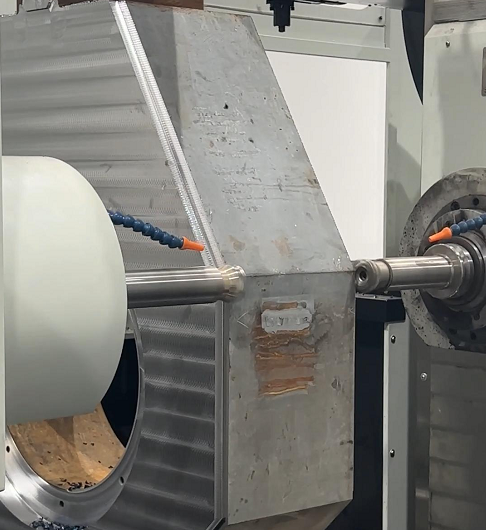
Automotive Manufacturing
A 65 kg A356 aluminum-alloy V6 engine block slides into the machining chamber along a roller track. A 10,000 rpm motorized spindle picks up a 160 mm PCD face mill and sweeps across the cylinder-head mating surface at a feed rate of 2,500 mm/min. Metal removal reaches 1,200 cm³ per minute, while the finished flatness is verified within 0.005 mm using a caliper.
The spindle retracts to the tool-change position, and in just 2.5 seconds, the automatic arm replaces the face mill with a custom compound boring tool. A 9AT automatic transmission housing enters the work area, its cast internal cavity containing 47 bearing bores and oil passages of varying sizes. The B-axis tilts to the programmed angle, and the three-edge compound boring tool reaches deep inside, holding the main bore to H6 tolerance.
· Bearing bore roundness tolerance: 0.003 mm
· Stepped bore coaxiality: 0.005 mm
· Through-spindle coolant pressure: 50 bar
· Tool change time: 2.5 s
· Machined surface roughness: Ra 0.8
The housing for a new-energy drive motor has a wall thickness of only 5 mm, while the inner water jacket cavity reaches a depth of 300 mm. The spindle maintains 8,000 rpm as the tool rubs intensely against the stator inner wall. Twenty liters of chilled coolant per minute are poured directly into the cutting zone to carry away heat and prevent thermal distortion in the aluminum housing.
Machining a single motor housing generates nearly 15 kg of aluminum chips. Gravity allows the chips to fall unobstructed into the bottom dual-screw chip conveyor, leaving the freshly reamed stator mounting bores free of scratches. The hydraulic fixture provides a stable clamping force of 12 MPa, while six flexible support points beneath the part keep housing deformation within 0.01 mm.
The guide bottom holes and valve seat rings in a cylinder head demand extremely high concentricity. A custom stepped compound tool cuts into gray cast iron at 6,000 rpm. Advancing 150 mm along the Z-axis, it forms both the bottom hole and the seat ring in a single pass, keeping coaxiality deviation below 0.008 mm.
· Valve seat angle error: ±5 arcseconds
· Guide bore diameter: 6 mm
· Stepped bore coaxiality: 0.008 mm
· Feed rate: 1,200 mm/min
· Cycle time per part: 3.2 minutes
A heavy horizontal fixture tower is densely loaded with 16 forged-steel connecting rods. The tombstone fixture rotates slowly with the B-axis. Carbide drills feed continuously through the big-end bores at 0.15 mm/rev. Drilling and chamfering for all 16 rods are completed in just 180 seconds.
On the surface of a cast-aluminum steering knuckle, the ball-joint taper hole and ABS sensor hole form a 12.5° spatial angle. The B-axis tilts the table precisely to the preset position. A 4 mm internal-coolant drill penetrates 35 mm into the solid aluminum boss, while 70 bar high-pressure coolant jets through the drill’s internal channels to flush chips out of the hole.
At the external loading station, an operator locks a 120 kg ductile-iron differential housing onto the standby pallet. The dual-pallet exchange system starts, and the heavy-duty hydraulic cylinder pushes the pallet into position. The entire exchange takes just 15 seconds. The machine maintains a longer effective cutting time, while the CNC tool magazine keeps 80 alloy tools of different specifications ready for use.
· Pallet exchange time: 15 s
· Laser tool-breakage detection: 0.8 s
· Effective cutting utilization: 95%
· Maximum tool weight in magazine: 20 kg
· Maximum pallet load: 1,200 kg
The CNC system samples spindle load current every 10 milliseconds. When a rough boring tool hits a hard spot in ductile iron, cutting resistance spikes to 1,800 N. Within 0.05 seconds, the servo drive issues a speed-reduction command, lowering the feed rate by 5% and preventing insert chipping.
A large fly cutter performs finish face milling on an engine block. Each insert sweeps across the cast-iron surface at 4,000 mm/min, removing just 0.1 mm of material. Laser interferometer measurements inside the plant keep full-travel positioning error across the three axes within 0.004 mm, allowing the offline cylinder-head mating surface to achieve a mirror-like finish of Ra 0.4.
Fluid Control
A 2.1-ton duplex stainless steel ball-valve body is lifted by crane onto an 800 × 800 mm cast-iron pallet. Four hydraulic cylinders instantly apply 15 MPa of pressure, clamping the metal structure securely for deep-sea oil and gas pipeline service. The dual-pallet exchange system completes its rotation in 18 seconds, and the loaded pallet slides into the fully enclosed machining chamber.
The spindle emits a deep roar as torque rises to 820 N·m. A 250 mm heavy-duty face mill cuts into 2205 duplex stainless steel at a cutting speed of 200 m/min. Sparks and coolant fly together as each pass removes a 6 mm-thick hardened layer, quickly bringing the valve flange face to a surface finish of Ra 3.2.
The spindle returns to home position, and within 2.8 seconds, the automatic arm swaps in a 450 mm vibration-damping boring bar. The internal flow passage of the valve body is highly irregular, and the tool tip must reach 380 mm deep from the end face to finish-bore the sealing surface. The B-axis table delivers a locking force of 4,500 kgf to resist the severe vibration caused by long overhang machining.
| Valve Body Material | Tool Type | Spindle Speed (rpm) | Depth of Cut (mm) |
| 2205 duplex steel | Heavy-duty face mill | 650 | 6.0 |
| HT250 gray cast iron | PCD finish boring tool | 3200 | 0.5 |
| Cast aluminum bronze | Stepped compound drill | 4500 | 12.0 |
Gravity is the best ally when clearing chips from internal cavities. The damping boring bar cuts micron-level metal filaments inside the enclosed valve chamber, and the chips fall freely through the vertical space of the horizontal machine. The bottom dual-chain chip conveyor runs at 2 m/min, protecting the newly bored valve seat surface with its Ra 0.4 mirror finish from chip scratches.
A 24-inch industrial butterfly valve body is undergoing through-hole machining for the valve stem bore. Concentricity between the two end holes is the key factor in preventing leakage, and the tolerance is held within 0.015 mm. The WJ-800 rotary table turns 180° according to the G-code command, maintaining an absolute positioning accuracy of ±3 arcseconds.
· 180° indexing time: 1.8 s
· Curvic coupling positioning error: ±3 arcseconds
· Through-hole concentricity: 0.015 mm
· Seal-face flange parallelism: 0.01 mm
An 18 mm carbide internal-coolant drill bores into the cast-iron mass at the bottom of the butterfly valve. Hole depth reaches 400 mm, with a length-to-diameter ratio exceeding 22:1. The spindle instantly pressurizes, and 70 bar emulsion coolant is forced through the drill’s internal channels.
Fine cast-iron particles are evacuated through the drill flutes as the peck-drilling feed is maintained at 0.1 mm/rev. Machining time for a single deep hole is reduced to 4.5 minutes. An M24 rigid tapping tool cuts blind holes around the flange, with the spindle encoder providing precise angular feedback to produce a perfect thread profile.
A large double-suction pump casing for a water treatment plant is cast from HT250 gray cast iron and measures 1,200 × 900 mm overall. The huge volute inner wall requires a very smooth surface to reduce fluid resistance. A ball-end mill follows a programmed path, performing 3D contour milling with a 0.2 mm step-over.
A Renishaw OMP60 probe extends from the tool magazine, and its ruby stylus touches the freshly machined flange face. Coordinate data flickers across the CNC screen, locking the flatness tolerance at 0.008 mm. The operator releases the hydraulic chuck at the external loading station, and the 1.5-ton finished pump body is lifted away by overhead crane as the next pallet exchange begins.
Aerospace
A 450 kg TC4 titanium-alloy monolithic forging is lowered slowly by overhead crane. The operator locks the hydraulic fixture, and 12 support points apply 8 MPa of clamping force to secure the main landing gear outer cylinder for a wide-body aircraft onto the pallet. The dual exchange table rotates, smoothly moving the two-ton load into the machining chamber in 16 seconds.
The geared spindle head shifts into low-speed mode, instantly delivering 1,200 N·m of torque. An 80 mm corn-cob milling cutter cuts into the titanium blank at a very low cutting speed of 45 m/min. Friction on the metal surface generates temperatures approaching 800°C, and the chips glow a dark red.
Titanium alloy tends to gall badly, and the cutting edge is subjected to intense thermal stress the moment it enters and exits the metal. Even while removing 300 cm³ of this hard material per minute, spindle load remains steady at 65%.
High-pressure internal coolant at 70 bar sprays from the spindle center, delivering 40 liters of emulsion per minute directly onto the cutting edge. The heat is suppressed immediately, and the dark-red titanium chips cool down and fall vertically into the bottom chip trough under gravity.
· Low-speed gearbox torque output: 1,200 N·m
· Radial width of cut for corn-cob mill: 25 mm
· Coolant flow in cutting zone: 40 L/min
· Titanium blank weight removal rate: 65%
The vibration-damping boring bar extends 480 mm, and the tool tip reaches deep inside the titanium cavity to perform a fine 0.1 mm finishing cut. The B-axis curvic coupling locks in place, and the 4,500 kgf hydraulic clamping force offsets the minor vibration caused by the long overhang. Bore roundness is verified at 0.006 mm using a caliper.
An aero-engine casing ring made from Inconel 718 nickel-based superalloy is highly prone to work hardening during machining. Mounted on the rotary table, the 900 mm ring rotates slowly while a four-edge ceramic milling cutter skims across the metal surface at a cutting speed of 800 m/min.
After 12 minutes of cutting the superalloy, the insert edge shows 0.15 mm of minor wear. The built-in laser tool setter in the CNC system emits a beam and detects the contour change at the tool tip within 0.8 seconds. The tool management program starts immediately, and the spindle returns to the tool-change position.
Within 2.5 seconds, the automatic arm removes the worn tool and retrieves a spare of the same specification from the 120-tool magazine. The Z-axis compensation parameter is automatically adjusted by 0.15 mm, keeping the cutter mark depth on the casing flange face below 0.003 mm.
· Laser tool-setting time: 0.8 s
· Ceramic tool cutting life: 12 minutes
· Automatic calling of identical spare tool: enabled
· Dynamic Z-axis tool-length compensation: 0.15 mm
· Cutter mark depth error: 0.003 mm
A thick 7075-T6 aerospace-grade aluminum plate is loaded to machine a wing rib frame. The spindle accelerates to 12,000 rpm, and a three-flute aluminum face mill runs across the plate at an extremely high feed rate of 6,000 mm/min. Over four hours of metal cutting, the blank weight drops sharply from 180 kg to 22 kg.
The reinforcing ribs in the frame are only 1.5 mm thick, while the cavity depth reaches 80 mm. Thin-wall parts are highly susceptible to distortion as cutting stress is released. The WJ-800 table is equipped with a programmable flexible clamping system, which gradually reduces clamping pressure from 6 MPa to 2.5 MPa as material is removed.
A high-precision Renishaw OMP400 strain-gauge probe mounted on the spindle nose extends outward. In 1.2 seconds, the ruby stylus touches three datum points on the reinforcing rib. The screen displays the coordinate data, and the perpendicularity deviation of the 1.5 mm thin wall is fixed at 0.012 mm, with no cutting deflection.
Inside the cast-iron machine bed, 16 coolant circulation channels are embedded. An industrial chiller keeps water temperature strictly at 22.5°C. During 18 hours of continuous aerospace-part machining, thermal displacement across the full 800 mm X-axis travel is held within 0.005 mm.

RFQ Points
Technical Specifications
The buyer’s RFQ should specify the BT50 standard 7/24 taper to ensure tight compatibility with 90% of large milling toolholders on the market. Ask the manufacturer for the exact inner diameter of the front spindle bearing. When the front bearing bore reaches φ130 mm, vibration resistance in cutting 45# steel is more than twice as stable as the standard φ100 mm configuration.
An 18.5 kW to 22 kW spindle servo motor can deliver 140 N·m of continuous torque in the cutting zone. Under harsh roughing conditions with an 8 mm radial depth of cut, the machine’s 30-minute overload torque can surge to 350 N·m, greatly reducing the risk of stalling or tool breakage.
Recommended reference parameters for spindle and drive selection:
· Taper type (BT50 or HSK-A100)
· Maximum spindle speed (6,000 rpm)
· Front bearing bore threshold (φ130 mm)
· Disc-spring tool-clamping force (18 kN)
· Pull-stud specification (MAS 403 P50T-1)
If the drawing includes large-diameter boring requirements, the RFQ should add the two-speed gearbox option. With a German ZF gearbox installed, the 1:4 transmission ratio can deliver up to 800 N·m of destructive torque at as low as 300 rpm. When using a φ160 mm slab mill for full-width cutting on cast iron, the geared drive eliminates the speed loss caused by belt slippage.
ATC capacity and the tool-changing mechanism determine how smoothly long machining programs can run. A standard 40-tool drum magazine can only handle conventional box-type parts. For hydraulic valve blocks with hundreds of different hole sizes, the purchase specification should be upgraded to a 60-tool or even 120-tool chain magazine. Combined with a double-sided cam mechanism, the T-to-T physical tool change time can be reduced to 2.5 seconds.
Heavy-tool compatibility directly affects acceptance of the ATC system. Show the supplier the size limits of the largest tool on your machining drawings and require the tool magazine to accommodate a φ220 mm large-diameter fly cutter when adjacent tool pockets are left empty. In a fully loaded magazine, the interference diameter allowance should be expanded to φ110 mm, while the maximum permitted weight per tool must never exceed 20 kg.
Verification parameters for the tooling and tool-change system:
· Tool magazine structure type (servo chain type)
· Adjacent pocket spacing (115 mm)
· Maximum tool length (400 mm)
· Tool-search motion mode (bidirectional nearest random access)
· C-to-C action time (6.8 s)
The WJ-800 typically offers X/Y/Z travels of 1,200 mm, 900 mm, and 900 mm. In the RFQ email, require the manufacturer to disclose the rapid traverse speed under no-load conditions. Heavy-duty roller linear guides combined with high-power servo motors can move the several-ton column at 24 m/min along the X-axis.
Under the G01 linear interpolation command, the maximum feed rate should exceed 10,000 mm/min. Long periods of high-speed reciprocating motion cause the ballscrew to heat up and expand, so the configuration sheet should include hollow ballscrew cooling. Continuously pumping cooling oil through the φ16 mm center bore of the screw can eliminate up to 12 microns of thermal elongation over one meter.
Key transmission and feed data for the three axes:
· X/Y/Z axis servo rated power: 7.0 kW each
· Rapid traverse speed for all axes: 24/24/24 m/min
· Effective cutting feed rate: 1–10,000 mm/min
· Ballscrew pitch: 16 mm
Deep-hole drilling depends heavily on the impact force of the through-spindle coolant (CTS) system. External nozzles cannot clear chip buildup from the bottom of a 300 mm deep hole. Ask the factory for the model and pump-head data of the high-pressure coolant pump. A Grundfos pump delivering 20 to 50 bar high-pressure cutting fluid can blast coolant out from the drill tip and instantly reduce cutting-zone temperature by 40°C.
The tens of liters of coolant sprayed every minute require a large tank and filtration system to maintain circulation. An 800-liter coolant tank can prevent the pump from running dry and stopping machining mid-cycle. Require the manufacturer to provide a paper-band filter combined with a magnetic separator. The dual filtration system can remove fine iron particles down to 20 μm, preventing small metal debris from wearing out the spindle rotary union.
Chip conveyor capacity directly limits the runtime of unattended machining. Dual screw conveyors mounted on both sides of the table should continuously push falling swarf toward the external outlet using 0.4 kW motors. The connected scraper-type lift conveyor should achieve a throughput of 300 kg per hour, lifting chips 1.2 meters and dropping them accurately into the workshop scrap bin.
Compressed-air demand often becomes a problem only during machine installation. At the RFQ stage, the buyer should confirm the machine’s total air consumption with the manufacturer. An inlet pressure of 0.6 to 0.8 MPa should be matched with a stable airflow supply of 500 L/min. The specification should also state the use of SMC or Festo FRL units to remove 99% of moisture and impurities from the plant air supply.
Under full-load cutting conditions, the WJ-800’s total power capacity is around 60 kVA. The document should clearly state in bold that the main power input must use national-standard pure copper cable with a cross-sectional area of 16 mm², and the workshop circuit breaker should have a load capacity of at least 100 A.
CNC System Electrical Standards
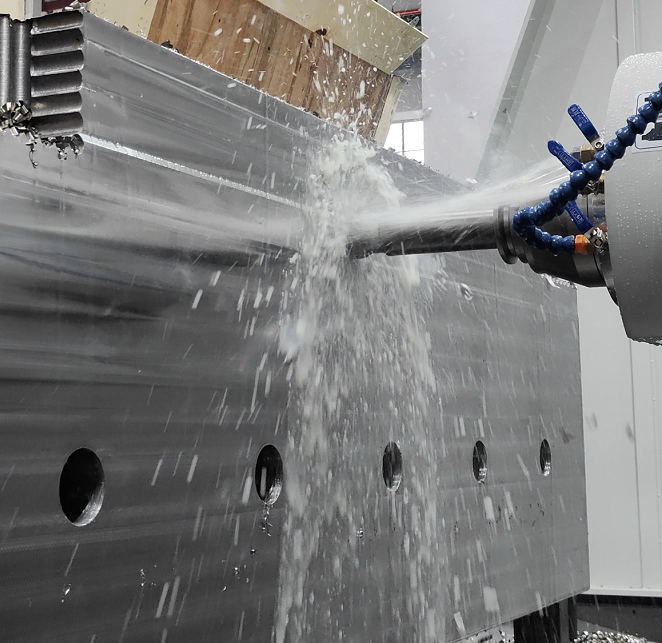
The RFQ email should specify the exact package version of the FANUC 0i-MF Plus system. The standard package offers only 512 KB of program storage, which is not enough for the 3D surface G-code of complex molds. The purchase order should require upgraded memory of 2 MB or even 8 MB, along with a 10.4-inch color LCD screen. With the AICC II contour control function, the system can pre-read 200 program blocks in advance.
If the operators are more familiar with European systems, the RFQ should instead specify a Siemens 828D with a PPU 290 touch panel. This CNC platform supports up to 80-bit floating-point precision, and the interpolation cycle is reduced to an astonishing 0.75 milliseconds. When machining aerospace aluminum parts with more than 1,500 surface nodes, the toolpath remains smooth and free of pause marks.
The Mitsubishi M80 is another Japanese system often found on purchase lists. Be sure to confirm with the factory that it uses the MSSC fiber-optic communication bus architecture. With a transmission rate of 100 Mbps, the fiber-optic cable can return servo motor torque feedback to the motherboard in 0.1 milliseconds. This high-bandwidth data flow keeps rigid tapping stable even at speeds up to 4,000 rpm.
List the optional CNC controller configurations from each supplier and send them to the manufacturer for confirmation.
| System Brand | Recommended Model | Look-Ahead Blocks | Screen Specification | Suitable Application |
| FANUC | 0i-MF Plus Type 1 | 400 | 10.4 / 15 in. | Batch box-type parts |
| SIEMENS | SINUMERIK 828D | 250 | 15.6 in. touch | Complex freeform-surface molds |
| MITSUBISHI | M80B | 270 | 10.4 in. | High-speed drilling and tapping |
| HEIDENHAIN | TNC 620 | 1024 | 15 in. touch | Reserved for future 5-axis linkage |
Clearly state the actual shop bus voltage in your country. Industrial power in Mexico is 220V/60Hz three-phase, while some regions of Saudi Arabia use 380V/60Hz. A machine supplied with China’s standard 380V/50Hz transformer will not even power up the servo drive panel after shipment.
The list must require the factory to install a 65 kVA isolation transformer. The winding material should be specified as 100% pure copper. Copper-clad aluminum windings may fail within three months under continuous 45 kW full-load operation. The allowable three-phase input voltage fluctuation range should be expanded to ±15% to handle nighttime grid surges of up to 420 V in some industrial parks in Southeast Asia.
The list of contactors and circuit breakers inside the electrical cabinet is a mandatory factory-inspection item. Specify Schneider TeSys D series contactors or ABB S200 series miniature circuit breakers. If the machine is exported to Europe, all relays, terminal blocks, and cable jackets must carry CE certification marks issued by TÜV.
Electrical cabinet cooling is critical in countries near the equator. When ambient temperature approaches 40°C, two 120 mm exhaust fans alone cannot remove the 700 W of heat produced by three servo drives. The contract should include a 1,500 W industrial electrical cabinet air conditioner to keep the closed cabinet below 28°C.
Complex wiring must strictly follow the IEC 60204-1 color code. Three-phase AC power lines should be black, brown, and gray, while 24V DC control lines should all be dark blue. Both ends of every 15-meter drag-chain cable must be fitted with machine-printed wire markers covered by transparent sleeves, so a maintenance electrician can locate signal wire “204A” within a minute while holding the schematic.
High-frequency interference can cause completely erratic scale readings. Require the spindle motor and all servo power cables to be upgraded to shielded cables with tightly braided copper mesh. Measure grounding resistance from the plant grounding point to the machine PE terminal with a megohmmeter, and it must not exceed 4 ohms. The residual-current protection device should be set to the 300 mA industrial trip level.
Customization Optional Accessories
The buyer should add the OMP60 infrared workpiece probe to the specification list. Without a probe, it can take an operator 40 full minutes to indicate and align a 2-ton cast-iron box on an 800 mm table using a dial indicator. By automatically calling the O9810 macro, the machine can touch the workpiece edge at 3,000 mm/min and compensate for 0.15 mm of setup misalignment in just 3 minutes.
Ask the manufacturer to add an NC4 non-contact laser tool setter. With a 12 mm end mill spinning at 8,000 rpm through the laser beam, the sensor can detect micro-chipping on the cutting edge with an accuracy of 0.002 mm. If the system finds that the tool has shortened by 0.05 mm, it immediately stops the spindle.
The OMI-2T infrared receiver for the probe should be mounted in the corner at the top of the sheet-metal enclosure. With a maximum transmission distance of 6 meters, two AA batteries allow the probe to continuously send coordinate pulse signals for 400 hours.
A quick-change baseplate from Schunk or Lang can reduce changeover time from 2 hours to just 3 minutes. Four pull-stud locking modules are embedded in the pallet. Each pneumatic module requires only 0.6 MPa of compressed air to generate a single-point downward clamping force of 25 kN.
The hydraulic fixture circuit should pass through the center of the rotary table before the machine leaves the factory. Ask the supplier to add a six-channel hydraulic rotary union at the center of the B-axis. Four channels carry 100 bar high-pressure hydraulic oil to lock the clamping cylinders, while two channels supply compressed air to blow fine chips off the fixture base, eliminating the need for operators to enter the enclosure and reconnect hoses every time.
To prepare for automation, the machine should include the following interfaces in advance:
· Side automatic door (cylinder-driven, 1,000 mm stroke, fully open within 2.5 seconds)
· Robot communication protocol (Profinet bus specified, 24V I/O interface)
· Fixture wash-down system (pump head 20 m, 15-second instant rinse)
The options sheet should include a Losma Darwin series mist collector. Mounted on top of the machine, the centrifugal fan runs at 1,200 m³/h and can capture 99% of PM2.5 oil mist particles into a HEPA filter. The condensed clean cutting fluid can then flow back into the tank.
For factories running 24/7 at full load, the standard 1.5 kW spindle oil chiller is not enough to control heat. The written specification should require an upgraded 3.0 kW high-capacity chiller. Even when summer shop temperature rises to 35°C, the compressor can keep the circulating VG32 cooling oil in the spindle housing locked at a constant 22°C.
Machines exported to Europe must specify the refrigerant model. R22 refrigerant may be held at customs and must be replaced with R410A or R134a, which comply with EU environmental regulations. The charge amount of 1.2 kg must also be engraved on the nameplate.
When fitted with a BK Mikro mechanical tool-breakage detection arm, the air cylinder drives the probe across the tool tip. After a 2 mm tap retracts from a machined hole, the probe completes physical contact inspection in 1.2 seconds. If the measured tool length is shorter than the preset 150 mm, the machine alarms immediately, saving a $500 aluminum-alloy blank from being ruined by the broken tap.
For deep-hole machining, 70 bar ultra-high-pressure through-spindle coolant (CTS) is essential. A German Knoll screw pump forces high-pressure coolant through the center bore of a 150 mm-long gun drill. The powerful water pressure explodes at the hole bottom, blasting coiled aluminum chips out through the evacuation channel and preventing the drill from clogging and breaking 20 mm before breakthrough.
The following coolant-system capacity upgrades must be written into the requirements:
· Total tank capacity increased (from 1,000 L standard to 1,500 L)
· Crawler-type oil skimmer (removes 2 L of floating way oil per hour)
· Constant-temperature water chiller (keeps cutting fluid below 25°C)
When machining thin-wall parts prone to vibration, spindle load monitoring software can save the machine spindle bearings. Add the optional Artis tool monitoring system, which reads the real-time current waveform from the FANUC servo motor. If current suddenly spikes by 15% under full-load cutting, the system identifies severe tool wear and forces the spindle to stop feeding within 0.05 seconds, preventing a crash at 10,000 rpm.
Factory Support
Factory Acceptance
Next to the final assembly area for the WJ-800 horizontal machining center is a 400 m² temperature-controlled inspection room. Eight high-power industrial air conditioners mounted overhead keep room temperature strictly at 20 ± 0.5°C. The granite surface plate reaches Grade 00 flatness, with a very thin layer of anti-rust oil applied to the surface. An assembly technician pushes a cart loaded with inspection tools to the side of the machine enclosure.
A 300 mm standard test bar is inserted into the spindle’s BT50 taper. A dial indicator with a magnetic base is fixed to the worktable, with the probe gently touching the outermost end of the bar. The operator slowly rotates the spindle by hand, and the total indicator movement is limited to within 0.003 mm.
Measuring squareness between the X and Y axes requires an 80 kg granite square. A crane uses a nylon sling to place it steadily at the center of the worktable. The dial indicator moves uniformly along the vertical face of the square over a travel of 500 mm up and down. If the reading changes by more than 0.005 mm, the fitter must scrape the column-base guideway interface again.
The transmitter of a Renishaw XL-80 dual-frequency laser interferometer is mounted on a tripod. An optical reflector is fixed to the spindle face using a magnetic base. The red laser beam passes through the interferometer and scans back and forth along the Z-axis over 800 mm of travel.
The laser control software records the positioning accuracy test data in real time:
· Five full-stroke runs each in forward and reverse directions
· Deviation data collected at 15 equally spaced target points
· Ballscrew backlash controlled within 0.002 mm
· Pitch-compensation file generated in compliance with ISO 230-2
The machine’s full-load run-in test operates continuously for 48 hours. The spindle steps up from an initial 500 rpm to a maximum of 10,000 rpm. A PT100 temperature sensor mounted outside the spindle front labyrinth seal continuously monitors temperature. The CNC screen shows spindle bearing temperature fixed below 43°C.
The insulation resistance tester for the electrical cabinet outputs 500 V DC. Probes are applied to the power input terminals of the servo drives and the machine’s main grounding copper busbar. The displayed insulation resistance remains stable above 50 megohms. A hi-pot tester applies 1,500 V AC to the electrical main circuit for one minute, with no breakdown or discharge.
The coolant tank at the rear of the machine is filled with 800 liters of emulsion coolant. The pump motor starts, and a 2 MPa through-spindle coolant (TSC) jet surges from the tool tip. The water stream forcefully washes every folded corner inside the stainless steel inner guarding. The inspector uses a high-intensity flashlight to check for leaks around the outer machine enclosure.
The 40-tool chain magazine enters the fatigue-validation stage. A FANUC macro program for cyclic tool change starts running.
· Spindle loaded with a simulated full tool of 15 kg
· Arm completes pick-and-place tool changes every 2.5 seconds
· 2,000 continuous fault-free tool-change cycles performed
· Lubricating oil temperature in the tool-magazine cam box kept below 55°C
The vibration acceleration sensor of the dynamic balancing instrument is attached to the side of the spindle headstock. At 8,000 rpm, the measured vibration velocity reads 0.6 mm/s. The factory acceptance standard requires that the reading must never exceed 0.8 mm/s. Based on peak frequency, assembly workers thread several-gram brass balance screws into the threaded holes on the spindle flange.
A 45-page machine inspection record is signed throughout by quality inspectors. The machine exterior is coated with a thick layer of grease and wrapped in two layers of 0.2 mm vacuum anti-rust aluminum foil bags. A vacuum pump removes the internal air, and 30 packs of industrial-grade bentonite desiccant are placed inside. The WJ-800 is then hoisted onto a fumigation-free wooden skid welded with channel steel, ready for shipment.
Overseas Installation
After being unloaded at the Port of Rotterdam, the WJ-800 is delivered by an air-suspension truck to an automotive parts workshop in Stuttgart, Germany. A 15-ton gantry crane slowly unloads the rain-covered wooden crate into the factory aisle. Two local technicians use electric screwdrivers to remove 120 galvanized self-tapping screws securing the crate panels. Once the 0.2 mm vacuum anti-rust film is cut open, the cast-iron machine body, coated in amber anti-rust oil, reflects under the incandescent lights.
Twenty-eight days in advance, the workshop floor had been cast with an independent concrete foundation measuring 4 meters long by 3 meters wide. The foundation is 600 mm thick and made from commercial C40 concrete. The assembly workers place 24 surface-hardened cast-iron leveling pads on the concrete according to the drawing dimensions. The crane then lowers the 12.5-ton machine body steadily onto the center of these pads.
The engineer places a precision spirit level rated at 0.02 mm/m at the center of the table. A wrench grips the adjusting nut of an M24 anchor bolt, turning it only 15 degrees at a time. The bubble in the level tube slowly shifts until it settles exactly between the two black lines. Leveling error in both the X and Z directions is strictly controlled within 0.01 mm.
European workshops use 400 V, 50 Hz three-phase AC power. A 50 kVA pure-copper isolation transformer weighing 150 kg is installed beneath the electrical cabinet. The technician measures the secondary output terminals with a multimeter, which reads exactly 220 V. Three black flame-retardant cables with a cross-sectional area of 25 mm² are stripped and fitted with crimp terminals.
| Overseas Power-Connection Inspection Item | Cable Material Specification | Tightening Torque | Test Tool |
| Main power input terminals (R/S/T) | 25 mm² annealed copper flexible conductor | 8.5 N·m | Preset torque wrench |
| Machine main grounding busbar (PE) | 35 mm² yellow-green dual-color wire | 10.0 N·m | Digital grounding resistance tester |
| Main workshop air-supply inlet pipe | 3/4-inch high-pressure PU hose | Quick fitting locked | Leak-detection foaming soap solution |
The gauge pointer turns clockwise and stops at 0.65 MPa. The hydraulic station tank cover is opened, and the technician slowly pours in 120 liters of Mobil DTE 24 anti-wear hydraulic oil. The lubrication pump starts, and 6 MPa pressure pushes the hydraulic oil into the B-axis clamping cylinders.
Because of the long sea voyage, some external components had to be disassembled and packed separately before shipment, so the on-site team begins reassembly:
· Bolt the 60-tool disc magazine to the side of the column using six M16 high-strength bolts
· Connect the aviation plug of the tool-magazine servo motor with its 24 tinned-copper pins
· Push the double-layer crawler chip conveyor into the U-shaped slot at the front of the base and lock the fixing plate
· Connect the two 1-inch inner-diameter steel-braided hoses for the spindle constant-temperature chiller
The 10.4-inch LCD screen lights up and displays the startup interface with coordinate data. The servo drives detect the absolute position encoder signals from all three axes, and the 6 V lithium battery did not lose power during ocean transport. The operator presses the Z-axis button on the handwheel, and the 2-ton spindle head moves slowly at 10 mm/min.
On site, the machine’s mechanical geometric accuracy must be rechecked after shipment. The 300 mm standard test bar is inserted again into the BT50 spindle taper. The dial indicator mounted on the worktable shows a runout of 0.003 mm, confirming that sea transport has had no effect. The service engineer also spot-checks several parameter values on the pitch-compensation screen in the control system.
Trial cutting is the final step before handover:
· Clamp a 45 kg P20 mold-steel blank on the table
· Load an 80 mm five-insert face mill into the spindle
· Set cutting depth to 2.5 mm and feed rate to 1,200 mm/min
· As chips fly, the spindle motor load meter remains steady at about 45%
The value displayed on the screen shows a surface roughness of Ra 0.6 μm. The coolant nozzle angle is readjusted so the emulsion strikes precisely at the contact point between the tool tip and the workpiece. The supervisor of the overseas workshop signs the bottom of the acceptance report, which includes three pages of inspection data. The WJ-800 is then officially integrated into the customer’s flexible manufacturing line.