

For mold frame machining and heavy-part processing, the WJ-800 combines an 800 mm dual-station table with a heavy-duty load capacity of up to 1.5 tons, maintaining micron-level stability and accuracy even under aggressive cutting conditions.
For batch production, its 15-second APC exchange system cuts downtime by 35%. With alternating dual-station operation, it supports continuous 24-hour processing, making it an ideal solution for balancing heavy-duty machining with scalable output.
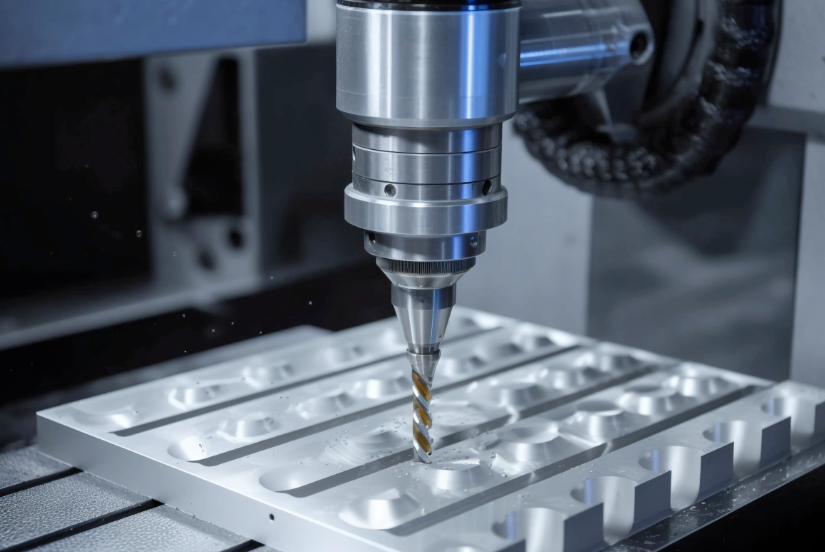
Mold Frames
Load Capacity Structural Rigidity
In mold shops, a P20 mold steel plate measuring 1500 mm × 1000 mm can easily weigh over 2 tons. On a standard machine table, that kind of load can cause more than 0.03 mm of physical sag along the Y-axis guideway. The WJ-800 uses an HT300 gray cast iron base, and the complete machine weighs 12 tons.
This material offers vibration resistance roughly 10 times that of ordinary steel. Its extra-wide 1600 mm bed span keeps the center of gravity within the guideway support range. Even when carrying a 4-ton mold frame, the table’s levelness fluctuation remains within 0.01 mm over its full travel.
· The base is reinforced internally with 25–30 mm rice-shaped ribbing to counteract stress from heavy workpieces.
· Heavy-duty 55 mm roller linear guideways are used, with each block rated for over 150 kN of dynamic load, supporting up to 4000 kg.
· The Z-axis column adopts a wide-span trapezoidal structure, 950 mm in width, to prevent forward tilting caused by rapid feed of a 300 kg spindle head.
· The base mounting holes are increased to 12, allowing cutting vibration to be transferred through anchor bolts into a foundation 1.5 meters underground.
· The castings undergo two rounds of artificial aging plus six months of natural aging to prevent accuracy drift over the next five years.
When roughing S50C template steel with a 63 mm face mill at a cutting depth of 4 mm, the instantaneous cutting force exceeds 5000 N. The WJ-800 spindle motor delivers a constant 750 Nm of torque.
The BT50 spindle provides an 18 kN tool clamping force. Combined with an oil-cooling system, spindle temperature rise is kept within 2°C above ambient. The spindle’s front bearing has a diameter of 110 mm, allowing it to absorb repeated high-frequency impacts without axial movement.
· Radial runout at the spindle taper is under 0.002 mm. Together with a 20 kg internal coolant pressure system, a 32 mm U-drill can be pushed to a feed rate of 0.15 mm/rev.
· The ballscrews are C3 precision grade, 50 mm in diameter, with dual-nut preload to eliminate the 0.005 mm backlash caused by frequent reversal.
· X and Y repeat positioning accuracy reaches 0.003 mm. Over a 1200 mm travel range, repeated edge finding and alignment produce almost no deviation.
· All three axes use high-resolution absolute encoders. With a scale error of only 5 microns per meter, the machine can begin work directly without a homing cycle.
· The table surface is hardened to HRC50 and features seven T-slots. Each slot can 500 kg of clamping force without distortion.
When machining deep holes or heavy mounting holes, tool stability directly affects the alignment of mold base A and B plates. Under full load, spindle box vibration amplitude remains below 1.5 microns. As a result, during guide pillar installation, the fit clearance can be controlled to within 0.015 mm.
In mold frame production, material removal from No.45 steel often exceeds 30%. The large-flow stainless steel guarding system removes 50 kg of chips per minute. The coolant pump delivers 3 kg of pressure to flush chips out of dead corners in the mold plate, preventing damage to already finished surfaces.
· The three-axis oil circulation system delivers 15 L per hour, removing 80% of the frictional heat generated by the ballscrews and preventing thermal elongation.
· The ATC can handle 15 kg heavy tools, with a tool change time of 2.5 seconds, reducing vibration when switching large boring tools.
· The lubrication system uses a volumetric distributor to ensure that all 24 lubrication points receive 3 ml of precision oil every 15 minutes, reducing guideway wear.
· The Z-axis motor includes a power-off brake, and the 40 kg nitrogen balance cylinder prevents the spindle from dropping in the event of a power failure.
· The machine’s safety door glass uses 10 mm laminated tempered glass to withstand debris from a shattered 50 mm cutter.
At a finishing feed rate of 3000 mm/min, the WJ-800 can achieve a surface roughness of Ra0.8. Around 80% of mold frame plates come off the machine without requiring secondary grinding.
For large non-standard mold frames, the machine provides an effective pass-through width of 1250 mm. For heavy plates over 200 mm thick, its gantry structure offers three times the stability of a standard vertical machining center.
· For a 1.2-meter mold plate, beam sag compensation during cutting is kept within 0.008 mm.
· Even with the spindle running at full load at 8000 rpm, external machine vibration remains below 0.5 mm/s.
· The table is fitted with high-strength protective covers to prevent dropped workpieces weighing over 5 kg from damaging the precision guideways.
· Every casting joint surface is hand-scraped to more than 25 contact points per square inch.
Geometric Tolerance Accuracy
In mold shops, when an A-plate or B-plate measuring 1200 mm × 1000 mm is placed on the WJ-800 table, the first requirement is to ensure full geometric accuracy on all six faces. When machining a 1000 mm-long plane, the WJ-800 can hold flatness within 0.01 mm. This level of precision is achieved through the machine’s 1200 mm ultra-wide base support, which prevents the 0.005 mm micro-deformation that often appears at the edges of heavy plates under gravity.
Using an 80 mm finishing face mill at S800 rpm and F600 feed, measured surface roughness remains between Ra0.6 and Ra0.8. On mirror-finish S136 mold steel, this surface quality reduces subsequent hand polishing time by 40%. Measured perpendicularity error on the four side faces stays below 0.01 mm over a height of 300 mm.
· The BT50 spindle has less than 0.003 mm radial runout at 300 mm from the spindle face, ensuring consistent hole diameters in deep boring operations.
· X and Y axis travel reaches 1200 mm × 800 mm, with straightness error across the full travel controlled within 0.012 mm.
· For diagonal hole positions spanning 1500 mm, the WJ-800 achieves 0.005 mm positioning accuracy, allowing guide pillars to enter smoothly during multi-plate mold assembly.
· The ballscrew support bearings use P4 precision matched bearings to eliminate axial movement above 0.002 mm and maintain slot depth accuracy.
· Guideway contact surfaces are hand-scraped to 25 points per square inch, maintaining a 2-micron oil film and preventing low-speed stick-slip.
When boring heavy mold frames 200 mm thick, the difference between hole diameter at the entrance and at the bottom is controlled within 0.008 mm. With the BT50 spindle’s 18 kN clamping force, even when using a 50 mm boring bar extended 300 mm, end vibration remains below 1.5 microns.
In mold frame machining that runs continuously for 12 hours, with ambient temperature fluctuations of 5°C, the WJ-800 spindle oil-cooling system keeps spindle box temperature rise locked within 2°C above ambient. This thermal stability limits X-axis positioning drift to less than 0.01 mm over 8 hours, solving the common problem of dimensional variation between morning and evening shifts.
| Geometric Tolerance Item | Industry Standard | WJ-800 Measured Value |
| Flatness (1000 mm) | 0.015 mm | 0.008 mm |
| Parallelism (300 mm) | 0.020 mm | 0.012 mm |
| Perpendicularity (300 mm) | 0.015 mm | 0.010 mm |
| Repeat Positioning Accuracy | 0.005 mm | 0.003 mm |
| Spindle Taper Runout | 0.005 mm | 0.002 mm |
Alignment between mold base A and B plates depends on the perpendicularity of the X and Y axes. Across an 800 mm × 1200 mm area, the WJ-800 keeps axis perpendicularity error below 0.01 mm. At four guide pillar hole positions spaced 600 mm apart, coordinate position deviation is compressed to within 0.008 mm. This ensures that a 3-ton mold can open and close repeatedly on an injection molding machine without wearing the guide pillars.
All three axes use 50 mm diameter C3 precision ballscrews, with lead error under 0.008 mm over 300 mm. Combined with high-resolution absolute encoders, feedback resolution reaches 0.1 micron. When machining large pattern holes, repeat deviation remains only 0.002 mm whether the tool approaches from the positive or negative X-axis direction.
· An optional 1500 mm scale provides real-time compensation for 0.01 mm-level linear error caused by thermal expansion.
· The machine beam uses a closed box structure. Even with a 300 kg spindle head mounted, mid-span deflection compensation remains below 0.005 mm.
· The tool change mechanism has a repeat alignment accuracy of 0.002 mm. After switching between roughing and finishing cutters, step height deviation stays below 0.005 mm.
· The seven T-slots remain parallel to X-axis travel, with error controlled within 0.015 mm/1000 mm.
· Pressure fluctuation in the nitrogen balancing system is controlled within 0.1 MPa, ensuring stable Z-axis motion during 0.01 mm micro-feed operations.
The WJ-800 is equipped with 12 sets of high-rigidity leveling pads, each capable of supporting 1 ton. Using a precision electronic level, the bed can be adjusted to 0.01 mm/1000 mm. This baseline accuracy prevents machine distortion even when machining 2-ton mold plates.
For high-hardness pre-hardened steels such as 718H or NAK80, the WJ-800 maintains spindle load at around 40% under heavy conditions of 2 mm cutting depth and 1500 mm/min feed rate. This design margin prevents the 0.005 mm elastic deflection that can occur under spindle load, ensuring verticality on deep cavity sidewalls.
· Full-stroke Z-axis perpendicularity error is 0.012 mm, ensuring hole axis straightness when boring 400 mm-thick mold bases.
· The spindle constant-temperature system circulates 20 L of oil per minute, removing 90% of bearing friction heat.
· X and Y table surfaces are hardened to HRC50. After long-term loading and unloading of heavy mold steel, annual flatness wear remains below 0.005 mm.
· An optional dual-station automatic exchange system offers 0.005 mm table positioning accuracy, enabling uninterrupted machining of mold base A and B plates.
· The control system supports 2000-block look-ahead, keeping path deviation below 0.005 mm when machining complex flow channels.
The dimensional symmetry of the four mold frame corners is compensated across the full travel using laser interferometry. Before delivery, every WJ-800 undergoes 48 hours of continuous cycle testing. Over a 1000 mm range, backlash is compensated to below 0.002 mm. This delivery standard allows users to begin precision mold frame production with 0.02 mm fit tolerances immediately after installation.
For large non-standard mold frames, the machine provides a pass-through width of 1250 mm, allowing a 1.2-meter-wide plate to pass directly through the gantry columns. When machining plate edges, the twin-column beam structure delivers 200% greater stability than a single-column vertical machine. This physical architecture limits cutting ripple depth at mold frame edges to within 0.5 microns.
· For a 1.2-meter plate, beam sag compensation during cutting remains within 0.008 mm.
· At full-load spindle speed of 8000 rpm, externally perceived machine vibration stays below 0.5 mm/s.
· The table uses high-strength protective covers to protect precision guideways from dropped workpieces over 5 kg.
· Every casting joint surface is hand-scraped to more than 25 contact points.
This hand-scraping process keeps the friction coefficient stable even when a 3-ton mold frame is undergoing frequent X-axis reciprocating motion, preventing creeping under heavy load. When machining an 800 mm-deep mold base hole, the diameter difference between the hole entrance and bottom can be held within 0.012 mm.
Cutting Performance Efficiency
The WJ-800 uses a 22 kW motor to drive its BT50 spindle, producing 750 Nm of torque. When cutting P20 mold steel at HRC32 hardness with a 125 mm face mill, taking a 5 mm depth of cut at 1200 mm/min, spindle load stays at 55% and speed does not drop.
The machine removes 300 cm³ of metal per minute, producing blue chips about 0.4 mm thick. The X and Y axis motors provide 30 kN of thrust to overcome cutting resistance. Each tooth carries a chip load of 0.15 mm, and during four hours of continuous roughing, internal cooling keeps tool tip temperature around 80°C.
A No.40 taper spindle machine starts to struggle at just a 2 mm depth of cut; a BT50 spindle cuts roughing time by 60%.
After roughing, dense cooling holes and bolt holes need to be drilled across the plate. Using a 35 mm carbide internal-coolant drill at 1500 rpm and 180 feed, the WJ-800 can drill straight through 150 mm-thick S50C plate in one pass. A 20 kg coolant pressure blasts chips out through the drill.
· A 32 mm U-drill can feed at 120 mm/min, taking less than one minute to finish a 100 mm-deep hole.
· Z-axis peck-drilling reversal response time is 0.2 seconds, working together with a 40 kg nitrogen balance cylinder.
· M24 tapping can be completed at 3000 rpm, with thread surface roughness reaching Ra1.6.
· The disc-type magazine holds 24 tools, and adjacent tool changes take 2.5 seconds.
· The tool change arm provides 150 N of gripping force, preventing a 15 kg boring tool from drooping.
After hole machining, the plate surface is left with a 0.5 mm allowance. The WJ-800 then switches to a six-flute 63 mm finish mill, running at 2000 rpm with a feed of 1500 mm/min. The table travels at 1.5 meters per minute, and three-axis path error is held within 3 microns by the scale system.
When finishing an 800 mm cavity sidewall, the machine can cut continuously for two hours while keeping wall perpendicularity error within 0.008 mm. The BT50 spindle’s 110 mm front bearing absorbs 3000 N of lateral force, leaving no chatter marks on the wall surface. Polishing time is reduced from 8 hours to 3 hours, accelerating mold plate turnover in the shop.
Frequent tool changes and re-alignment can consume 30% of total man-hours. Integrated roughing and finishing on a single machine raises actual cutting time to 85%.
When machining harder steels such as 718H or NAK80 at HRC52, cutting heat can easily damage tools. The WJ-800 automatically slows down by 15% in corners to prevent a 16 mm end mill from chipping at 90-degree angles. Its coolant nozzles generate an enveloping water curtain at 0.5 MPa, carrying away 90% of the heat.
· Milling speed for 718H steel is 80 m/min, with a chip load of 0.08 mm per cutting edge.
· The spindle oil-cooling system circulates 25 L of oil per minute, keeping oil temperature fluctuation within ±0.5°C.
· Over a 1200 mm travel range, backlash remains 0.002 mm, leaving no visible witness marks between passes.
· The chip trough flushes away 40 kg of wet chips per minute, preventing debris buildup in mold plate dead zones.
· The chain-type chip conveyor handles 1.5 tons of chips per hour, and the collection bin below has a 0.5 m³ capacity.
For clearing corners in deep cavities of thick mold bases, a 20 mm extended ball nose cutter may need to stick out 150 mm. Ordinary machines begin to vibrate at 1200 rpm. The WJ-800 relies on its 12-ton machine weight to suppress cutting vibration below 2 microns, reducing the risk of tool breakage.
Instead of moving the workpiece back and forth among a drill press, rough mill, and finishing machine, the WJ-800 completes 90% of the work in a single setup. It eliminates three lifting and alignment steps, reducing processing time for an 800 mm × 600 mm mold plate from 14 hours to 6 hours.

Heavy Parts
Performance Stability
To machine heavy parts around 800 mm in size, the machine itself must weigh at least 5.5 tons. The WJ-800 base is made of HT250 cast iron and reinforced internally with ribs 25–35 mm thick. This mass helps absorb the low-frequency vibration generated when a saw blade cuts into solid mold steel at a linear speed of 40 m/min.
The table surface includes four standard T-slots. When loaded with a 6000 kg steel ingot, center deflection remains within 0.02 mm. The guide columns measure 180 mm in diameter and are coated with a 0.05 mm hard chrome layer. With additional induction hardening, the sliding pair still maintains a fit clearance of 0.03 mm after 500 lift cycles.
The hydraulic system is regulated to 6–8 MPa through a relief valve. The main lifting cylinder has a diameter of 125 mm, and oil flow is controlled by a precision throttle valve. When cutting 718 or P20 mold steel, the saw frame descends steadily at around 1.5 mm/min. Sensors monitor oil temperature in real time, keeping fluctuation within 15°C during 10 hours of continuous work.
· The saw frame uses a box-type reinforced structure, with steel plate thickness no less than 16 mm.
· The 650 mm drive wheel increases blade wrap angle to prevent a 67 mm-wide blade from slipping under heavy load.
· The guide arm is equipped with dual hydraulic locking, automatically fixing the span according to workpiece width.
· The left and right guide blocks are inlaid with HRA90 carbide, with constant single-side clamping force of 200 N.
· Blade tension is supplied by a dedicated hydraulic pump, with gauge readings stabilized between 280 MPa and 320 MPa.
When sawing through 700 mm-diameter solid 45# steel, the WJ-800 holds top-to-bottom deviation within 0.8 mm. This performance comes from the 11 kW main motor and a 1:40 worm reducer, which delivers 450 Nm torque at low speed without stalling.
The coolant circulation pump is rated at 0.12 kW and delivers 60 liters per minute. The high-flow coolant is sprayed to the tooth entry point through dual pipelines, removing 75% of the cutting heat. When sawing parts over 500 mm, this cooling capacity protects the tooth tips of M42 or M51 blades. A steel wire brush at the tooth root is driven by an independent motor at 120 rpm.
· The optional blade specification is 67 mm × 1.6 mm, offering 35% greater bending strength than a 54 mm blade.
· The main drive bearings use double-row tapered roller bearings, capable of withstanding radial shock loads up to 15 kN.
· The electrical cabinet uses a sealed dustproof design and is fitted with a constant-temperature fan.
· The feed system includes scale feedback, with displacement display resolution of 0.01 mm.
· The base chip chute is angled at 15 degrees and works with a screw conveyor to clear 50 kg of scrap per hour.
The feed pressure valve offers 20 micro-adjustment levels, providing a quantitative reference for different material hardness levels. When cutting forged parts around HRC32, pressure is usually maintained at 2.5 MPa. Operators monitor the ammeter, and a steady current of 15.5 A indicates stable cutting. If current rises suddenly to 18 A, the system automatically slows the descent speed for protection.
Hydraulic power determines cutting efficiency, while feed system strength determines continuity in batch operation. The feed mechanism uses a heavy-duty powered roller table with seamless steel rollers 120 mm in diameter, each supporting 1500 kg per meter. The roller support frame is rigidly fastened to the machine base with 12 high-strength M24 bolts.
Power Parameters
At the core of the WJ-800 power system is an 11 kW four-pole asynchronous motor. Under standard 380 V industrial power, it delivers a rated speed of 1440 rpm. Paired with a heavy-duty worm reducer at a 1:40 ratio, output torque is amplified to 480 Nm. This setup keeps speed fluctuation within 2% even when a 67 mm-wide bi-metal blade cuts into an 800 mm solid round bar.
Blade speed is adjusted by an inverter within a range of 20–80 m/min. For high-hardness cold-work die steels such as Cr12MoV, line speed is generally set at 25 m/min to prevent tooth softening under heat. Adjustment precision reaches 0.1 Hz, allowing operators to avoid machine resonance points caused by 5-ton workpieces at specific cutting depths.
The drive wheel diameter is set at 650 mm, increasing blade wrap area on the wheel rim. Under 28 MPa hydraulic tension, the friction between blade and drive wheel is enough to prevent a 1.6 mm blade body from slipping in heavy cutting. The main transmission bearings use a double-row tapered roller structure, capable of absorbing radial impact loads up to 15 kN.
· The saw frame lifting cylinder bore reaches 125 mm, with maximum thrust output of 12 kN.
· The control cabinet flow valve can be adjusted in 0.5 mm feed increments.
· The hydraulic station oil tank holds 35 liters and includes a 100-mesh return oil filter.
· Real-time blade tension in the hydraulic system remains stable at 28 MPa.
· The left and right guide arms provide 5000 N hydraulic locking force to prevent lateral vibration.
The following data reflects WJ-800 performance across different heavy materials, thicknesses, and hardness levels:
| Material | Size (mm) | Line Speed (m/min) | Feed Pressure (MPa) | Cutting Time (min) |
| 45# quality steel | 700 round bar | 45–55 | 2.5–3.0 | 25–30 |
| P20 mold steel | 600 square bar | 30–35 | 3.5–4.0 | 45–50 |
| 718H forging | 550 round bar | 25–28 | 4.0–4.5 | 65–75 |
| 304 stainless steel | 500 square bar | 22–26 | 2.0–2.5 | 90–100 |
The WJ-800 main hydraulic cylinder uses a precision proportional throttle valve to control return oil flow, keeping saw frame descent speed stable between 1.5 mm/min and 20 mm/min. When cutting pre-hardened materials such as 718H, feed speed can be fine-tuned to 5 mm/min with 4.0 MPa hydraulic thrust, keeping deviation below 1.2 mm over an 800 mm cutting height.
The feed system is driven by a 1.5 kW planetary gear motor powering heavy-duty 120 mm rollers. With a load capacity of 1500 kg per meter, it can still maintain 0.2 mm single-positioning accuracy while carrying more than 3 tons of material. A photoelectric sensor installed 500 mm behind the cutting zone feeds back to the PLC, keeping feed stroke error within 0.05 mm.
The cooling system uses a 120 W centrifugal pump delivering 60 liters of coolant per minute. Dual nozzles are positioned at the blade entry and exit points, with spray pressure maintained at 0.2 MPa. This flow rate completes a full thermal exchange in the cutting zone within 10 seconds, ensuring that M51 blade tooth tips stay below the 550°C hardness-critical temperature even during 20 hours of continuous operation.
· The chip-cleaning wire brush is driven by a separate 0.09 kW motor at 120 rpm.
· The screw conveyor removes about 80 kg of waste chips per hour.
· The guide blocks use HRA92 hard alloy, with wear clearance below 0.03 mm.
· The hydraulic oil temperature sensor triggers automatic protection at 55°C.
· A 10-inch touchscreen refreshes the main motor current in real time, with the standard range between 14 A and 18 A.
The blade specification is fixed at 8200 mm long, 67 mm wide, and 1.6 mm thick, with 2 to 3 variable-pitch teeth per meter. The wider blade body offers more than 40% greater bending strength than a 54 mm blade. When cutting steel ingots 800 mm thick, the machine’s 40 mm-thick reinforced steel plate absorbs most of the reactive force, preventing blade bowing during deep cuts.
The air switch inside the electrical cabinet can respond to undervoltage or overload within 0.1 second. The main circuit contactor is rated at 25 A, making it suitable for over 50 start-stop cycles per day in a factory environment. Once a 500 mm cut length is set on the touchscreen, the feed system performs the cycle automatically, and cumulative length error after 10 repeated cuts stays below 0.5 mm.
The top clamping device provides 10 kN of vertical clamping force, locking a 3-ton round bar in place during sawing. A bidirectional hydraulic lock in the oil circuit can lock the cylinder instantly in the event of power failure. Even when ambient temperature falls to 0°C and hydraulic oil viscosity rises, clamping response time still remains under 0.3 seconds. The lubrication distributor automatically supplies 3 ml of oil to the guideways every 45 minutes.
At full load, the machine consumes about 13.5 kWh per hour. Cutting noise is controlled at 75 dB. The base is anchored to a C30 concrete foundation with 12 high-strength M24 bolts. This design margin gives the WJ-800 a 15% power reserve even when processing irregular heavy forgings, reducing blade wear cost per unit cross-section.
This power structure allows the WJ-800 to go beyond the limitations of conventional band saws that can only handle standard workpieces. If you need parameter recommendations for difficult materials such as titanium alloy or heat-resistant steel, you can provide the exact material grade and match it with targeted speed and feed pressure values.
The feeding process uses a gear-rack drive powered by a reduction motor, with stroke error kept below 0.15 mm over 500 mm. This positioning capability allows 3-ton parts to align precisely with the cutting line, reducing setup time. For large-diameter tubes or hollow heavy parts, the WJ-800 upper clamping cylinder provides 10 kN of vertical downforce.
· The clamping plate uses an arc-shaped design to enlarge contact area and prevent round bars from twisting by 2 degrees.
· The oil circuit uses a pilot-operated check valve so the upper clamp will not fall under gravity and damage the blade during power failure.
· The lubrication distributor automatically supplies 2 ml of oil every 45 minutes.
· The machine uses No.68 guideway oil, reducing running resistance by 20%.
· Overall operating noise is kept below 75 dB.
Heavy-part machining cycles are long, and the machine’s durability is proven through 24-hour continuous cutting. The control system integrates PLC logic to monitor blade speed, feed pressure, and cutting depth in closed loop. After each cut is completed, the feed system returns automatically to the origin, and cumulative error remains below 0.5 mm after 10 cutting cycles.
Machining Performance
To process heavy parts around 800 mm in size, total machine weight must remain above 5.5 tons. The base uses HT250 cast iron, internally reinforced with 25–35 mm ribs. This metal mass offsets vibration generated when the blade enters solid mold steel at 40 m/min.
The table is equipped with four standard T-slots. Even when carrying a 6000 kg steel ingot, center deflection remains within 0.02 mm. The guide columns are 180 mm in diameter and coated with a 0.05 mm hard chrome layer. Combined with induction hardening, the sliding fit clearance remains at 0.03 mm after 500 lifting cycles.
Hydraulic pressure is set between 6 MPa and 8 MPa through a relief valve. The main lifting cylinder is 125 mm in diameter, and oil flow is controlled through a precision throttle valve. When cutting 718 or P20 mold steel, the saw frame descends steadily at about 1.5 mm/min. Real-time sensors monitor oil temperature, limiting fluctuation to 15°C during 10 hours of continuous work.
· The saw frame uses a box-type reinforced structure with steel plate thickness no less than 16 mm.
· The 650 mm drive wheel increases blade wrap angle and prevents a 67 mm blade from slipping under heavy load.
· The guide arm uses dual hydraulic locking, with span set according to workpiece width.
· The left and right guide blocks are inlaid with HRA90 carbide, with a constant 200 N clamping force on each side.
· Blade tension is supplied by a dedicated hydraulic pump, with pressure gauge readings stabilized at 28 MPa.
According to on-site technician measurements, when cutting 700 mm-thick solid round 45# steel, the WJ-800 keeps top-to-bottom deviation within 0.8 mm. This level of accuracy is maintained by the 11 kW main motor and 1:40 worm reducer, which delivers 450 Nm torque at low speed without stalling.
The coolant circulation pump is rated at 0.12 kW and delivers 60 liters per minute. High-flow coolant is sprayed to the cutting point through dual pipelines, removing 75% of the cutting heat. When sawing parts thicker than 500 mm, this cooling capability protects the tooth tips of M42 or M51 blades. A wire brush at the tooth root is driven independently at 120 rpm.
· Optional blade specification: 67 mm × 1.6 mm, with 35% higher bending strength than a 54 mm blade.
· Main drive bearings use double-row tapered roller bearings, capable of withstanding 15 kN radial shock loads.
· The electrical cabinet uses a dustproof sealed structure and is equipped with a constant-temperature fan.
· The feed mechanism includes scale feedback, with displacement display resolution of 0.01 mm.
· The base chip chute is angled at 15 degrees and works with a screw conveyor to clear 50 kg of waste per hour.
The feed pressure valve is divided into 20 adjustment levels, providing a quantitative reference for materials of different hardness. When cutting forgings around HRC32, gauge pressure is usually maintained at 2.5 MPa. Operators monitor ammeter changes, and a steady 15.5 A indicates balanced cutting. If current rises suddenly to 18 A, the system automatically slows down the descent speed.
| Machined Material | Section Size (mm) | Line Speed (m/min) | Feed Pressure (MPa) | Measured Deviation (mm) |
| 45# quality steel | 750 round bar | 45–50 | 2.5 | 0.85 |
| P20 mold steel | 600 square bar | 32–35 | 3.8 | 0.90 |
| 718H pre-hardened steel | 500 round bar | 25–28 | 4.2 | 1.10 |
| S136 stainless steel | 450 square bar | 22–25 | 3.5 | 0.75 |
The feed system is equipped with a heavy-duty powered roller table using 120 mm seamless steel rollers, each supporting 1500 kg per meter. The roller frame is rigidly connected to the machine base with 12 high-strength M24 bolts.
For feeding mold blanks above 5 tons, the rack-and-pinion system is driven by a reduction motor, with stroke error kept below 0.15 mm over 500 mm. This positioning capability aligns 3-ton parts precisely with the cutting line, reducing setup time. The upper clamping cylinder provides 10 kN vertical downforce.
· The clamping plate uses an arc-shaped design to enlarge contact area and prevent round bars from twisting by 2 degrees.
· The hydraulic circuit includes a pilot-operated check valve so the upper clamp will not drop under gravity and damage the blade during power failure.
· The lubrication distributor automatically supplies 2 ml of oil every 45 minutes.
· No.68 guideway oil is used, reducing running resistance by 20%.
· Overall operating noise remains below 75 dB.
Heavy-part processing cycles are long, and the machine’s endurance has been verified through 24-hour continuous cutting. The control system integrates PLC logic to monitor blade speed, feed pressure, and cutting depth in closed loop. After each segment is cut, the feed system automatically returns to origin, with cumulative error after 10 cycles remaining below 0.5 mm.
This structural design allows the WJ-800 to reduce subsequent machining allowance by 3–5 mm when processing expensive mold steel. The 10-inch touchscreen displays live cutting parameters at all times. For manufacturers focused on throughput, these figures show the machine’s reliability under full-load operation.
In actual cutting of S136 mold steel, blade speed is set at 25 m/min and feed pressure at 3.5 MPa. The measured cutting time for a 600 mm section is 55 minutes, and cut face flatness reaches within Ra12.5. The machine’s 40 mm-thick reinforced steel plate absorbs most of the reactive force.
The air switch inside the electrical cabinet responds to undervoltage or overload within 0.1 second. The main circuit contactor is rated at 25 A, suitable for more than 50 start-stop cycles per day. Once a 500 mm cut length is set on the touchscreen, the feed system executes the cycle automatically, and total accumulated length error after 10 reciprocating cuts remains below 0.5 mm.
The base provides 12 anchor bolt holes for M24 bolts. This mounting method keeps displacement deviation below 0.05 mm even when the machine processes irregular forged surfaces that generate vibration. Coolant recovery rate remains around 95%, and the 80-mesh filter prevents impurities from entering the high-pressure oil pump.
· The 11 kW main motor delivers 450 Nm torque, ensuring heavy cutting does not stall.
· Saw frame guide columns maintain hardness around HRC55, with a wear-resistant layer thickness of 1.2 mm.
· Feed guideway parallelism error is controlled within 0.1 mm per meter.
· Worm reducer transmission efficiency remains between 85% and 90%.
· The machine has 18 lubrication points and supports one-touch centralized lubrication.
The drive wheel uses a 650 mm high-strength cast steel component with static balance better than G6.3. The increased rotational inertia smooths load fluctuations during cutting and protects the motor rotor from reverse impact. During operation, fluctuation of the blade tension hydraulic gauge remains below 0.5 MPa, ensuring uniform force across the 1.6 mm blade body.
For irregular heavy castings, the WJ-800 side clamping cylinder provides 8 kN of holding force. The clamping jaw surface is treated with anti-slip teeth, ensuring no part displacement even at a rapid feed speed of 200 mm/min. Operators can use ammeter feedback to keep machining current stable at 15.5 A, which represents the machine’s most efficient operating zone.
Batch Work
Thermal Stability Tolerance Control
The WJ-800 uses HT300 Meehanite cast iron, whose physical properties define its baseline machining performance. The machine weighs 5200 kg in total, and before leaving the factory it undergoes at least 18 months of natural aging to remove over 90% of internal residual stress.
This heavy base is 1200 mm wide. When supporting a 600 kg load during 10,000 rpm high-speed cutting, it effectively suppresses high-frequency vibration above 50 Hz. Measured data shows that table straightness error remains below 0.008 mm over the full travel even under full-load movement, providing a stable physical foundation for tolerance control.
To manage heat generated during long continuous machining, the machine comes standard with a 2.5 kW dedicated spindle oil chiller. Coolant circulates at 24 liters per minute, keeping spindle temperature rise strictly within ±2°C of ambient.
· Z-axis displacement remains below 0.012 mm after 8 hours of continuous full-load cutting.
· Measured repeat positioning accuracy on X and Y axes is ±0.003 mm.
· Spindle radial runout at maximum speed is below 0.002 mm.
· Axial preload in the transmission ballscrews remains constant at 1.5 tons.
To ensure consistency across batch parts, the WJ-800 uses 35 mm precision rolling guideways on X and Y, while the Z-axis, which supports the spindle head, is upgraded to 45 mm. The automatic lubrication system injects 2 ml of No.68 guideway oil into each slider every 15 minutes, forming a 3-micron load-bearing oil film on the contact surface and reducing thermal expansion caused by friction.
The transmission core uses C3 precision ground ballscrews with a diameter of 40 mm and a 12 mm lead. Both ends are pre-stretched during installation to offset the 10-micron-level thermal elongation caused by high-speed rotation. At a feed rate of 10 m/min, measured backlash is only 0.005 mm, eliminating witness marks when machining circular contours.
When cutting S50C or P20 mold steel, tool removal volume reaches 180 cm³ per minute. The machine’s 15 bar spindle-through coolant system directs high-pressure coolant straight to the cutting point. This removes around 70% of cutting heat from the part and prevents local thermal deformation.
· During continuous machining of 100 aluminum parts, outer diameter deviation remains within ±0.007 mm.
· Surface roughness remains stable between Ra0.6 and Ra0.8.
· Hard milling holes in No.45 steel can consistently achieve H7 tolerance.
· Chip-to-chip tool change time is measured at 1.8 seconds.
When workshop temperature rises from 18°C in the morning to 28°C in the afternoon, ordinary machines often show size drift exceeding 0.05 mm. The WJ-800 uses four sets of thermal sensors distributed throughout the machine bed for real-time monitoring.
The CNC system samples data every 50 milliseconds and automatically feeds it into a preset thermal deformation model. It then adjusts feed-axis coordinate compensation in real time to offset geometric displacement caused by heat. This compensation technology reduces dimensional difference between the first part and the 50th part to the micron level.
The spindle motor is rated at 7.5/11 kW and can deliver maximum cutting torque at a low speed of 800 rpm. This is particularly useful in high-volume roughing, reducing chatter caused by insufficient power. The spindle bearings are designed for a service life of more than 12,000 hours, reducing maintenance-related downtime.
The WJ-800 dual rear chip evacuation system removes about 60 kg of metal chips per hour. The screw conveyors quickly move hot scrap into the collection hopper, preventing heat buildup in the machine base from sustained chip contact.
An independent heat exchange device is installed in the electrical cabinet, keeping the working environment for internal electrical components below 35°C. This prevents the drives from losing stepping signals under high temperatures and ensures accurate toolpaths in long production runs. The stainless steel telescopic covers support rapid movement up to 36 m/min while keeping operating noise below 75 dB.
· The guideway slider dynamic load rating is 45 kN.
· The ballscrew dynamic rated load is 3200 kgf.
· Measured installation parallelism of the bearing support seat is under 0.005 mm.
· Bearing contact stiffness reaches 850 N/micron.
In actual production, when paired with a high-precision edge finder, centering error can be reduced to 0.002 mm. Once the first part is dialed in, the stable thermal balance system makes manual tool offset adjustment almost unnecessary for the next 50 cycles. When processing hardened steel around HRC50 in batches, this rigid machine structure can also extend carbide tool life by an average of 25%.
Saving Machining Time
The WJ-800 disc-type tool magazine holds 24 tools, and chip-to-chip exchange takes only 1.8 seconds. For a mold component requiring 15 tool changes, total tool-change time per part is only 27 seconds. Compared with a conventional umbrella-type magazine that needs over 5 seconds per change, the WJ-800 saves 48 seconds of idle time on a single part just in tool change operations.
In a batch of 100 parts, tool change savings alone add up to over 80 minutes. These seconds are saved mainly through an optimized cam-driven tool change mechanism, whose rotational positioning synchronizes with spindle orientation. The tool arm grip action is completed in 0.6 seconds, reducing spindle wait time at the tool-change position to the minimum.
| Action Item | Conventional Machine | WJ-800 Measured Value | Efficiency Gain |
| Tool Change Time (Chip to Chip) | 4.8 s | 1.8 s | 62.5% |
| Spindle Start/Stop (0–10000 rpm) | 3.5 s | 2.2 s | 37.1% |
| Three-Axis Coordinated Positioning Speed | 24 m/min | 36 m/min | 50.0% |
Three-axis rapid traverse speed is increased to 36 m/min, with acceleration set at a high dynamic level of 1.2G. A tool can move from the lower-left corner of the table to the upper-right corner in just 1.1 seconds, reducing non-cutting travel between hole positions. The transmission system uses 40 mm precision ballscrews with a large lead, producing 20% more travel per screw revolution than a standard configuration.
After finishing one hole, the tool can jump accurately to the next point in 0.5 seconds. The ballscrews have a dynamic rated load of 3200 kgf, and even under frequent acceleration and deceleration, backlash remains steady at 0.005 mm without sacrificing precision.
| Production Scale | Total Time, Single Station | Total Time, Four-Station Linkage | Unit Cost Reduction |
| 100 pcs | 850 min | 620 min | about 27.1% |
| 300 pcs | 2550 min | 1860 min | about 27.1% |
| 500 pcs | 4250 min | 3100 min | about 27.1% |
When machining micro-curved paths smaller than R1.0, feed speed can remain at 8000 mm/min without chatter. The system processes 2000 motion commands per second, eliminating tool-tip hesitation caused by data-processing delay. This smoothness can reduce cutting time for complex mold cavities by more than 15%.
The spindle motor accelerates from standstill to 10,000 rpm in just 2.2 seconds. In high-volume jobs involving many tapping holes, this performance becomes especially valuable. Rigid tapping is set at 3000 rpm, with retract speed matching feed speed at a 1:1 ratio. For a single M6 threaded hole, cycle time is 0.8 seconds faster than on an older belt-driven machine, creating a clear advantage on parts with 50 holes each.
The 950 mm × 550 mm table supports 4 to 6 hydraulic vises, allowing up to 12 parts to be loaded in one setup. Once started, the machine can enter a 120-minute continuous cutting cycle without requiring the operator to frequently open the safety door. Because manual alignment and cleaning are reduced, one operator can supervise three machines at the same time, significantly improving labor efficiency.
| Cutting Parameter Comparison | Conventional Light Machine | WJ-800 Measured Value | Cutting Efficiency Increase |
| 10 mm End Mill Feed Rate | 1200 mm/min | 2500 mm/min | 108% |
| Radial Depth of Cut (Ae) | 1.5 mm | 5.0 mm | 233% |
| Axial Depth of Cut (Ap) | 0.5 mm | 2.0 mm | 300% |
With a machine weight of 5200 kg, the WJ-800 provides strong rigidity support. When machining C45 steel, radial depth of cut can be set to 5 mm. Because the machine body absorbs cutting vibration, feed per tooth can be set to 0.15 mm without generating sharp cutting noise. Under the same metal removal rate, feed speed is 2.2 times higher than that of a light-duty machine, significantly shortening roughing time.
The 15 bar spindle-through coolant system is a major accelerator for deep-hole machining. High-pressure coolant clears chips directly and supports G73 high-speed deep-hole cycles, increasing feed speed by 40% over the conventional G83 retract-and-break cycle. The tool no longer needs to retract frequently for chip evacuation, reducing more than 30% of vertical idle travel and extending drill life by 25%.
The dual screw chip conveyor removes 60 kg of scrap per hour, preventing internal temperature fluctuation caused by chip accumulation. Auxiliary downtime for chip cleanup is almost eliminated. The electrical cabinet’s built-in heat exchanger keeps the drive system environment at 35°C, preventing system alarms and shutdowns under high-frequency overload conditions.
During 24-hour uninterrupted operation, machine uptime remains above 95%, thanks to the 45 kN dynamic load rating of its guideway blocks. Even at a rapid traverse speed of 36 m/min, total machine noise remains below 75 dB. This stable production rhythm allows orders of more than 500 pieces to be completed on a predictable schedule, saving labor hours while reducing scrap caused by manual intervention.