

1.Introduction
In mold manufacturing, machining accuracy directly affects mold quality and service life. However, deformation during CNC machining is one of the most common problems in mold steel processing.
Residual stress, cutting heat, improper clamping, and uneven material removal can all cause deformation, leading to dimensional inaccuracies and additional machining costs.
Therefore, controlling deformation is essential for improving machining precision and production efficiency.
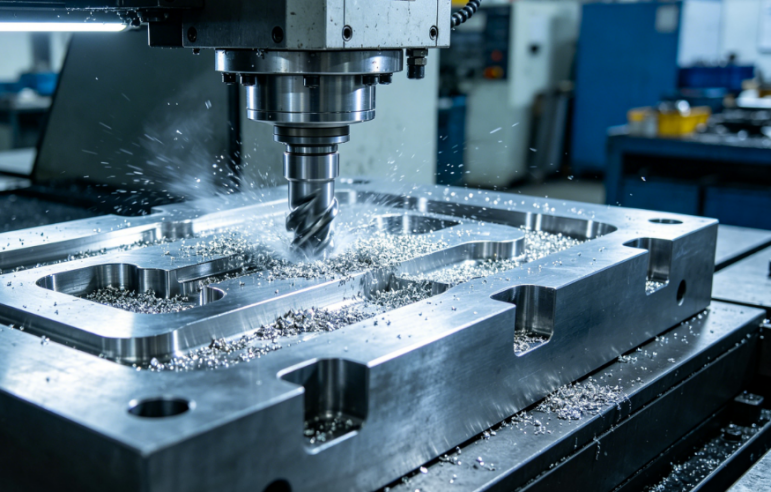
2.Common Causes of Mold Steel Deformation
One major cause of deformation is residual stress inside the material. During forging, rolling, and heat treatment, internal stress may remain inside the mold steel. When material is removed during machining, the stress balance changes and deformation may occur.
Excessive cutting heat can also affect dimensional stability. High cutting speeds or insufficient coolant may generate excessive heat, causing thermal expansion during machining.
Improper clamping methods may introduce additional stress into the workpiece, especially for large mold plates or thin-wall structures. In addition, uneven material removal may lead to unbalanced stress release and increase deformation risk.
Heat treatment quality is another important factor. Inadequate stress relief or uneven hardness distribution may reduce machining stability during CNC processing.
3.How to Reduce Mold Steel Deformation
Stress-relief heat treatment before finish machining is one of the most effective methods for reducing internal stress and improving dimensional stability.
A proper machining sequence is also very important. Rough machining should generally be completed before finish machining, while symmetrical material removal helps maintain stress balance during processing.
Optimizing cutting parameters, including cutting speed, feed rate, and coolant supply, can also reduce machining heat and improve stability. Proper fixture design and balanced clamping further help reduce deformation during machining.
Selecting suitable mold steel materials is equally important. Pre-hardened steels such as P20 and P20+Ni usually provide better machining consistency and stability.
4.The Importance of Temperature Control
Temperature stability plays an important role in precision mold machining. Factors such as workshop temperature, spindle heat, and coolant performance may all affect machining accuracy.
Maintaining a stable machining environment helps reduce thermal deformation and improve dimensional consistency.
5.Conclusion
Mold steel deformation during CNC machining is influenced by multiple factors, including residual stress, cutting heat, machining sequence, and heat treatment quality.
By using proper machining strategies, stress-relief treatment, and stable temperature control, manufacturers can effectively reduce deformation risk and improve mold machining precision.
FAQ
1. What causes mold steel deformation during CNC machining?
Mold steel deformation is usually caused by residual stress inside the material, excessive cutting heat, improper clamping, and uneven material removal during machining. Poor heat treatment quality may also reduce machining stability and increase deformation risk.
2. How can deformation be reduced during machining?
Deformation can be reduced by using stress-relief heat treatment, proper machining sequences, balanced material removal, and optimized cutting parameters. Stable clamping and sufficient coolant supply also help improve machining accuracy.
3. Why is temperature control important in mold machining?
Temperature changes during CNC machining may cause thermal expansion, which affects dimensional accuracy. Maintaining a stable machining environment and proper coolant circulation helps reduce thermal deformation and improve machining consistency.
4. Which mold steels offer better machining stability?
Pre-hardened mold steels such as P20 and P20+Ni generally provide better dimensional stability and machining consistency. These materials are widely used in mold manufacturing due to their balanced hardness and good machinability.