

1. How Do CNC Duplex Milling Machines Work?
In today’s competitive manufacturing industry, improving efficiency while maintaining precision is essential. One technology that has significantly enhanced productivity in metal processing is the CNC duplex milling machine.
Unlike traditional milling systems, duplex milling introduces a smarter, faster way to process workpieces—especially for parts requiring parallel surfaces.
In this guide, we will explain how CNC duplex milling machines work, their core components, and why they are becoming indispensable in modern factories.
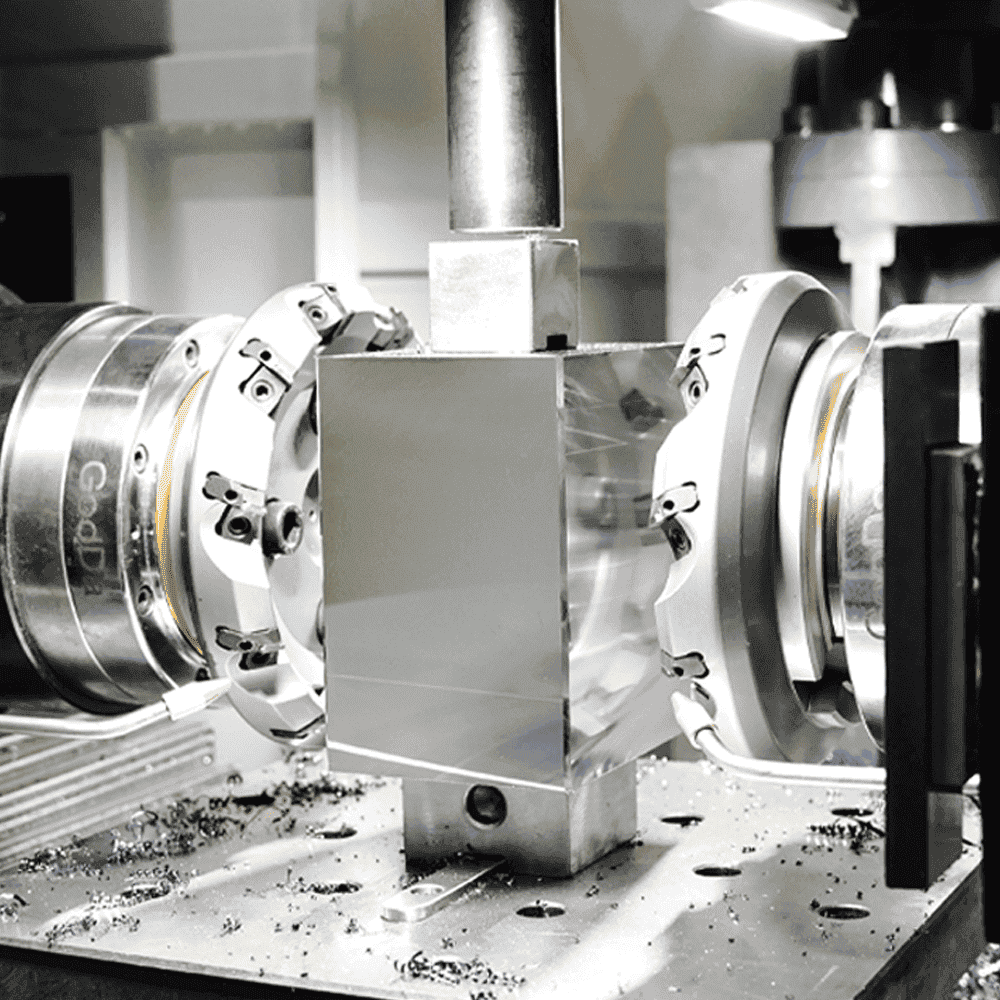
2. What Is a CNC Duplex Milling Machine?
A CNC duplex milling machine is a specialized type of milling equipment designed to machine two opposite sides of a workpiece simultaneously.
In conventional milling, only one surface is processed at a time, requiring multiple setups such as flipping and re-clamping the workpiece. This not only increases cycle time but also introduces positioning errors.
In contrast, duplex milling machines use two opposing spindle heads, allowing both sides to be machined in a single operation.
3. How Do CNC Duplex Milling Machines Work?
The working principle of a CNC duplex milling machine is based on synchronized dual-side machining, which greatly improves efficiency and accuracy.Here is a simplified step-by-step process:
Step 1: Workpiece Clamping
The raw material (usually steel blocks or plates) is fixed securely on the worktable using fixtures.
Unlike traditional milling, the workpiece is clamped only once, which helps maintain dimensional accuracy between both sides.
Step 2: CNC Programming and Setup
Operators input machining parameters into the CNC system, including:
- Final dimensions
- Cutting depth
- Feed rate
- Spindle speed
The CNC system then positions both milling heads precisely according to the program.
Step 3: Simultaneous Milling Process
This is the key advantage of duplex milling.
As the worktable moves, two cutting tools remove material from opposite sides at the same time, completing the machining in a single pass.
This balanced cutting force:
- Reduces vibration
- Improves stability
- Enhances surface quality
Step 4: Finishing and Unloading
Once the machining cycle is completed:
- The workpiece already has two finished parallel surfaces
- No additional repositioning is required
The part is then unloaded, and the machine is ready for the next cycle.
4. Key Components of a CNC Duplex Milling Machine
The performance of duplex milling depends on its core components:
- Machine Bed:Provides structural rigidity and absorbs vibration during cutting.
- Dual Milling Heads:The most important part—two spindles working simultaneously to machine both sides.
- Worktable System:Moves the workpiece smoothly through the cutting area with high precision.
- CNC Control System:Controls all movements, ensuring synchronization and repeatability.
Modern CNC systems enable precise control over speed, position, and cutting parameters, ensuring consistent results.
5. Why Duplex Milling Is More Efficient Than Traditional Milling
The biggest advantage of duplex milling lies in single-setup machining.
In traditional milling:
- Machine one side
- Stop the machine
- Flip the workpiece
- Re-align and machine again
In duplex milling:All of this is completed in one single operation
This leads to:
- Up to 50% reduction in cycle time
- Lower labor costs
- Higher production throughput
6. Accuracy and Precision Advantages
Repositioning errors are a common issue in traditional milling.
Each time a workpiece is re-clamped, small deviations occur, affecting parallelism and dimensional accuracy.
With duplex milling:
- Both surfaces are machined simultaneously
- No repositioning error
- Perfect parallelism is achieved
This makes duplex milling ideal for high-precision applications.
7. Applications of CNC Duplex Milling Machines
CNC duplex milling machines are widely used in industries that require high efficiency and precision:
- Mold and die manufacturing
- Automotive components
- Hydraulic blocks
- Steel plate processing
- Heavy machinery parts
They are especially suitable for producing:
- Rectangular blocks
- Precision plates
- Large metal components
8. How to Choose the Right CNC Duplex Milling Machine
When selecting a duplex milling machine, consider the following factors:
- Workpiece Size:Ensure the machine can handle your part dimensions and weight.
- Material Type:Different materials require different spindle power and cutting capabilities.
- Precision Requirements:High-precision applications need better machine rigidity and control systems.
- Production Volume:For mass production, prioritize machines with higher automation and efficiency.
9. Conclusion
CNC duplex milling machines represent a major advancement in modern manufacturing.
By enabling simultaneous machining of two surfaces, they:
- Reduce cycle time
- Improve accuracy
- Increase production efficiency
For manufacturers working with steel plates or precision blocks, adopting duplex milling is not just an upgrade—it is a strategic advantage.
FAQ:
1. What is a CNC duplex milling machine?
It is a milling machine that uses two spindles to machine both sides of a workpiece simultaneously.
2. How is duplex milling different from traditional milling?
Traditional milling processes one side at a time, while duplex milling machines both sides in one setup.
3. What are the advantages of duplex milling?
Higher efficiency, better accuracy, reduced setup time, and lower labor costs.
4. What materials can be processed?
Steel, stainless steel, aluminum, and other metal materials.
5. Is duplex milling suitable for mass production?
Yes, it is ideal for high-volume production due to its speed and efficiency.