

Introduction
Modern precision manufacturing relies heavily on efficiency, accuracy, and cost control. For complex multi-sided workpieces and high-volume production that vertical CNC machines struggle to handle, the horizontal milling machine stands as the ideal upgrade solution. As a high-performance cnc horizontal machining center, it solves core industry pain points including poor chip removal, repeated clamping errors and low heavy-cut efficiency. 2026 Google Trends data shows global searches for horizontal CNC equipment have risen 45% year-on-year, with more manufacturers adopting this heavy-duty cnc machine for stable, high-efficiency production. This article covers its features, advantages, comparisons and practical applications to help factories make smarter equipment choices.
1. What Is a Horizontal Milling Machine?
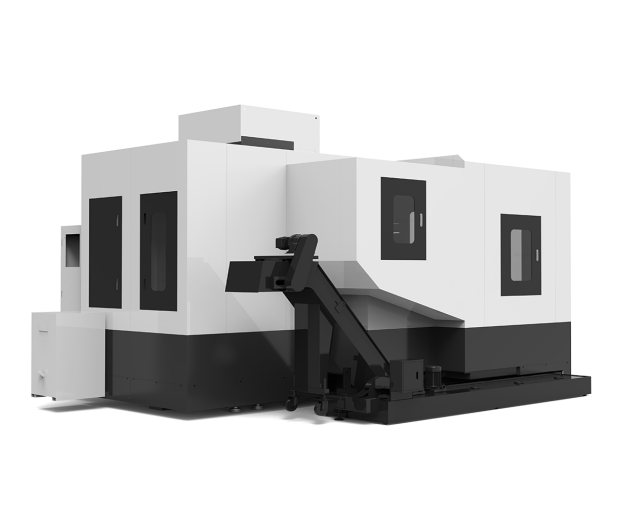
A horizontal milling machine is a professional heavy-duty CNC device featuring a horizontal spindle layout. Unlike vertical mills with vertical up-down cutting, its rear-mounted spindle cuts horizontally, paired with a front rotary table for fast workpiece loading, unloading and multi-angle processing.
High-end models are equipped with a B-axis programmable rotary indexing table, enabling 360° positioning and completing multi-sided drilling, boring, tapping and contour forming in one clamping. Integrated automatic pallet changers (APC) and automatic tool changers (ATC) eliminate idle downtime, supporting 24-hour unattended production, making it a versatile cnc horizontal machining center.
Core Structural Features
X/Y/Z three-axis linkage + B-axis rotary indexing for multi-angle composite machining
Heavy-duty cast iron integral bed for anti-vibration during heavy cutting
Gravity chip removal structure to avoid chip accumulation and secondary cutting
Optional 40-80 station tool magazine and automatic pallet exchange system
Front open processing area for ergonomic loading and unloading
2. Unique Core Advantages of Horizontal Milling Machines
Horizontal milling machines own inherent structural strengths that outperform vertical mills in heavy-duty and mass production scenarios, boosting efficiency, precision and economic benefits comprehensively.
2.1 Efficient Chip Evacuation & Extended Tool Life
Chip accumulation severely affects vertical CNC machining quality and tool lifespan. The horizontal structure allows chips to fall freely by gravity, with matching conveyor systems removing residues thoroughly.
This avoids secondary cutting, improves workpiece surface finish up to Ra 0.4-0.8, and extends tool life by 30%-50%. It also reduces coolant waste and shutdown cleaning frequency, ensuring continuous production.
2.2 One-Clamping Multi-Sided Precision Machining
Vertical mills require 3-8 repeated clamping operations for box and shell parts, causing cumulative errors and wasted time. Horizontal milling machines use B-axis rotation to process 4-6 workpiece sides in a single clamp.
It cuts 85%-95% of clamping times, reduces cumulative errors by 70%-90%, and controls batch workpiece tolerance within ±0.01mm, greatly improving product qualification rates.
2.3 Ultra-High Rigidity for Heavy-Duty Cutting
As a professional heavy-duty cnc machine, it adopts a thickened cast iron bed and reinforced spindle structure, eliminating cantilever vibration common in vertical equipment. Its metal removal rate is 2-3 times higher than ordinary vertical mills.
It stably processes hardened steel (below HRC50), cast iron and titanium alloy, perfect for roughing and finishing thick-walled parts, large molds and mechanical components.
2.4 High Automation for Mass Production
Equipped with APC and multi-station tool magazines, horizontal machining centers support uninterrupted cyclic production. Operators load and unload workpieces on one pallet while the machine processes the other, achieving zero idle time.
Equipment utilization reaches 85%-95%, processing cycles are shortened by 35%-55%, and long-term unattended lights-out production is available for standardized batch parts.
2.5 Safe & Ergonomic Operation
The front open processing area avoids the need for operators to reach into closed cutting cavities, preventing tool collision and chip scratch risks. Cranes and robotic loaders can be matched for heavy workpieces, reducing labor intensity and improving safety.
2.6 Low Long-Term Comprehensive Cost
Though featuring higher initial investment, horizontal mills reduce single-piece production costs by 20%-40% via longer tool life, fewer reworks, lower labor costs and high utilization. With standard maintenance, the 15-20 year service life delivers far higher long-term ROI than vertical CNC equipment.
3. Horizontal vs Vertical CNC Machine: Detailed Comparison
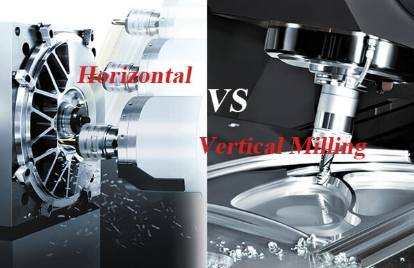
The core performance differences between horizontal and vertical CNC milling machines are sorted out below for accurate equipment selection:
| Feature | Vertical CNC Machine | Horizontal CNC Machine |
| Spindle Direction | Vertical (up-down) | Horizontal (sideways) |
| Chip Evacuation | Poor, easy chip accumulation | Excellent, gravity automatic removal |
| Clamping Times | Multiple times for complex parts | One-time clamping for multi-sided processing |
| Equipment Rigidity | Medium, prone to vibration | Ultra-high, stable heavy cutting |
| Tool Service Life | Short, easy to wear | 30%-50% longer lifespan |
| Metal Removal Rate | Moderate | 2-3 times higher |
| Applicable Scenarios | Small parts, flat processing, prototyping | Heavy-duty, complex parts, mass production |
| Single-piece Cost | Higher | 20%-40% lower |
4. Main Industrial Application Scenarios
The high-performance cnc horizontal machining center serves as core equipment for precision manufacturing, covering automotive, aerospace, mold, hydraulic and energy industries.
4.1 Automotive Manufacturing
70% of mainstream automakers use horizontal milling machine to process engine blocks, cylinder heads and transmission housings. It meets high-precision and high-consistency batch production requirements for automotive box-type parts.
4.2 Aerospace & Defense
It adapts to precision machining of landing gear, wing structures and equipment housings. With ultra-high rigidity, it perfectly processes titanium alloy and high-strength aluminum parts with tight tolerances up to ±0.005mm.
4.3 Heavy Machinery & Hydraulics
It completes one-clamp multi-sided drilling, boring and threading for gearbox shells, pump bodies and valve blocks, eliminating repeated positioning errors and ensuring equipment sealing stability.
4.4 Mold & Die Industry
Ideal for large injection, die-casting and stamping molds. It efficiently finishes deep cavity and multi-hole processing, shortening mold opening cycles and improving manufacturing accuracy.
4.5 Oil & Energy Equipment
As a reliable heavy-duty cnc machine, it stably handles heavy cutting of large valves, flanges and generator shells, meeting high-precision energy equipment processing standards.
5. Product Strength Introduction
Our cnc horizontal machining center is customized for heavy-duty and mass production. Equipped with a high-rigidity cast iron bed and precision CNC system, it features a 400mm-1000mm worktable, 8000-15000RPM spindle speed and ±0.008mm repeated positioning accuracy.
Optional automatic pallet exchange and multi-station tool magazines adapt to multi-industry processing needs, providing stable, cost-effective heavy-duty cnc machine solutions for global manufacturers.
Conclusion
In competitive modern manufacturing, horizontal milling machines make up for all shortcomings of vertical processing equipment with superior chip removal, ultra-high rigidity, one-clamp multi-sided machining and automated mass production capabilities.
As a high-end cnc horizontal machining center and professional heavy-duty cnc machine, it has become mainstream 2026 equipment for heavy-duty and high-volume production. Upgrading to horizontal milling equipment is an inevitable trend for factories pursuing high efficiency, stable quality and cost reduction.
Contact our professional team for equipment selection, customized processing solutions and exclusive quotations.
FAQ
Q1: What is the core difference between horizontal and vertical milling machines?
A: The key difference is spindle layout. Vertical spindles suit small flat parts, while horizontal side-cutting design delivers better chip removal, higher rigidity and one-clamp multi-sided processing for heavy-duty batch production.
Q2: Are horizontal milling machines cost-effective with higher initial cost?
A: Yes. It reduces tool consumption, labor cost and rework rates, cutting single-piece cost by 20%-40%. The 12-18 month ROI cycle brings excellent long-term cost performance.
Q3: Can it realize 5-axis linkage processing?
A: Yes. Adding an A-axis rotary trunnion to the standard 4-axis system enables full 5-axis linkage machining for complex curved and special-shaped parts.
Q4: What workpieces suit horizontal milling processing?
A: It is ideal for box shell parts, thick-walled heavy components, multi-hole precision parts, large mold bases and batch standardized parts requiring multi-sided high-rigidity machining.
Q5: What is the service life of a horizontal CNC machining center?
A: With standardized maintenance, its service life reaches 15-20 years, far longer than ordinary vertical CNC machines with stable performance and low failure rate.