

When selecting the WJ-800 horizontal machining center, pay close attention to an 8,000 rpm spindle speed, an 800 × 800 mm worktable, and repeat positioning accuracy of ±0.003 mm.
By optimizing fixtures and toolpaths, it can integrate roughing and finishing for mold cavities, shortening cycle time per part by more than 20%.
WJ-800
What Is the WJ-800?
The WJ-800 occupies a footprint of 6,200 mm by 4,500 mm, and the top of the machine stands a full 3.2 meters above the ground. Its base is a massive T-shaped iron casting. Inside walls more than 45 mm thick, the structure is packed with honeycomb-like reinforcing ribs. The 8-ton column travels back and forth on the rails, bracing itself against the thousands of newtons of reverse cutting force generated when the tool bites into steel.
At the front of the machine is a BBT50 dual-contact spindle. It grips not only the taper of the toolholder but also the flat face of the holder itself. At 10,000 rpm, the drawbar mechanism inside clamps down on a 25 kg face mill with 18 kN of pull force. Coiled cooling pipes wrap around the spindle housing, and the motor above delivers 22 kW of power.
Ordinary tap water is chilled to 22°C by the nearby chiller, then circulated through the spindle bearings at 15 liters per minute. The machine housing is kept to just 2°C above ambient temperature. A high-pressure tube also runs through the center of the spindle.
· The high-pressure pump raises water pressure to 70 bar
· Coolant is sprayed from the tiny outlet at the tip of the drill
· The cutting zone temperature drops instantly by 300°C
· Chips are flushed away four times faster
· Deep-hole drills are far less likely to seize and break from overheating
On the left side of the machine stands a chain-type tool magazine, with 60 aluminum alloy tool pockets mounted along the chain. A tool-change arm beside it rotates via an internal cam mechanism. The arm grips the old tool, pulls it out, rotates 180 degrees, and inserts the new one. The entire sequence takes 2.5 seconds.
Heavy rough boring tools and long drills with a length ten times their diameter are arranged in sequence on the tool chain, ready for use. Beside the worktable is a laser tool setter. An invisible laser beam passes across the tool tip spinning at 7,500 rpm, measuring dimensional differences to within less than 0.002 mm.
The 800 mm × 800 mm cast-iron table has nine standard T-slots, each 22 mm wide. Beneath it, a toothed locking system clamps the table firmly in place. The WJ-800 is equipped with two worktables, and a hydraulic motor underneath can lift and rotate the table.
· The table first disengages from the hydraulic lock in the base
· A full 180-degree pallet rotation takes 15 seconds
· Repeat return-to-position error is only 0.003 mm
· High-pressure air is blown from below to clear chips from the mating surface
· Four hydraulic cylinders underneath pull the table down with 4 tons of clamping force
An operator mounts a 160 mm face mill fitted with six inserts onto the spindle. The cut is set to 4 mm deep, spindle speed is reduced to 800 rpm, and the table pushes the steel forward at 1,200 mm per minute. In just one minute, 768 cubic centimeters of No. 45 steel are turned into flying chips.
When boring holes in automotive engine blocks, a rough boring bar with two small cutting heads enters a 120 mm cast-iron blind hole. The cutting speed is set at 250 meters per minute. A heavy-metal damping core inside the bar absorbs high-frequency vibration, keeping cylindricity error within 0.006 mm.
Along the X, Y, and Z axes are Heidenhain LC115 glass scales. When the motor receives a command to move 1 micron, it drives the ballscrew through an angle too small to see with the naked eye. The glass scale immediately reads the actual travel distance and sends the data back to the electrical cabinet.
The X-axis below is equipped with four high-rigidity linear guideways built to P4 precision. The bearing blocks are packed with countless cylindrical rollers. The entire guide system withstands a dynamic load of 150 kN. Even with a 2-ton mold block on the table, the machine can rapidly retract at 20 meters per minute, supported entirely by the rolling action inside the guide blocks.
Coolant mixed with curled steel chips and fine cast-iron powder drops into a funnel-shaped V trough beneath the machine. Two screw shafts rotate continuously, pushing the swarf to both sides. Conveyor tracks at each end carry the oily waste upward and dump it into a collection bin in the corner of the workshop.
· The lubrication pump injects oil into the rails every two hours
· The spindle chiller filter is removed and cleaned once a month
· Water collected in the pneumatic components’ filter cup is manually drained every day
· A technician uses a laser measuring device once a year to recheck flatness
On the 15-inch color display in front of the operator, the live coordinates of all three axes keep updating. Wearing oil-stained gloves, the machinist taps at the keyboard and revises the Z-axis height values. The incoming 380V AC power is converted by a row of inverters into the waveforms required by the servo motors.
Advantages
The spindle of the WJ-800 is parallel to the ground, so the tool cuts into the metal from the side. Gravity pulls chips downward, keeping a 150 mm-deep mold cavity clean. If chips are not evacuated and get recut, carbide inserts can chip in under 40 minutes.
When machining P20 plastic mold steel, the same batch of 12 mm four-flute carbide end mills would wear out after 120 hours on an older vertical machine. Mounted on a horizontal machine, they can cut continuously for 165 hours before the tool-tip wear reaches the 0.15 mm rejection limit.
In the past, when machining a square gearbox housing, the operator had to stop after each side, loosen the fixture, lift the workpiece with an overhead crane, turn it over, and realign it. Now the workpiece is placed on a pallet, and the hydraulic pump locks the base with 6 MPa of pressure. The table rotates an 800 kg steel workpiece through a complete process, drilling and milling all four major sides in one cycle.
Manual repositioning is physically demanding, and every reclamping introduces a positional deviation of 0.02 mm to 0.05 mm. What used to require four separate setups and three and a half hours can now be reduced to just 40 minutes of intervention using the built-in rotary table. Without waiting for manual handling, spindle utilization in 24-hour operation rises from 55% to over 85%.
| Traditional Multi-Setup Machining | WJ-800 Rotary Table Machining | Estimated Cost Saving |
| 4 setups take 210 minutes | 1 setup takes 40 minutes | Saves 170 minutes per part |
| Requires 4 dedicated fixtures | Uses general clamps or simple tooling | Saves RMB 25,000 in fixture cost |
| Cumulative positioning error of 0.08 mm | Rotary indexing error of 0.005 mm | Scrap rate drops to 0.3% |
| Requires 2 operators for lifting | 1 operator can finish independently | Significantly reduces labor cost |
Friction in the cutting chamber generates heat that causes machine components to expand. The Z-axis ballscrew is hollowed out, allowing room-temperature anti-rust oil to circulate through it at 2 liters per minute to carry away heat. On a large 1,200 mm-long ballscrew, thermal growth after 8 continuous hours of operation is held to within 0.01 mm.
When machining hardened steel at HRC55, the spindle is fitted with an 8-edge corn mill. The main motor delivers a brutal 1,200 N·m of torque, forcing the inserts directly into the hardened surface. Damping blocks beneath the machine absorb the high-frequency shock waves from the violent impacts, so even when you place a hand on the sheet-metal guarding, you feel only a faint tremor.
Because the machine remains stable under heavy cutting, the mold surface it produces is almost mirror-like. With conventional methods, achieving a surface roughness of Ra 1.6 μm requires a polishing technician to spend more than two half-days working by hand with sandpaper and polishing compound. On the WJ-800, one cutting pass can bring the surface down to Ra 0.4 μm.
The Z-axis servo motor is directly connected to the ballscrew by an elastic coupling instead of a belt. If the motor rotor twists by even one ten-thousandth of a turn, the 3.5-ton column advances by 1 micron. For every 100 kilometers of machine travel, the lubrication system consumes 400 ml of guideway oil, while older machines could go through two 18-liter drums of waste oil every month.
Two nitrogen balance cylinders are mounted outside the spindle head, looking like large black oxygen tanks. Filled with pure nitrogen at 12 MPa, they counteract the 1.2-ton gravitational load of the spindle head during vertical motion. The Y-axis motor no longer has to fight to lift the heavy spindle box, allowing acceleration to reach 0.5G. The non-cutting travel time between holes is shortened by 0.6 seconds.
Industrial machines often cut continuously for more than ten hours at a time, and worn inserts can go unnoticed deep into the night. A power monitoring module inside the electrical cabinet solves this problem. Spindle cutting current normally stays around 15 A, but when the insert becomes dull and starts struggling through steel, the current suddenly spikes to 28 A. The system immediately lights a warning and stops the feed, saving a RMB 3,000 toolholder from destruction.
Equipment Maintenance Service
Installing a 22-ton machine requires civil work first. The manufacturer’s technician arrives with a geological testing device and drills six 50 cm-deep sample holes into the concrete floor. The display must show a floor load capacity of over 8 tons per square meter before the site is approved. Workers then dig a 5 m × 5 m foundation pit along the chalk lines.
The concrete poured into the pit must be at least C30 grade, and the pouring process cannot be interrupted for even a minute. Twelve threaded anchor bolts, each 25 mm in diameter, are embedded at designated positions. The curing period must last the full 28 days before the many-ton machine can be set down.
Precision levels are placed at different positions along the three axes. Even if the bubble shifts by only half a division, the adjustment nut underneath must be backed off by one-fifteenth of a turn. Perpendicularity among the three axes is held to within 0.005 mm over every 300 mm.
Before the sheet-metal covers are even installed, a Renishaw XL-80 laser interferometer worth more than RMB 200,000 is set up on the table. Its red beam is reflected off a mirror on the table, measuring how many microns the machine deviates every 10 mm of travel. After a full day of testing, the compensation table in the control cabinet is filled with 21 pitch-error correction values.
Once the hardware is in place, the application engineer from the manufacturer checks into a budget hotel across from the factory for half a month. For 14 straight days, he sits in front of the machine control and teaches new shop-floor workers how to write G-code by hand. The first lesson focuses entirely on feed rate and depth-of-cut settings.
· If spindle load current exceeds 25 A, the red emergency stop button must be pressed immediately
· In deep-hole drilling programs, each retract distance for chip evacuation is fixed at 3 mm
· Before pressing Enter on the M60 rotary table command, check that the clamp bolts are fully tightened
· Probe contact-point calibration on the Heidenhain system must be redone every 48 hours
Machines inevitably develop problems over time, and cost-effective operation depends on careful day-to-day maintenance. The chiller on top of the spindle head must be cleaned once a month, always on the 25th. A worker uses a high-pressure air gun to blast the condenser fins, and thick layers of pale cast-iron dust and sticky oil sludge immediately fly out from the gaps.
The transparent filter cup below the pneumatic FRL unit must be drained first thing every day at 8 a.m. If the collected water flows back into the pneumatic tool-change circuit, the RMB 4,000 solenoid valve behind it will rust and seize within three months.
While rushing an H13 mold steel order, a piercing alarm suddenly sounds from the electrical cabinet. The center of the screen flashes the code ALM 401. The workshop supervisor pulls out his phone and calls for service. Four hours later, a maintenance engineer arrives wearing a backpack. Inside an anti-static bag is a brand-new servo drive board.
To prevent the entire factory from stopping while waiting for spare parts, four domestic distribution warehouses keep large stocks of machine wear parts on hand all year round.
· At least 12 sets of high-precision ceramic spindle bearings are kept in stock
· C3-grade heavy-load Z-axis ballscrews are boxed and ready for dispatch nationwide
· 5,000 disc spring washers for the drawbar mechanism are held as standing inventory
· Rubber seals and chip-scraper plates can be handed to SF Express within 24 hours of order placement
Once the spindle reaches 2,500 operating hours, the manufacturer’s white inspection van arrives at the factory on schedule. The technician removes the Z-axis sheet-metal cover and shines a flashlight inside, revealing a patch of blackened oil sludge around the ballscrew nut. He tears out the yellowed old oil hose and replaces it with a new PTFE tube with a 4 mm inner diameter.
One item on the maintenance checklist is to measure spindle pull force. A digital force gauge is inserted into the spindle taper, and the display immediately reads 16.5 kN. The original manual specified 18 kN, so the technician opens the rear spindle cylinder and pulls out two spring plates showing metal fatigue cracks, tossing them into the scrap bin.
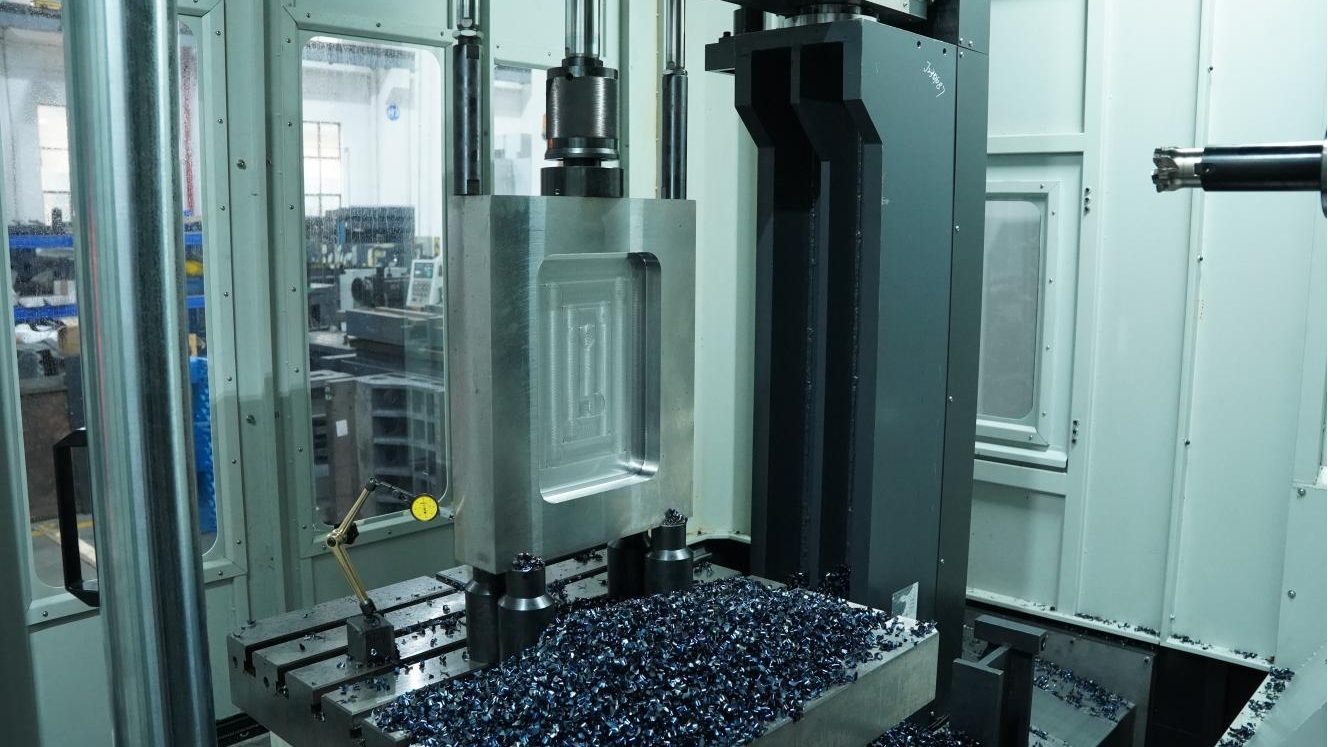
Mold Work
Machining High-Hardness Materials
Walk into a mold shop and you will see cold blocks of special steels such as NAK80 and S136 stacked across the floor. After being heated red-hot and quenched, their hardness rises to HRC50 to HRC65. A household cleaver barely reaches HRC50, while ordinary A3 low-carbon steel is only around HRC15. Yet the machine must carve a 30 mm-deep, 800 mm-long three-dimensional groove into steel harder than a kitchen knife.
When the cutter hits hardened steel, the pressure at the cutting edge approaches 3,000 MPa. The insert and the workpiece grind against each other violently, and in just 0.1 second the temperature surges to 1,000°C. Dark red chips at 800°C shoot in all directions at 15 meters per second. Through the window, the operator sees only dense white mist from evaporated coolant inside the machining chamber.
· Tool coating thickness: 2 to 4 μm
· Spindle speed: 12,000 rpm
· Feed per revolution: 0.05 mm
· Temperature in the spark zone: above 800°C
A 10 mm carbide end mill loses 0.02 mm from its tip after covering 1,500 meters of cutting distance on the mold. Once wear exceeds that 0.02 mm threshold, the machined steel surface begins to ripple like waves. The machinist watches the 300-minute countdown on the control screen, and when time is up, the tool is changed immediately.
The WJ-800 horizontal machine handles high-intensity cutting through sheer mechanical strength. It uses an HSK-A100 spindle interface, with 2.5 tons of pull force on the toolholder. The motor outputs 35 kW and 420 N·m of torque. Fitted with a 63 mm corn mill, it can remove a 5 mm-thick layer of steel in one pass.
Heavy cutting brings harsh high-frequency vibration ranging from 300 to 800 Hz. The machine base, made of 15 tons of Meehanite cast iron, suppresses those shock waves by brute force. The flake graphite in the cast iron absorbs micro-vibration, holding tool-tip runout within 0.003 mm and preventing edge chipping.
Cooling and chip evacuation rely on a 70 bar high-pressure pump. Water-based cutting fluid shoots through micro-holes at the front of the tool, removing 80% of the cutting heat almost instantly. Because the horizontal machine opens from the side, 500 kg of waste chips roll down the Z-axis slope and drop straight into the chain-type chip conveyor at the bottom.
· EDM with the old process takes 20 hours
· Recast and hardened surface layer thickness: 0.05 mm
· The new micro-cutting process takes 8 hours
· Final hand finishing with an oilstone takes only 3 hours
In the past, mold work required 20 hours of EDM after rough machining. Now, with CBN inserts removing just 0.02 mm per pass and cutting at up to 200 meters per minute, the curved surface can be gradually generated by micro-cutting. What once required 40 hours of manual polishing can now be finished in just 3 hours.
The finished mold surface reaches Ra 0.2 μm. It feels smoother than a phone screen when you run a fingernail across it. The CNC system calculates the next 2,000 lines of toolpath in advance. When it encounters a tight 0.5 mm-radius corner, the feed motor brakes within 0.01 second, reducing feed speed from 3,000 mm per minute to 800 mm per minute.
Mechanical Structure Data
When a WJ-800 arrives at the workshop and the outer wooden shock-proof crate is removed, what emerges is a 15-ton cast-iron mass. The machine occupies roughly 4 meters by 6 meters, wider than a standard single bedroom.
Turn the base over and you can see the densely packed honeycomb reinforcing ribs inside. The outer cast-iron wall reaches 80 mm in thickness. When heavy tooling slams into steel, the resulting impact force is absorbed by this thick structure.
Above the base, the X- and Z-axis guideways are firmly mounted. The 3-ton spindle head travels back and forth on these rails at up to 60 meters per minute. Ordinary sliding guideways cannot survive hundreds of thousands of friction cycles, so the manufacturer uses heavy-load roller linear guideways throughout.
| Axis | Maximum Travel | Guideway Width | Load Capacity per Block |
| X-axis (left/right) | 1,050 mm | 55 mm | 12 tons |
| Y-axis (up/down) | 900 mm | 55 mm | 8 tons |
| Z-axis (front/back) | 1,000 mm | 65 mm | 15 tons |
Each rail is packed with 15 mm-diameter cylindrical steel rollers. The load capacity is more than doubled. Even if the weight of two family sedans were placed on one guide block, the spindle box would still glide smoothly along the rail.
Three bright ballscrews drive the spindle head. Each screw is 50 mm in diameter, with helical grooves machined to a 12 mm lead. One full rotation of the servo motor moves the spindle head forward by exactly 12 mm.
The screws are THK C3-ground components from Japan. On the assembly line, workers check them with dial indicators directly against the thread surface. Over 300 mm of travel, cumulative positioning error is held within 0.005 mm.
When machining parts that need to be turned over, everything depends on the 800 × 800 mm cast-iron rotary table in the center. A worm and worm gear underneath mesh tightly together. When the motor is energized, the table can rotate in increments as fine as 0.001 degree.
During cutting, the rotary table must not wobble in the slightest. The hydraulic unit behind the machine starts roaring, driving 35 MPa hydraulic oil into the base of the rotary axis. The piston pushes upward, generating 4 tons of mechanical clamping force to lock the table rigidly in place.
Steel-on-steel friction generates heat very easily. If the temperature of a 1-meter-long steel ballscrew rises by just 1°C, its physical length increases by 0.01 mm. Inside the machine housing is a dedicated industrial chiller with 5 kW of cooling capacity.
A total of 150 liters of special refrigerating oil circulates continuously through the hollow core of the ballscrew. The 20°C oil removes heat from the motor and friction surfaces. Even after the machine runs continuously for three days and nights, internal component temperature variation stays within 0.5°C.
The senior technicians who assemble the machine often carry a 600 mm granite square weighing several hundred pounds. They stand it on the guideway surface to check perpendicularity, then shine a flashlight along the contact line. The factory standard is that any visible gap over 300 mm must be less than 0.005 mm.
Even tightening bolts is treated as precision work. For an M16 high-strength bolt, the worker stands on the torque wrench handle until it reads exactly 120 N·m. Too little torque leads to loosening; too much can distort the flat cast-iron base.
The automatic lubrication pump is mounted on the sheet-metal panel on the right side of the machine. Every 15 minutes, when the machine timer activates, the pump injects 0.5 ml of thick lubricant through plastic tubing. The guideways are coated with a uniform transparent oil film 2 μm thick.
The spindle on a horizontal machine projects sideways from the column. A 100 mm-diameter alloy-steel spindle is suspended in midair. When it extends forward to its 600 mm limit for deep-cavity machining, the downward deflection at the front end is controlled within 0.008 mm.
On the left side stands a tool magazine more than 2 meters tall. The large aluminum tool disc is filled around the edge with 60 different milling cutters and twist drills. A pneumatic arm with two metal fingers completes tool removal, rotation, and insertion in just 2.5 seconds.
To install this expensive machine, the factory must dig a dedicated foundation pit. An excavator cuts a 2-meter-deep hole into the workshop floor, then 30 cubic meters of C50 high-strength concrete are poured in. After that, nothing can be done except wait 28 full days for the concrete to cure completely.
Thermal Deformation & Positioning Accuracy
In July and August, the temperature inside a sheet-metal workshop often rises above 35°C. A 1-meter-long standard mold steel bar grows by 0.012 mm for every 1°C increase in ambient temperature.
That may sound like less than one-third the width of a human hair, but in high-precision mold work it is a serious problem. When two mold halves are fitted together, even a 0.005 mm mismatch can leave sharp burrs on the molded plastic part.
A heavy metal shaft spinning at 15,000 rpm in its bearings can reach 60°C in under ten minutes just from friction.
That heat spreads through the cast-iron structure, causing small but unavoidable expansion and distortion. To control this, the spindle is wrapped in a cooling jacket with labyrinth-style flow channels.
An 8 kW industrial chiller hums as it cools purified water mixed with anti-rust additives to a steady 20°C. The pump forces 25 liters of chilled water per minute through the labyrinth channels, carrying away the spindle’s heat.
As a 3-ton worktable races back and forth, the steel balls inside the ballscrew nut collide continuously, and the screw can thermally grow by 0.04 mm over the course of a day.
To address this, the manufacturer hollows out the 50 mm-diameter screw and drills an 8 mm passage through its center. Temperature-controlled cooling oil flows through that core from end to end, keeping the temperature difference inside and outside the screw within 0.2°C.
Physical cooling alone is not enough, so twelve coin-sized PT100 temperature sensors are attached to the machine housing and internal base.
· The data acquisition card records temperatures every 0.5 second
· The control software calculates thermal expansion in the X, Y, and Z directions
· The servo motor receives a command to shift the spindle 0.003 mm in the opposite direction to cancel the error
If the control screen is given a command to move the table forward by 500.000 mm, the actual travel after motor stop may be 499.996 mm.
Ordinary machines rely on the encoder at the rear of the servo motor to count revolutions. One full turn is divided into 1.04 million increments, and travel distance is calculated from how many increments the motor rotates.
The WJ-800 hands that job over to the glass scale mounted beside the guideway. It is a 1-meter-long quartz glass strip, laser-etched with 500,000 microscopic grating lines.
· The read head slides along the glass strip and determines actual travel from changes in the light pattern
· Resolution reaches 1 nanometer, equivalent to one ten-thousandth of a human hair
· Even if the ballscrew develops 0.02 mm of backlash from wear, the glass scale forces the motor to compensate for the lost motion
During annual maintenance, the manufacturer’s engineer arrives with a locked case containing a Renishaw XL-80 dual-frequency laser interferometer worth more than RMB 300,000, used specifically for machine accuracy inspection.
A magnetic base secures the laser emitter to the worktable, while the reflector is mounted on the spindle face. The red laser beam travels out and back, while changes in air temperature, pressure, and humidity are recorded in real time by a weather station sensor.
The engineer commands the machine to stop every 10 mm, and the interferometer immediately calculates the real positioning error at each point. Along the 1-meter Z-axis, 100 measurement points are taken, forming an undulating error curve.
The operator then enters all 100 compensation values line by line into the FANUC pitch-error compensation table. The next time the machine returns to the same position, the system automatically adds or subtracts 0.002 mm.
Factory Support
Diagnostic Validation
Late at night in the workshop, the WJ-800 is milling a 2.5-meter-long automotive door-panel mold at a spindle speed of 8,000 rpm when the control panel suddenly flashes a red spindle-load code and the machine comes to an emergency stop.
The backend screen displays the complete operating curve from the last 48 hours. In the final three seconds before shutdown, spindle servo current spikes from a normal 12 A to 45 A. A chipped tool alone would not cause such a dramatic current jump; the abnormal waveform points to a mechanical problem inside the spindle.
· Z-axis drive motor temperature variation
· Instantaneous coolant flow readings
· X/Y-axis glass-scale feedback displacement
· Coolant pump pressure readings
· Fluctuation rate of spindle three-phase current
The engineer pulls up the machine’s accumulated cutting records from the past 15,000 hours. Last month, while cutting H13 mold steel at HRC52, spindle vibration held steady around 120 Hz. But in the ten-plus minutes before tonight’s shutdown, the high-frequency sensor captured a continuous abnormal peak at 250 Hz.
Over the past seven years, 1,200 WJ-800 machines across the country have generated a massive database of service records. Using the 45 A current peak and 250 Hz vibration frequency, the system searches the archive and finds 14 highly similar historical cases. Every one of them was caused by slight coolant ingress washing grease out of the front spindle bearing.
· Historical backlash deviations of the same ballscrew model
· Spindle concentricity degradation trend chart
· Lubrication pump life-cycle table
· System memory error log stack
It takes less than 20 minutes to identify the fault. A parts-release alert sounds in the warehouse computer system. Two brand-new NSK P4 high-precision spindle bearings are packed into a shockproof foam case. The 15 kg shipment is labeled for air freight and sent immediately to a machining base 800 km away in South China. That same evening, the dispatched engineer books the first flight the next morning, carrying a 30 kg metal toolbox filled with special pullers and Renishaw dial indicators.
At exactly 1 p.m., he is standing beside the idle machine. A pneumatic wrench removes the six M8 socket-head bolts from the spindle end cap, and the spindle cartridge is gently withdrawn. The front bearing dust cover is already darkened and slightly deformed, and the balls inside show faint bluish-purple discoloration from high-temperature sintering.
· No-load temperature rise at 10,000 rpm
· Z-axis rapid-traverse following error
· Dial indicator reading of spindle face runout
· 24-hour continuous cutting tool-drop rate
The outer locknut is tightened with a calibrated torque wrench, fixed precisely at 45 N·m. Once everything is assembled, the machine runs for two hours at low speed. An infrared thermometer shows the spindle housing stabilized at 28°C, less than 5°C above shop temperature. A 12 mm carbide end mill is then loaded again for cutting P20 prehardened steel, and the load needle on the control panel swings steadily around the 15% mark.
Machining Strategy
The drawing clearly specifies that the cavity surface roughness must reach Ra 0.4. After the final pass on the WJ-800, the workers check it with a Mitutoyo roughness tester from Japan, and the screen reads Ra 0.83. If the 600 mm × 600 mm steel block were polished by hand, two skilled workers would waste 40 hours on it.
At that moment, the machine is using a four-insert face mill running at 8,000 rpm. The technician presses an SKF vibration pen against the spindle housing and measures a vibration velocity of 1.4 mm/s. By shop standard, to achieve a mirror-like finish, vibration must stay below 0.8 mm/s.
The part being machined is 718H prehardened steel at HRC38. Instead of changing the program first, the technician has the toolholder removed from the spindle. The shop had been using a standard BT40 single-contact holder, with only about 60% contact between the taper and the spindle bore.
He then inserts a test bar into the spindle and checks it with a dial indicator. At a point 150 mm from the spindle face, runout is 0.003 mm. Every experienced machinist in the shop knows that to achieve Ra 0.4, runout must be held firmly below 0.002 mm.
The shop supervisor collects three brand-new HSK-A63 dual-contact shrink-fit holders from the tool room, increasing face-and-taper contact to more than 85%. The underlying machining parameters are then completely reworked.
| Process Parameter Comparison | Before On-Site Tuning | After On-Site Tuning | Observed Change |
| Toolholder and contact surface | BT40 single-face clamping | HSK-A63 dual-contact | Tool runout reduced by 0.0015 mm |
| Spindle speed setting | 8,000 RPM | 14,500 RPM | Cutting sound changes from dull to crisp |
| Radial depth of cut (ae) | 0.15 mm | 0.03 mm | Chips become ultra-fine powder |
| Cooling method | 5 bar external coolant | 20 bar through-spindle coolant | 0.01 mm chips are flushed away instantly |
| Measured surface roughness | Ra 0.83 | Ra 0.38 | Meets drawing requirement with no polishing |
The 20 bar through-spindle coolant makes a major difference. With external coolant alone, 0.01 mm chips tend to remain in dead corners of the cavity. When the tool comes back around, those chips are recut and scratch a 0.05 mm groove into the mold surface.
The technician glances at the thermometer on the wall. The shop is stuffy, and room temperature is 26°C. The WJ-800’s Y-axis ballscrew is 800 mm long, and a 1°C temperature difference can make the heavy metal structure expand or contract by several microns. The shop immediately switches on the climate control and forces the room down to 22°C.
The original program used a straight back-and-forth toolpath, leaving a faint witness mark each time the direction changed. The technician instructs the programmer to switch to a 3D spiral path with a constant lateral step of 0.02 mm. The cutter now traces continuous circular motion across the steel surface, and the witness marks disappear.
Steel at this hardness is extremely demanding on tools. The new cutter is a solid carbide R2 ball nose with a PVD coating. After 45 minutes of cutting in the 22°C constant-temperature environment, flank wear reaches 0.015 mm. The technician adds a hard stop to the program: once the machine has run for 40 minutes, the tool must be retracted and replaced.
Factory Calibration
Last October, a 15-ton WJ-800 horizontal machining center arrived at a die-casting mold factory in Suzhou. The workshop foundation had been poured 30 days earlier using C50 high-strength concrete, excavated to a depth of 1.5 meters. After the outer wooden crate was removed, two 50-ton cranes lowered the machine steadily into place.
The factory assembly technician did not rush to power it up with 380V industrial electricity. Before any test run, three full days were spent restoring the machine’s mechanical condition to its original factory values. He took out two Swiss Wyler electronic levels and placed them crosswise at the center of the table.
Hidden beneath the machine base are 12 heavy anchor bolts, each paired with cast-iron wedge shims. Workers hold a 1-meter breaker bar in both hands and tighten or loosen the bolts according to the technician’s gestures. The electronic level display flickers between 0.08 and 0.02.
Tiny unevenness in the factory floor can twist the machine base. If the tilt exceeds 0.005 mm per meter, deep holes machined on the machine will drift off axis.
A 500 mm Jinan black granite square is lifted onto the table. This heavy stone, naturally aged for years, is so heavy that three young workers are needed just to move it.
The technician fixes a dial indicator to the spindle housing and lets the fine indicator tip run up and down the edge of the granite square. The amount of needle movement reveals the geometric error directly. According to factory practice, the on-site engineer prepares a base-condition inspection checklist:
· X-to-Y perpendicularity error held within 0.008 mm
· Spindle face physical runout no greater than 0.002 mm
· B-axis rotary center offset within 0.005 mm
· Pallet exchange pick-up height difference below 0.1 mm
Two 10-horsepower air conditioners run at full power for four hours, holding ambient temperature at 20°C. A difference of just 1°C can make a 1-meter high-rigidity ballscrew expand by 10 microns.
Only then is the black case containing the Renishaw laser interferometer opened. The tripod is set up beside the machine bed, the emitter is aligned, and the reflector is attached tightly to the side of the table.
The Z-axis receives a command from the computer and travels its full 800 mm stroke from front to back. Every 20 mm, the machine pauses for 1.5 seconds so the nearby laptop can capture and record the microscopic positioning deviation.
Even if the ballscrew is brand-new, manufacturing and assembly always leave a few microns of error. The purpose of the laser test is to reveal those invisible gaps.
The computer screen plots a fluctuating curve like an ECG trace, and the maximum positioning error reaches 0.012 mm. The technician opens the electrical cabinet at the rear of the machine and enters a long series of pitch compensation values into the FANUC control.
After another forward-and-reverse laser test, the red curve straightens and the reading is held firmly within 0.003 mm. The next tool brought in is a QC20-W wireless ballbar. Its two ends are connected to the spindle nose and the table surface.
The machine then executes a rapid circular interpolation program at 3,000 mm per minute. Once the standard 100 mm-radius circle is complete, the analysis software immediately displays a radar-like polygon chart. From the pattern distortion, the team can identify potential issues:
· Servo motor current response lags by 2 milliseconds
· X- and Y-axis scaling mismatch of 0.004 mm
· Reverse clearance of 0.003 mm in the linear guide system
· Ballscrew vibration frequency at 500 Hz
After compensating each of these small errors in the software, the technician finally presses the green spindle start button. The spindle ramps up gradually from 1,000 rpm, increasing by 2,000 rpm every 10 minutes. At 12,000 rpm, two people on site have to raise their voices to talk over the noise.
The magnetic sensor of the balancing instrument is pressed firmly against the spindle face. The display shows a live vibration velocity of 0.6 mm/s. According to the manufacturer’s G2.5 factory standard, the reading must remain below 1.0 mm/s to be considered fully acceptable.
After three full days of work, a thick stack of test reports lies on the table. Only then is the 15-ton machine officially considered commissioned in the Suzhou workshop and approved to take its first milling cutter into a mold steel block worth tens of thousands of yuan.