

Gray cast iron is usually the better starting point when vibration damping is the priority. Welded steel offers more flexibility for large, custom beds and avoids casting-pattern costs. Neither material guarantees a stiffer machine. Compare the finished structure, stress-relief process and cutting performance—not just the material name.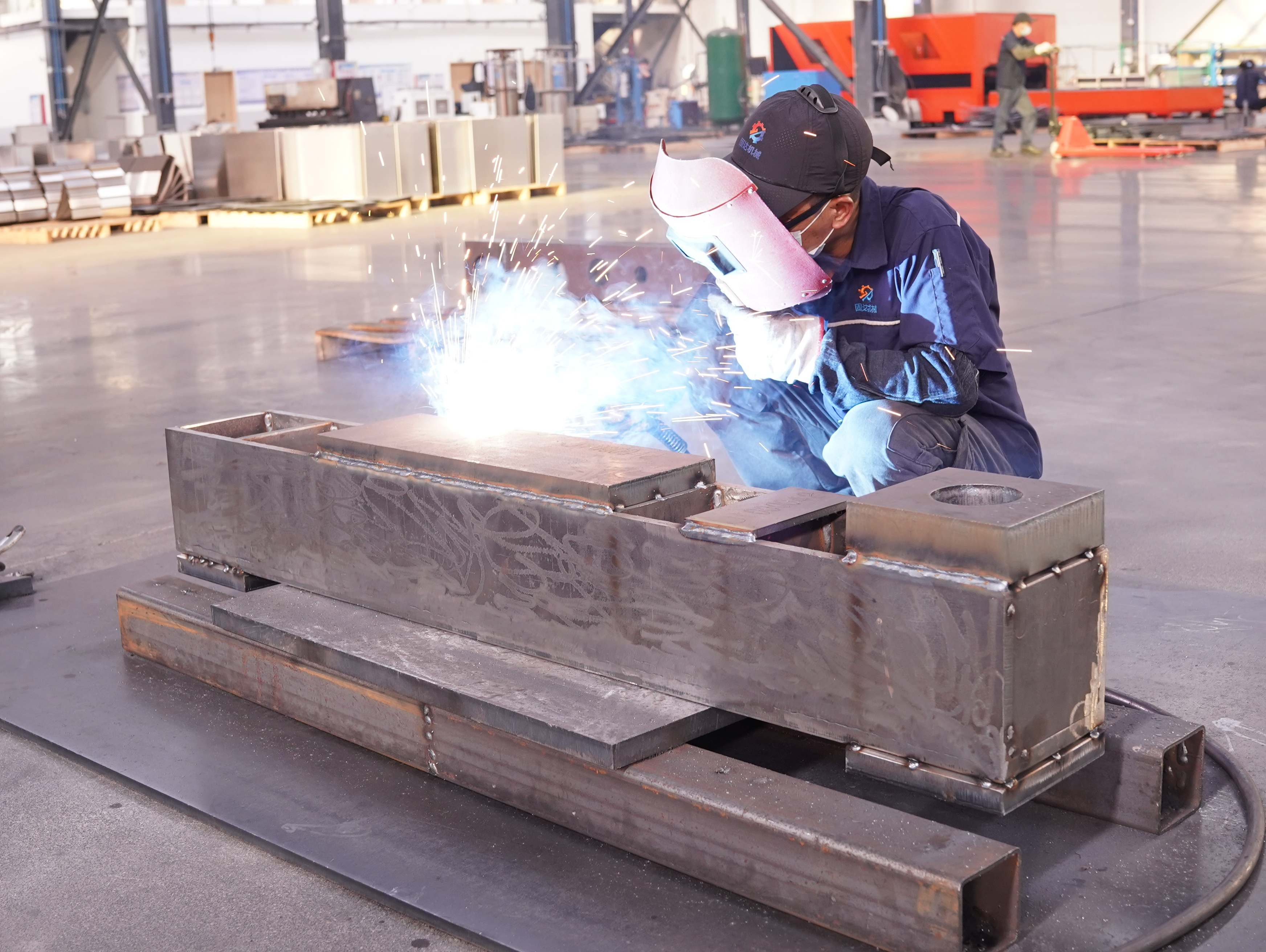
Material Comparison
| Factor | Gray Cast Iron | Welded Steel |
|---|---|---|
| Material stiffness | Lower elastic modulus; grade and graphite structure affect the value | Higher elastic modulus; structural steel is approximately 200 GPa |
| Vibration damping | Graphite flakes contribute to high material damping | Low material damping; fill or other damping treatments may help |
| Manufacturing | Patterns and molds allow integrated ribs and internal cavities | Plates and sections allow design changes without new casting patterns |
| Dimensional stability | Depends on casting quality, residual-stress control and machining sequence | Depends on weld design, residual-stress control and machining sequence |
| Cost drivers | Pattern tooling, casting yield, batch size and machining | Plate preparation, welding, inspection, stress relief and machining |
Rigidity Depends on the Structure
Steel’s higher elastic modulus does not automatically produce a stiffer bed. Box depth, rib placement, rail support and the distance between mounting points can outweigh the material difference. For a simple rectangular beam, doubling its depth increases its bending second moment of area eightfold, provided its width stays unchanged. A machine bed is more complex, but the example shows why section geometry matters.
Weight alone is not a stiffness measurement. On a double-column machining center such as the LM-2016, the published 2,000 × 1,600 × 800 mm travels and 4,000 kg table capacity define a useful purchasing envelope. They do not establish tool-to-workpiece stiffness. That requires load and displacement measurements at specified axis positions.
Ask where the load was applied, in which direction, and how far the structure moved. As a calculation example, a 1,000 N load producing 10 μm of displacement gives a static stiffness of 100 N/μm. Two results are comparable only when the loading, support conditions and measurement locations match.
Gray Iron Has a Damping Advantage
Gray iron’s flake graphite contributes to its vibration-damping properties and helps explain its established use in machine-tool bases. That advantage belongs to gray iron specifically; ductile iron has a different graphite shape and should not be treated as an interchangeable material.[1]
There is no universal damping multiplier that applies to every finished bed. Guideways, bolted joints, spindle assemblies, foundations and axis positions all affect the machine’s response. A dull sound from a hammer tap is not evidence of a particular damping ratio, surface finish or tool-life improvement.
A Published Hybrid-Bed Test
Abuthakeer, Mohanram and Mohankumar studied a bed combining welded steel and polymer concrete. Their numerical and experimental work reported a 24.7% increase in first-mode natural frequency and a first-mode damping ratio 2.7 times that of the cast-iron comparison bed. Those results apply to the tested design—not to every filled steel frame.[2]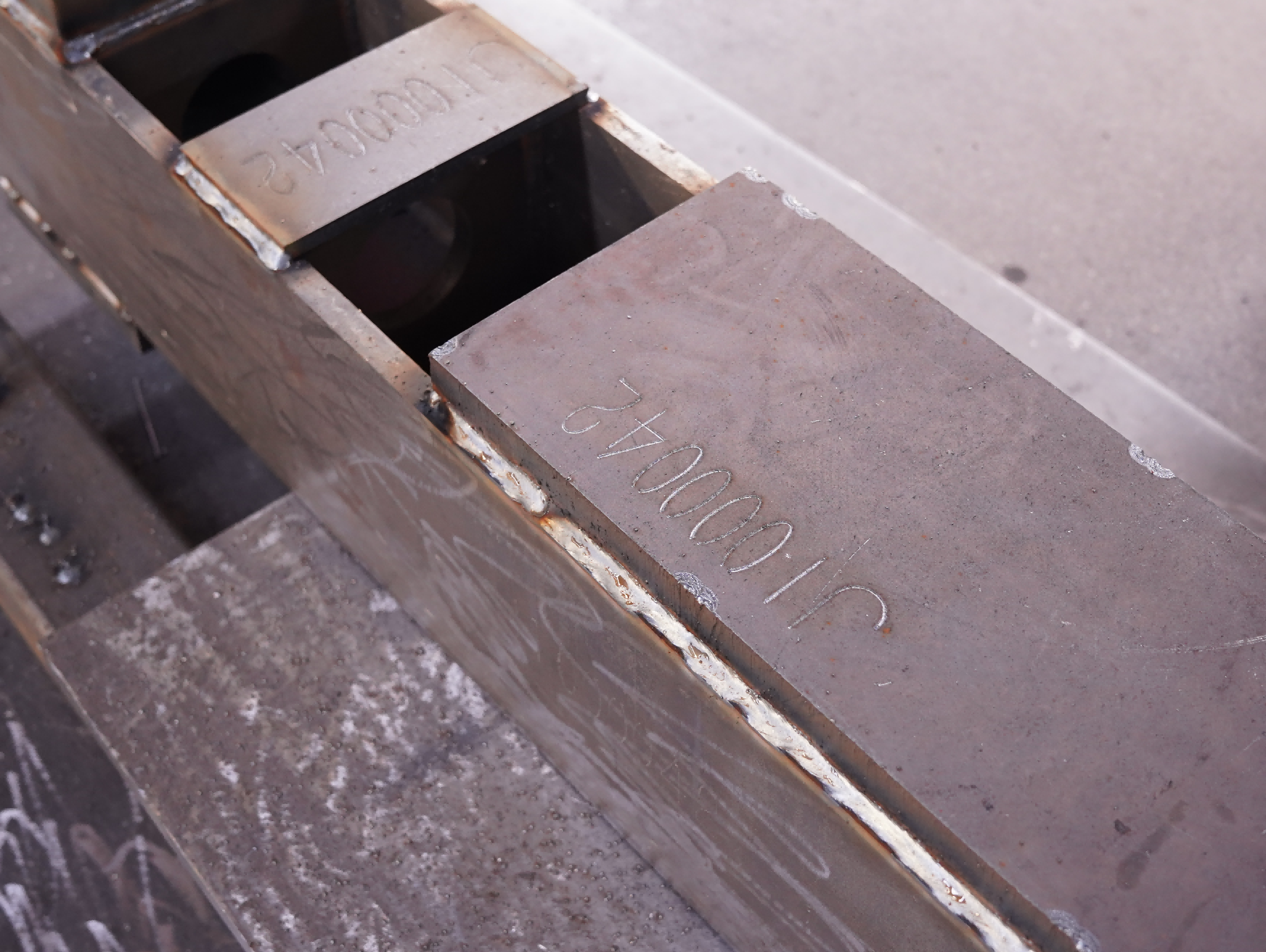
The practical question is how the fill works with the steel shell. Request its formulation, placement, curing conditions and interface design. Adding mass can change natural frequencies without delivering the intended stiffness or damping improvement.
Cost Depends on the Quote
Welded construction avoids casting patterns, which can favor one-off designs and frequent revisions. Cast construction can spread tooling costs across repeated units. Neither route has a fixed percentage saving or a universal break-even batch size.
Illustrative calculation: suppose the casting route has RMB 30,000 more in initial tooling costs but costs RMB 1,500 less per finished bed. The simple break-even point is 20 beds: RMB 30,000 ÷ RMB 1,500. Changing either quotation changes the result.
Compare both quotations at the same delivery stage: stress-relieved, finish-machined, inspected and ready for assembly. Include fill, coating, transport, lifting and installation. A welded shell price and a finished casting price are not comparable.
Downtime also needs a defined basis. If a repair stops production for three days and the unrecovered contribution is RMB 2,000 per day, the production loss is RMB 6,000 before repair costs. Use the shop’s actual figures rather than treating machine billing rates as lost profit.
Heat and Long-Term Stability
For a freely expanding 1 m member with an assumed expansion coefficient of 11 × 10−6/K, a uniform 5°C temperature rise produces approximately 55 μm of growth. This is a calculation example, not a prediction of machining error. Tool-to-workpiece error depends on which components heat up, their constraints and the temperature distribution.
Neither material guarantees uniform heating or a fixed warm-up time. Spindle heat, coolant, chips, sunlight and air movement can create temperature differences across either structure. Ask for thermal measurements under a defined operating cycle.
Both castings and weldments need residual-stress control. Request the actual process record, rough- and finish-machining sequence, and dimensional checks. A statement such as “aged” or “stress-relieved” is not a guarantee of five-year accuracy.
Verify the Machine Before Purchase
For mold-base work, test a representative block with the intended fixture and cutting conditions. A duplex milling machine should be assessed during its intended two-sided cutting cycle, not only during an unloaded axis demonstration.
- Record the setup. Identify the workpiece grade and hardness, dimensions, fixture, tool, overhang, coolant and machine temperature.
- Record the cut. State spindle speed, feed per tooth, axial depth and radial engagement. A “3 mm cut” alone does not define cutting load.
- Measure the result. Check specified dimensions, flatness, parallelism and surface roughness in Ra or Rz. Record the instrument and measurement conditions.
- Check axis behavior. Request positioning and repeatability results, including test length, direction, compensation settings and warm-up conditions.
- Repeat critical checks. Compare results after the agreed production cycle, with limits written into the acceptance agreement.
These are proposed acceptance steps, not tests performed for this article. No original shop trial or long-term ownership data is claimed here. The numerical performance example above comes from the identified published study; the cost and thermal examples are calculations with stated assumptions.
Choosing Between the Two
For a new design where damping is a priority, gray cast iron deserves early consideration. For a large custom structure or a design likely to change, welded steel may simplify fabrication. For either option, make the purchase conditional on measured performance with the intended workpiece—not a promised finish improvement, delivery time or accuracy lifespan based on material alone.