

1 Introduction
Before buying a CNC machine, first clarify six core dimensions: purpose, precision, space, configuration, after-sales service, and budget. Many beginners reverse this order—focusing on appearance, price, and specs first, and only considering actual needs at the end. This often leads to insufficient rigidity, unqualified precision, inadequate travel, operational difficulties, and ultimately idle equipment. Follow this logical sequence to minimize risks and choose the right machine.
2 What are you really going to use this CNC machine for?
This is the starting point of all decisions and the most important link. Your purpose directly determines the machine type, configuration, and grade, and no parameters can replace it.
2.1What materials are you going to process?
Different materials have completely different requirements for the spindle, rigidity, and cutting capacity:
- Aluminum, copper, plastic, acrylic: A high-speed spindle (8000–12000rpm) is required to pursue fast and light cutting and high efficiency.
- Steel, cast iron, mold steel: A high-torque spindle and a high-rigidity bed are a must; otherwise, cutting will be weak, heating will be easy, and efficiency will drop by more than 50%.
- Hard materials, high-hardness plates: Stronger cutting stability is required; otherwise, dimensional deviation will be large and tool wear will be extremely fast.
Many beginners buy "universal machines" but end up cutting aluminum too fast and unstable, and cutting steel too slow and weak because they do not choose configurations according to the material.
2.2 What level of processing precision do you need?
Precision directly determines whether your products are qualified and whether you can receive orders:
- Handboards, models, woodworking, simple workpieces: A precision of ±0.03mm–±0.05mm is sufficient.
- Molds, jigs, hardware structural parts: Must reach ±0.01mm or higher.
- Medical devices, precision parts, optical accessories: Require ±0.005mm or even higher.
Special reminder:The theoretical precision marked by the manufacturer is usually high; the actual precision should be based on test cutting, user reputation, and long-term use stability.
2.3What is your processing output?
Output determines the durability and grade of the machine:
- Small batch, prototyping, R&D: Ordinary standard models can meet the needs.
- Batch production, long-term daily processing: Industrial models with good heat dissipation and strong stability must be selected.
- 24-hour continuous production: Heavy-duty beds, high-quality spindles, and strong dust-proof design must be used.
The larger the output, the higher the requirements for spindle life, bed rigidity, and failure rate.
3 Can your site and space really accommodate this machine?
More than 70% of beginners ignore the space issue and only find out when the equipment arrives:
It can't enter the door, pass the elevator, fit in the workshop, or leave room for operation.
You must confirm before purchasing:
- The overall length, width, and height of the machine
- The operation and maintenance space that needs to be reserved around
- Whether the workshop passage, door width, and elevator size meet the handling requirements
- Whether the voltage, air source, cooling system, and chip removal space are matched
If the space is not up to standard, even high-end equipment cannot be installed and used normally.
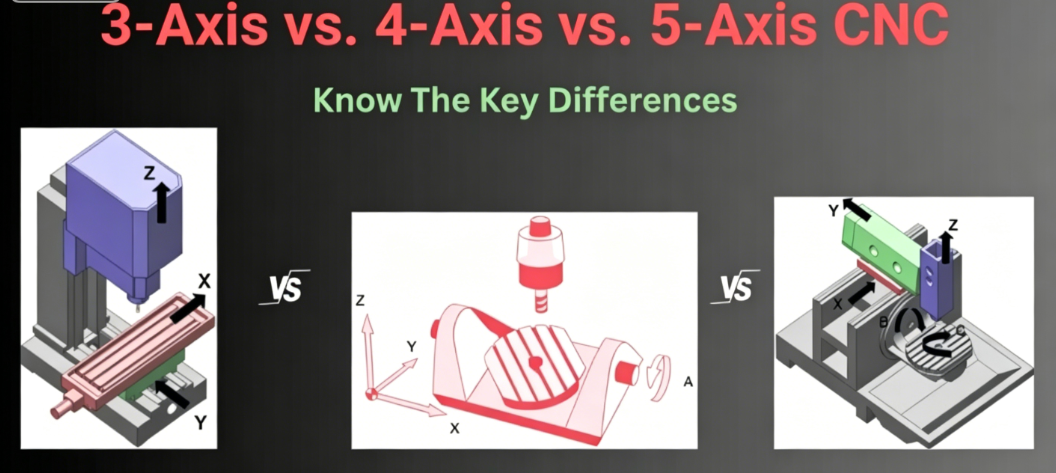
4 Should you choose a 3-axis, 4-axis, or 5-axis machine?
More axes are not better; they are better when matched.
3-axis CNC Machine
- The easiest to get started, the lowest cost, and the easiest software to use
- Meets more than 80% of conventional part processing needs
- First choice for beginners
4-axis CNC Machine
- Suitable for rotating and cylindrical parts
- Learning cost, software difficulty, and price increase significantly
- Choose only when there is a clear demand
5-axis CNC Machine
- Suitable for complex curved surfaces, high precision, and one-time forming of polyhedrons
- High price, complex software, and extremely high requirements for operators
- Not recommended for beginners to buy blindly
In a word,without special needs, a 3-axis machine is the most stable and practical choice.
5 Can your technical level handle this CNC machine?
CNC is not a plug-and-play device; it requires basic operation and programming capabilities.
Ask yourself three questions:
①Can you use CAD for drawing?
②Can you use CAM for programming and generating tool paths?
③Can you independently complete tool setting, tool changing, debugging, and troubleshooting?
- If the answer is "not very proficient", you must give priority to choosing:
- Simple and easy-to-understand operation interface
- Complete tutorials, training, and videos provided
- Fast after-sales response and remote guidance available
- Stable system and low failure rate
An easy-to-use ordinary machine is far more valuable than a difficult-to-use high-end machine.
6 How to judge the quality of a CNC machine?
Don't just listen to the salesperson say "high precision, strong rigidity, fast speed"; the real quality depends on these four points:
6.1 Warranty Period
The longer the warranty period, the more confident the manufacturer is in its products.
- Standard industrial machine: 1–2 years
- High-quality model: 3–5 years
6.2 User Reputation and Real Reviews
Look at more third-party user feedback and less official advertising. Frequent failures, unresponsive after-sales service, and precision drift are all high-risk signals.
6.3Core Hardware Configuration
- Spindle: Power, concentricity, heat dissipation, durability
- Guide rail: Square rail stability > Round rail
- Drive: Servo system > Stepper motor
- Bed: Cast iron bed > Aluminum profile bed
6.4 Safety and Stability Design
Limit sensors, emergency stop, overheating protection, and dust-proof structure—these details directly determine the service life and safety of the machine.
7 Are the accessories complete? Will you keep spending money later?
A common trick of many low-priced machines:
The host price is very low, but all key accessories are charged separately.
You must confirm before purchasing:
- Is the control system included?
- Is the spindle standard?
- Are tools, fixtures, and toolboxes included?
- Do you need to purchase additional tool setters and edge finders?
- Do you need to equip an additional computer, transformer, or air compressor?
It seems to save money in the early stage, but the accessories added later may exceed the host price.
Hidden consumption is the biggest pitfall.
8 Is the software compatible? Is post-maintenance convenient?
8.1 Software Openness
Give priority to machines compatible with general CAD/CAM software. Avoid machines that can only use the manufacturer's exclusive system, which may even require annual renewal.
8.2 Accessory Universality
Are motors, drivers, guide rails, bearings, etc., general accessories? Can they be bought and replaced quickly when broken?
Closed system + exclusive accessories = bundled consumption in the later stage.
9 How should you reasonably allocate your budget?
The budget for a CNC machine is not just the host price; the complete budget should include:
- Machine host
- Tools, fixtures, and consumables
- Training and learning costs
- After-sales service, maintenance, and wearing parts
Reasonable thinking:
- Beginners: Economical 3-axis industrial machine
- Stable orders: Mid-range standard model
- High precision/high output: High-end industrial machine
Buy what's right, not what's expensive.
10 Can the machine be upgraded, expanded, and keep up with your development?
The most cost-effective machine is one that can grow with you.
You can pay attention to when purchasing:
- Can a higher-power spindle be upgraded later?
- Can a tool magazine and 4th axis be added?
- Can it be connected to automation and robot loading/unloading?
An upgradeable machine allows you to not replace the equipment within 3–5 years, which is more cost-effective in the long run.
11 Final Step: Have you really done test cutting verification?
No matter how beautiful the parameter table is, it's not as good as actually processing a cut.
You must observe during test running:
- How much vibration is there during cutting?
- Is the operation noise normal?
- Is the spindle and motor heating serious?
- Is the precision stable after 2 hours of continuous operation?
Placing an order without test cutting and verification is the biggest risk for beginners.
12 Summary: Golden Order for CNC Machine Purchase
- First determine the purpose, then the machine type
- First confirm the material, then select the configuration
- First calculate the space, then check thesize
- First check the precision, then the speed
- First check the after-sales service, then compare theprice
- First complete the test cutting, then place the order
Following this logic, you can avoid 90% of the pitfalls and buy the CNC machine that truly suits you.
FAQ
1.Q: What axis is recommended for a beginner's first CNC machine?
A: Priority is given to 3-axis, which is the most versatile, easiest to get started, and most cost-effective.
2.Q: Can the same machine process aluminum and steel?
A: Yes, but you must replace the tool, adjust the cutting parameters, and the spindle torque must be sufficient.
3.Q: How to avoid buying a machine with falsely marked precision?
A: Be sure to conduct on-site test cutting, detect the precision with real parts, and do not rely solely on the parameter table.
4.Q: How long can a CNC machine be used normally?
A: It can be used for 8–12 years with good maintenance; usually only 3–5 years with insufficient maintenance.
5.Q: Is an industrial-grade CNC machine suitable for small workshops?
A: As long as space, voltage, and budget permit, the stability and service life of industrial machines are far higher than those of small desktop machines, making them more worthy of long-term investment.