

45 steel and 1045 steel are essentially the same medium-carbon steel, corresponding only to China’s GB standard and the U.S. AISI standard.
Both have a carbon content controlled between 0.43% and 0.50%, with tensile strength of around 600 MPa.
In machining, they are fully interchangeable. Both require quenching at 840°C to achieve a surface hardness of HRC45, and the cutting parameters and tool selection are essentially the same.

Same Material
0.45% Carbon Content
The molten steel inside the furnace is above 1600°C. Workers use a spectrometer at the furnace side to keep the carbon content precisely at 0.45%. Add 0.05% too much, and the steel ingot is more likely to crack along grain boundaries during forging. Reduce it by 0.05%, and even after rapid water cooling, the surface hardness will still struggle to reach HRC40.
Under a metallographic microscope at 500x magnification, the material shows a mottled black-and-white structure. The white areas are as soft as pure iron and can deform under external force, with elongation holding steady at around 16%. The dark areas are made up of alternating lamellae of soft ferrite and hard carbon-rich structures, with spacing of only 0.2 to 0.3 microns.
These dark regions make up more than half the total volume and provide tensile strength above 600 MPa. By comparison, low-carbon A3 steel used for ordinary shelving contains around 0.2% carbon. When you take a 3 mm cut from it on a lathe, the chips come off soft and sticky, clinging to the tool tip, and the surface finish usually stops at Ra 3.2. Raise the carbon content to 0.45%, and the chips break cleanly into neat C-shapes.
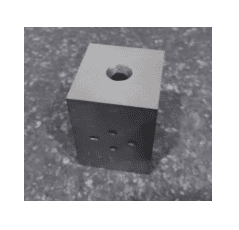
On a CNC lathe running at 800 rpm with a standard carbide insert, with cutting speed held at 120 m/min, the cutting sound is crisp and continuous. The machined bearing step can easily reach a surface finish of Ra 1.6. Machinists like working with this material because it is neither so soft that it gums up the tool nor so hard that it chips inserts like high-carbon tool steel.
· Feed per pass: 0.2 mm
· Depth of cut per side: 2–4 mm
· HSS drill life: about 40 minutes
· Thread tapping torque is very stable
· The chips come off blue
After rough machining, the part is placed in an electrically heated furnace at 840°C. After soaking for 1 to 2 hours, the original internal structure is broken down and reorganized into grains suitable for rapid cooling. Grain size is generally controlled between grades 5 and 8.
The worker then pulls the red-hot part out with tongs and immediately drops it into running water at 5 to 15°C, or into a 5%–10% brine tank. The cooling rate can reach 30 to 50°C per second.
Right after quenching, surface hardness can jump to HRC55 or even HRC60. At the same time, the part is filled with severe internal stress. If a solid shaft 50 mm in diameter is simply left on the floor, it may audibly crack by itself within two hours.
So the worker quickly puts it back into a furnace at 500–600°C. After holding for two hours and then air cooling at room temperature, the brittle needle-like structure softens slightly. Surface hardness drops back to HB220–HB280, but impact resistance rises to more than 35 joules.
· Yield strength: ≥ 355 MPa
· Tensile strength: ≥ 600 MPa
· Reduction of area before fracture: ≥ 40%
· Brinell hardness: HB227–269
· Fatigue limit in long-term operation: about 270 MPa
When a gear factory produces spur gears with module 4 and 30 teeth, it often buys hot-rolled round bar and anneals it first. The material is heated through at 850°C, then removed and left to cool in the workshop. Hardness becomes very uniform, staying between HB170 and HB210, which is exactly the range where hobbing machines cut fastest.
Some parts need wear resistance on the surface and toughness at the core, such as spline shafts in automotive gearboxes. In these cases, the factory runs 200 kHz high-frequency current through an induction coil. The current instantly heats only the outer 1 to 2 mm of the part to 860°C, and a special polymer quenching fluid is sprayed immediately afterward.
This creates a hardened shell with a surface hardness around HRC50, while the core remains tough and impact-resistant. A factory producing 100,000 gear reducers a year may consume more than 300 tons of 0.45% carbon round bar every month, with purchase prices staying around RMB 4,000 to 4,500 per ton.
Rebar used in buildings and bridges generally contains only 0.2% to 0.25% carbon so workers can weld it directly on site. Once carbon rises to 0.45%, the equivalent carbon value in weldability assessment exceeds 0.55%. The 3000°C heat of arc welding makes the area around the weld hard and brittle.
Before welding, the welder first preheats 150 mm on each side of the joint to 150–250°C with a flame torch. The welding current is set to 220 A, voltage to 26 V, and E5015 low-moisture electrodes are used. After welding, the joint must be wrapped immediately in thick insulation so the cooling rate does not exceed 50°C per hour, preventing cracking caused by cooling too quickly.
· Local preheat before welding: 150–250°C
· Interpass temperature: 200°C
· Use very low-hydrogen electrodes
· Reverse electrode polarity
· Slow cooling at 300°C after welding
In the machinery we deal with every day, about 80% of transmission parts that do not need corrosion protection in water are made from steel with this same carbon range. On a standard turning machine weighing 2 tons, aside from the cast-iron base and a small amount of bearing steel, the remaining threaded rods, guide rods, and more than a hundred bolts add up to nearly 400 kg of this type of material.
Chemical Composition Comparison
The computer screen immediately displays the percentages of more than twenty chemical elements. The shipping order says 1045, the U.S. designation, while the supplier’s material certificate is headed with 45, the Chinese designation.
The plant manager instinctively checks carbon first. The U.S. standard sets the lower limit at 0.43%, while the Chinese standard sets it at 0.42%. Both standards align perfectly on the upper limit of 0.50%.
In a 100-ton steelmaking furnace, a 0.01% change in carbon is equivalent to adding only about 10 kg of graphite powder. As long as the actual carbon content is controlled around 0.45% to 0.46%, the chemistry certificate will pass customs inspection in any country.
The second line is manganese. The U.S. 1045 standard specifies 0.60% to 0.90%, while China’s 45 steel standard sits slightly lower at 0.50% to 0.80%.
| Element | U.S. 1045 Limit Range | China 45 Limit Range | Steel Mill Internal Target |
| Carbon (C) | 0.43%–0.50% | 0.42%–0.50% | 0.45%–0.47% |
| Manganese (Mn) | 0.60%–0.90% | 0.50%–0.80% | 0.65%–0.75% |
| Phosphorus (P) | ≤ 0.040% | ≤ 0.035% | 0.015% |
| Sulfur (S) | ≤ 0.050% | ≤ 0.035% | 0.010% |
Adding ferromanganese to molten steel at 1600°C not only removes oxygen, but also improves hardenability during quenching. In actual production, steel mills usually target 0.65% to 0.75% Mn, right in the overlap of both standards’ safe zones.
Phosphorus and sulfur, shown in the lower half of the table, are always treated as impurities that must be cleaned out. The U.S. is slightly more tolerant of sulfur, allowing up to 0.050%, while China holds it below 0.035%.
Some U.S. factories running automatic lathes for high-volume turning actually prefer slightly higher sulfur. An extra 0.015% of manganese sulfide inclusions can act like a lubricant during cutting and extend insert life by 15 to 20 minutes.
To lower sulfur further, Chinese special steel mills blow argon through the bottom of the ladle for an extended period. Reducing sulfur by each additional 0.010% raises electricity and consumable costs by roughly RMB 40 to 50 per ton of steel.
Silicon on the test certificate is usually around 0.20%. China’s 45 steel standard clearly specifies 0.17% to 0.37% Si, while the U.S. 1045 standard leaves it to buyer-seller agreement; actual mill values are usually still around 0.10% to 0.20%.
When scrap yards compress old car panels and radiators into large steel blocks and remelt them in electric furnaces, small amounts of chromium, nickel, and copper inevitably come along. Both standards are surprisingly similar here, setting the upper limit for residuals around 0.25% to 0.30%.
Once copper exceeds the 0.30% red line, the surface of the steel can develop turtle-shell-like cracking during rolling above 1000°C. A quality inspector only has to shine a flashlight on it, and the entire batch of dozens of tons will be rejected on the spot.
· Purchase order specifies 40 mm hot-rolled round bar
· Heat No. 2A4589 fully meets the chemistry requirements
· Measured impurity levels are below 60% of the maximum limit
· Third-party spectrometric error is under 0.005%
· Incoming warehouse acceptance rate stays above 99.8% year-round
A machining factory in Ningbo producing automotive drive shafts landed a large order from a customer in Detroit, shipping 200,000 solid shafts per month. The drawing specified ASTM 1045, and the purchasing manager immediately placed an order with a local steel distributor for GB 45 hot-rolled round bar.
The mill certificate delivered with the truck clearly listed C 0.46%, Mn 0.65%, S 0.012%, and P 0.015%. Apart from the different heading, every measured value fit neatly within the American limits.
The third-party lab in Detroit tested the sample and still issued a fully compliant report. Inspectors in mechanical export factories often carry portable spectrometers about the size of a hair dryer into the workshop.
Once the anti-rust oil is ground off the surface and the trigger is pulled, the instrument gives a reading in about 30 seconds. In one test, the manganese reading came out at 0.72%. Those few chemistry values alone are enough to confidently sign off on export release documents.
· Portable spectrometer weight: about 1.5 kg
· Full battery supports about 800 tests
· Surface grinding depth required: 0.5 mm
· Operating temperature for field testing: -10°C to 45°C
· Data can be sent and printed instantly via Bluetooth
Are They 100% Identical?
If you break open and test two round bars labeled 45 and 1045, then examine them under an electron microscope at 1000x magnification, you can indeed find subtle differences invisible to the naked eye. Chinese steel mills usually rely on blast-furnace hot metal mixed with 15% to 20% scrap.
Many North American mills, by contrast, melt recycled car chassis and discarded appliances in 120-ton electric furnaces. Those mountains of scrap often hide bits of copper wire and solder from old circuit boards.
In a 50-ton heat of molten steel, even tin equal to the weight of two beverage cans—only about 20 ppm—can make the steel prone to cracking when forged at 1100°C.
When the U.S. 1045 standard was established, its framers allowed slightly more tolerance for residual copper, chromium, and nickel in order to accommodate electric-furnace mills processing large amounts of scrap. They did not lock those limits down as tightly as carbon.
China’s 45 steel standard, on the other hand, clearly caps chromium and nickel below 0.25%, and copper must also stay below 0.25%. Even an extra 0.01% is enough to disqualify the batch.
A reducer parts factory in Hangzhou brought in two truckloads of North American 1045 black-skin round bar last year. When the machinist took a 3 mm cut, the chips were visibly bluer and did not break as cleanly into short crescent shapes as domestic 45 steel normally does.
· Electric-furnace steel may contain 50–80 ppm nitrogen
· Cleaner blast-furnace hot metal can keep nitrogen below 40 ppm
· Those extra tens of ppm of nitrogen slip into the spaces between iron atoms
· They can increase deformation resistance by about 15 MPa
Workshop QC then checked the finished step with a portable roughness tester. Domestic material they were used to could reach Ra 1.6, while the American material with more scrap content struggled to stay at Ra 3.2. That slight increase in impurities also sped up carbide tool wear by around 10%.
When tensile tests were run on standard 10 mm specimens using a 50-ton hydraulic tester, domestic 45 steel reached 610 MPa before fracture, while the American 1045 sample hit 625 MPa.
If both shafts are used as transmission gear shafts in a tractor gearbox and run for 100,000 km in real service, a difference of a dozen or so MPa would not cause even one ten-thousandth of typical machine failure variation.
When pouring steel, mill workers feed dozens of meters of pure aluminum wire into the ladle to remove oxygen bubbles. If acid-soluble aluminum is controlled between 0.020% and 0.040%, the final grain size stays steadily between grades 5 and 8.
American third-party labs usually refer to this as ASTM grain size. In reality, whether the steel is produced in China or overseas, as long as aluminum addition is stable and well controlled, the grain structure under the microscope is nearly identical.
Some factories making wind turbine flanges cut round bar into thick steel discs for forging. The inspector coats the surface with oil and slowly moves a 2 MHz ultrasonic probe across it.
Even a shrinkage cavity as small as 1.5 mm inside will trigger a sharp alarm. Demanding German automotive buyers never care what foreign trade name is printed on the wrapping paper when purchasing round bar.
Their purchase contracts are usually followed by an A4 sheet specifying that oxygen must not exceed 20 ppm and non-metallic inclusions must not exceed grade 1.5.
· Sulfide inclusions must be kept below grade 1.0
· Hard alumina particles must not exceed grade 1.5
· No coarse silicate clusters are allowed in the microscope field
· Centerline porosity in the round bar must not exceed grade 2
To meet these demanding drawing requirements, steel mills feed calcium-silicon wire into the melt just before tapping. The calcium turns long manganese sulfide inclusions into small rounded particles.
When a lathe insert encounters these spherical inclusions, it is less likely to chip, and the machined surface can achieve a mirror-like finish. As long as those microscopic impurities—hundreds of times finer than a human hair—are kept under tight control, the results remain stable.
Whether it is 45 steel continuously cast by Baosteel in China or 1045 round bar from Nucor in the United States, if both are heated to 840°C and then quenched immediately in water, the result is the same.
A Rockwell hardness tester will show surface hardness at around HRC55. In a temperature-controlled workshop, a CNC operator can load either material, press the green start button using the same cutting parameters, and even a machinist with 20 years of experience will not hear any difference in the cutting sound at 1200 rpm.

Different Market Names
China Market
In the steel markets of Qianzhou in Wuxi or Chang’an in Dongguan, most of the round bar on the ground is labeled simply 45. In the third quarter of last year, the ex-factory price of cold-drawn round bar in East China hovered around RMB 4,200 per ton.
Machinists love putting it on the machine. At a cutting speed of 120 m/min and a feed of 0.2 mm, the chips come off in clean C-shapes. Replace it with softer Q235, and the chips wrap around the chuck like noodles. With an ordinary carbide insert costing only a few dozen yuan, the machine can run eight hours straight without changing tools.
At wholesale counters, sellers usually throw over a few battered catalogs and let you choose. Current stock materials on the market generally fall into the following categories:
· Hot-rolled black-skin round bar: 10 to 300 mm diameter
· Cold-drawn bright bar: outer diameter tolerance to h9
· Open-die forgings: single-piece weight above 5 tons
· Precision ground bar: surface roughness below Ra 0.4
Fresh stock material comes in at only about HB 197, and a standard file will leave a deep mark with one light stroke. After heat treatment—first quenching at 840°C, then high-temperature tempering at 600°C—the hardness settles at HRC 28 to 32 after cooling.
If you come across material quoted below RMB 3,800 per ton, be careful. Some small shops remelt scrap into off-grade material, and sulfur can exceed 0.06%. Just last month, one buyer tried to save money on twenty tons and saw scrap rates jump to 15% as soon as the material hit the press.
The safest way to avoid bad material is to cut off samples and send them for spectrometric testing. A report costs only RMB 150, and any batch with carbon below 0.42% or above 0.50% should be rejected outright. Silicon must stay between 0.17% and 0.37%, or the material can crack easily during quenching.
Warehouse inspectors usually carry a caliper and a few sheets of coarse sandpaper when receiving goods. They focus on screening for the following surface defects:
· Hairline cracks deeper than 0.2 mm
· Folds caused during rolling
· Pits larger than 1 cm²
· Scabs or raised metal laps about 0.5 mm thick
Factories making shafts of all kinds especially like 50 mm cold-drawn stock. On a CNC lathe, peeling off 1 mm of the outer skin gives a stable finished size of 48 mm exactly as drawn. Logistics in the Yangtze River Delta are fast—place the order at night, and before 8 a.m. the next morning, a semi-trailer loaded with 30 tons is already at the factory gate.
When you run the numbers, machining a 400 mm motor shaft costs only about RMB 30 in raw material, and averaged tool wear is under RMB 0.20. If the drawing does not explicitly require an expensive chromium-molybdenum alloy, the owner will always try to substitute a cheaper grade. Over a year, the savings can easily pay for two FANUC machining centers.
A slender shaft 2 meters long may bend as much as 3 mm after only a few seconds in the quench tank. Over time, shops figured out that adding 10% industrial salt to the water, or switching to PAG water-soluble quench fluid, can just about reduce distortion to under 1 mm.
If you saw open many moving parts in ordinary machinery, you would find the same base material everywhere. Typical drawing applications include:
· Elevator traction machine: module 4 gears
· Automotive engine: connecting rods under 800 MPa load
· Agricultural tractor: half shafts transmitting 200 N·m torque
· Stamping dies: guide pillars with 0.01 mm fit clearance
· Tower cranes on construction sites: anchor bolts rated for 10 tons of tension
Companies in Guangdong making non-standard automation equipment go through hundreds of thousands of A4 drawings a year. For bearing seat base plates, drawings usually specify ordinary rolled medium plate in 20 mm or 25 mm thickness. Plasma cutters can cut 1.5 meters a minute, with little dross, and after two minutes on an angle grinder the part is ready for milling.
Long-established heavy machinery plants in Northeast China often have massive in-house forging shops. A solid steel ingot weighing over 2 tons can be heated to 1200°C, then hammered under a 3,000-ton hydraulic press until your ears ring. The grain structure is compressed to grade 6 or better, and after full forging the yield strength comfortably exceeds 355 MPa.
Scrap dealers especially prize the factory’s clean steel turnings. One ton of clean chips can sell for RMB 2,600, but if copper or aluminum gets mixed in, the price drops instantly to RMB 1,800. At the end of each day, the cleaning staff wheel the chip cart to the scale, where weighing error is kept within 0.5 kg.
After more than ten years in machining, your nose gets used to the pungent smell of 5% cutting fluid. Each month, when two or three hundred tons of black-skin round bar arrive from steel traders, experienced hands can tell the quality just by feeling the rough surface. And when it comes time to negotiate the next half-year supply contract, they know they can probably squeeze another RMB 50 per ton out of the price.
International Stage
In PDFs from U.S. customers, the material line almost always says AISI 1045. Last month, a job for oilfield equipment in Houston required four full containers a month just for 2.5-inch flanges, with each container worth more than USD 200,000.
The shop supervisor checks the diameter with digital calipers. According to the American drawing tolerance, the outside diameter must stay within ±0.005 inch. On customs paperwork, the chemistry is declared honestly as 0.43% to 0.50% carbon. Manganese under the U.S. standard is set at 0.60% to 0.90%, which is 0.1 percentage point wider at the top end than the Chinese standard, making steelmaking slightly more demanding.
Foreign buyers take inspection seriously. They often insist on SGS or TÜV sampling in the workshop. A full tensile and yield test package costs about RMB 2,800. What matters to them is seeing at least 585 MPa tensile strength on the English report, along with elongation over 16%, before they will sign the bill of lading release.
A 20-foot container lined up at the port can hold at most 28 tons of round bar because of domestic road weight limits. Ocean freight has been rising again, and shipping to Los Angeles now costs about USD 85 per ton. To keep the bars from corroding in salty air over a month at sea, each one must be wrapped in three layers of rust-proof paper and then sealed in 0.2 mm PE vacuum film.
European and Japanese orders often use the same base material under different names. On the workshop wall, there is usually a laminated grade equivalency chart that every new sales rep studies while preparing quotations:
| Country or Region | Common Grade Name | Manganese Requirement | Phosphorus / Sulfur Limit | Common Delivery Condition |
| United States (SAE/AISI) | 1045 | 0.60%–0.90% | ≤ 0.040% | Cold drawn or hot rolled |
| Japan (JIS) | S45C | 0.60%–0.90% | ≤ 0.030% | Quenched and tempered or normalized |
| Germany (DIN) | C45 or 1.0503 | 0.50%–0.80% | ≤ 0.045% | Annealed or quenched |
When working with a Tier 1 Toyota supplier in Japan, the drawing only recognizes JIS S45C. Japanese buyers are extremely strict about surface quality: on an 800 mm driveshaft, runout at the two ends must not exceed 0.05 mm. They are equally strict about phosphorus and sulfur, holding both below 0.030%. Even 0.001% over the limit can trigger a long claim email in Japanese.
German wind turbine yaw gearbox drawings are usually marked C45 or 1.0503. German engineers focus relentlessly on detail. They require the induction-hardened case depth to be verified by ultrasonic thickness measurement at 2.5 to 3.5 mm. Even the V-notch dimensions for the Charpy impact test are checked to within 0.01 mm, and the impact energy at room temperature, 20°C, must not be below 39 joules.
v
Export sales teams often spend a long time on Teams calls with overseas buyers, debating equivalent material substitution. They pull out Baosteel mill certificates stamped with CNAS seals, matching six key chemistry values and mechanical properties one by one. After three to five rounds of discussion, if they can guarantee yield strength above 355 MPa and provide a 500-hour salt spray report, most buyers will accept it.
Agricultural machinery repair shops in Los Angeles still think in pounds and degrees Fahrenheit. So 840°C quenching in the process sheet becomes 1544°F, and coolant flow in the oil tank must reach 40 gallons per minute. The imported U.S. hardness tester that cost RMB 80,000 is checked against the ASTM E140 conversion table so strictly that if the Rockwell reading is off by even one point, the whole batch has to be redone.
Steel traders near Beilun Port in Ningbo who specialize in export-grade materials often keep three to four thousand tons of stock produced to U.S. or Japanese standards. Even if all you have is a small sample order and need one 100 mm diameter, 2-meter-long bar of S45C, they can cut it immediately on a CNC saw. Cutting is charged at RMB 0.20 per square centimeter, so one cut costs roughly RMB 25, and they can also issue a VAT invoice with an English header.
European customers involved in ESG supply chain certification often require full heat-number and carbon-emissions traceability. Both ends of each steel bar are sprayed with an 8-digit bright yellow code, and the ERP system can trace it all the way back to the source blast furnace. Even the steel chips swept from under the lathe must have heat-number records kept on the factory server for a full 15 years, ready in case of an EU anti-dumping investigation.
Other Countries
When doing business with heavy machinery plants in Russia’s Far East, the drawing material line usually says GOST 45. For eccentric shafts in mining crushers, Russian buyers insist the material must still absorb 25 joules of impact energy at -40°C. At Suifenhe border crossing, trucks with Russian license plates haul in cold-drawn bar every day, and customs charges 8% duty by tonnage.
Their inspections are rougher. They tap the surface a few times with a Leeb hardness tester, and if the screen shows HL 450, it passes. Flanges supplied to them are intentionally left with 5 mm machining allowance because furnace temperatures in Siberia can fluctuate by 15°C, and they still need to take another cut on a vertical lathe after receiving the material.
Long-term Russian customers are particularly strict about deoxidation, and their contracts often require “killed steel,” which adds RMB 120 per ton in steelmaking cost.
At the Birmingham hardware show in the UK, older engineers often refer to EN8. Under the old BS 970 standard, the base code is 080M40. For classic car restoration parts, British buyers may insist that the carbon content of a 600 mm steering tie rod stay between 0.36% and 0.44%, saying anything outside that range changes the feel.
When producing aftermarket parts for Land Rover, drawings may specify Ra 0.8 μm, forcing the machinist to lower spindle speed to 800 rpm and grind slowly. Third-party testing in the UK is expensive: sending three test bars to London for salt spray testing costs GBP 450. To save money, sales teams usually use DHL economy service, and the samples reach the lab in seven days.
The Korean standard used in shipbuilding and automotive parts is KS D 3752. Purchase orders usually say SM45C, where the extra M indicates structural steel for machinery. Containers arriving in Busan and moving into Hyundai’s Tier 2 suppliers are inspected under high-power microscopes, and A-type sulfide inclusions must not exceed grade 2.0.
Korean customers push by the hour. Ships from Qingdao to Incheon sail every Tuesday and Friday and arrive in 14 hours. Exported ground bars must be coated with two thick layers of Shell VCI-329 rust preventive paper coating. One drum costs RMB 1,800, which is just enough for two container loads.
Buyers in Mumbai often attach PDFs of IS 1570 in their emails. They also call 0.45% carbon steel C45, just like the Germans, but they negotiate aggressively. They may press the price of hot-rolled black-skin round bar from RMB 4,000 down to RMB 3,850 per ton and still demand free delivery to the bonded warehouse at Yangshan Port.
Indian buyers may take 120 tons at a time for motorcycle sprocket scrap. To cut costs, suppliers source from smaller mills in Tangshan, keeping silicon right at the lower limit of 0.15%. Deliveries are usually divided into the following forms:
· Stamping sheet: 2.5 mm thick, tolerance 0.1 mm
· Medium plate offcuts: width starting at 150 mm
· Forged discs: mixed diameters from 60 to 80 mm
Frequent power outages in Indian factories mean they often insist on annealed delivery condition, with hardness kept below HB 180 so older presses can still handle the material.
For high-speed rail parts produced for Alstom in France, drawings may specify AFNOR XC45. French buyers are very strict about residual chromium and nickel, with the combined total not allowed to exceed 0.40%. In the workshop, their material is usually stored separately under heavy dust covers with a dedicated yellow identification card.
For rough blanks, ultrasonic inspection must often be carried out by Bureau Veritas (BV) in Shanghai. On a 30 kg solid shaft, the inspector scans point by point, and even a 0.5 mm internal pore is unacceptable. The inspection fee is RMB 200 per piece, and the bilingual report runs to a full eight A4 pages.
Mining maintenance stations in Australia commonly use 1045 under AS 1442. Track pins used in the red soil of Western Australia are hard chrome plated to a thickness of 0.05 mm. LCL shipment to Sydney costs USD 65 per cubic meter, and fumigation for wooden pallets costs RMB 80.
Factories in Vietnam generally recognize S45C. One truck can carry 35 tons of cold-drawn bright shafting, and after the driver scans the code and pays a RMB 20 weighbridge fee, the cargo can be unloaded into the bonded zone in Bac Ninh within half an hour. Different countries also set slightly different residual impurity limits:
· Russia GOST: sulfur ≤ 0.050%
· UK BS: phosphorus ≤ 0.050%
· Korea KS: copper residual < 0.30%
· Australia AS: silicon between 0.10% and 0.35%