

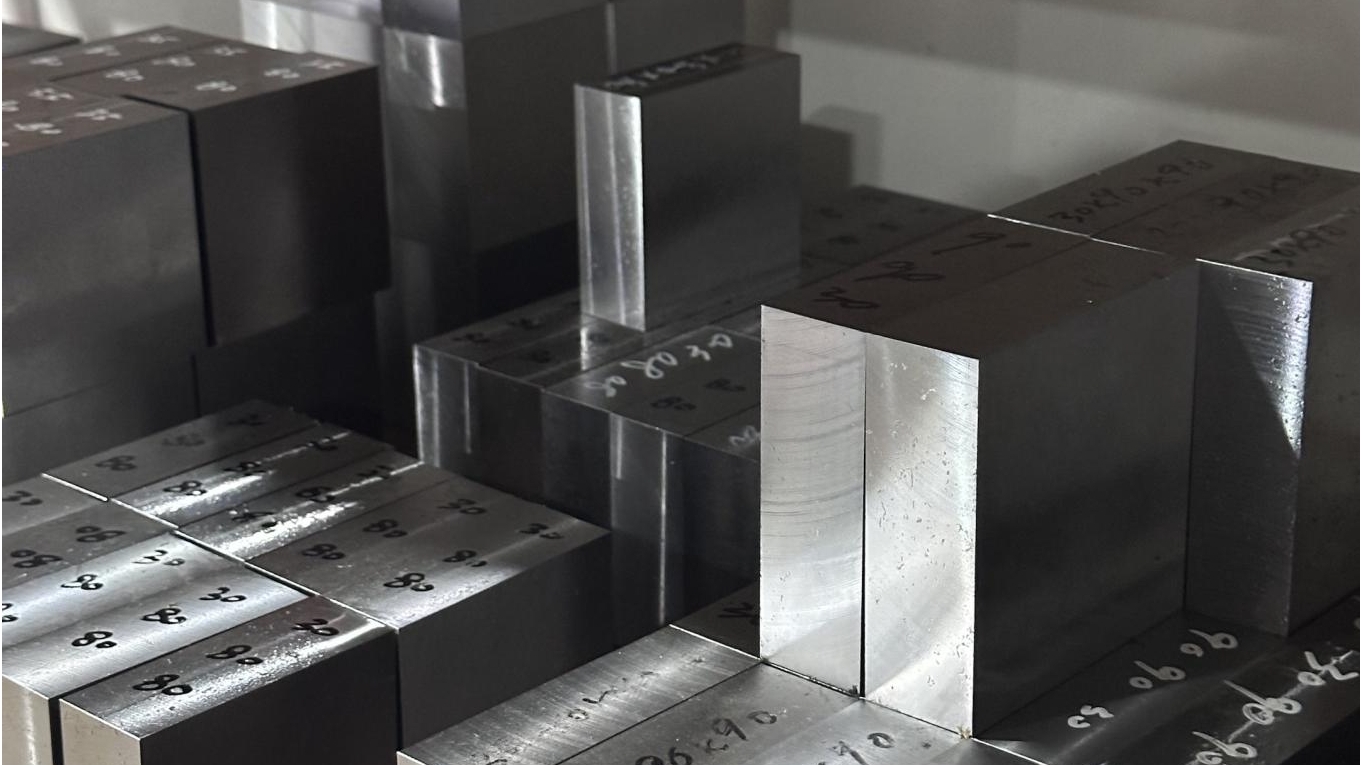
45 steel is suitable for machining mold bases and support components. With a hardness of HB 170–220, it offers good machinability.
A common practice is to leave a 0.5–1 mm machining allowance during roughing before finishing.
After quenching and tempering, the hardness can reach HRC 20–28, improving wear resistance and load-bearing capacity while ensuring dimensional stability and service life.
Bases
High-Quality Medium-Carbon Structural Steel
Inside the blast furnace, molten iron reaches 1,600°C. To keep the interior of the base steel plate clean and consistent, steelmakers add manganese in a tightly controlled range of 0.50% to 0.80%, which helps prevent heat-related brittleness in the molten metal. Silicon, used for deoxidation, is controlled at 0.17% to 0.37%, where it also contributes to strengthening the material. Harmful phosphorus and sulfur are both kept below 0.035%, ensuring that the large steel ingot contains very few impurities and offers excellent impact resistance.
With 0.45% carbon evenly distributed throughout the iron matrix, the steel achieves a well-balanced combination of hardness and toughness. Under a microscope at room temperature, its internal structure shows alternating lamellar phases. Before leaving the mill, its grain size is tested to meet Grade 6 to Grade 8, with an average grain diameter of 20 to 40 microns. This carbon level gives the steel strong compressive strength, allowing large load-bearing plates weighing tens of tons to withstand the high-pressure clamping shock of an injection molding machine without cracking.
· Rough cutting depth: 3–5 mm per side
· Feed per tooth: 0.15–0.25 mm
· Spindle speed: 1,200–1,800 rpm
· Surface roughness after machining: Ra 3.2–6.3 μm
In the workshop, a heavy furnace heats the rough-machined steel plate to 840°C. After two hours at high temperature, its internal structure changes completely. The overhead crane then rapidly transfers it into a water tank for quenching, where the surface cools at a rate of 30–50°C per second. The sudden cooling traps the carbon atoms before they can diffuse out, severely distorting the internal structure and driving the surface hardness above HRC 50.
Fresh out of the quench tank, the plate is extremely hard and brittle, with internal tensile stress reaching tens of megapascals. Left untreated, it can crack on its own. Workers immediately move it into a 600°C pit tempering furnace and hold it there for 4 hours. The heat gradually releases the internal stress, and the carbon transforms into extremely fine particles dispersed throughout the iron matrix. After tempering, the plate stabilizes at HRC 28–32, while its tensile strength remains around 600 MPa.
· Structural transformation point: about 780°C
· Quenching medium: 5%–10% saline solution
· Hardened depth after water quenching: 3–5 mm per side
· Residual untransformed structure: controlled below 5%
A single base plate measuring 1,000 mm × 800 mm × 150 mm weighs nearly 940 kg. After rough machining on a gantry machine and final grinding on a large surface grinder, flatness variation across the two broad faces must be controlled within 0.02 mm. This extremely small deformation ensures that even after sitting in a normal workshop for months, the diagonal dimensional deviation will remain within 0.01 mm.
The four corner holes used for guide pillars have a nominal diameter of 50 mm. Using a carbide cutting insert at a cutting speed of 80 m/min, the machine controls the hole diameter tolerance within +0.015 mm. On the assembly line, when the guide pillar is fitted into the bushing, the clearance between them is only 15 microns.
At a factory producing molds for 27-inch LCD TV rear housings, the mold itself measures 1,200 mm × 1,500 mm and weighs 8.5 tons. The steel plate used for the base structure alone accounts for 6.8 tons of that weight. At a spindle speed of 150 rpm, the cutting tool removes about 120 kg of metal chips per day. A single 20 mm diameter coated end mill can machine as much as 400 meters of groove length without needing a new insert.
According to standard welding calculations, steel with 0.45% carbon has a carbon equivalent of about 0.55%. This relatively high carbon content makes it prone to microscopic cold cracking around welds. If a machining defect must be repaired by TIG welding, the technician must first preheat a 15 cm radius around the damaged area to 150–200°C with a torch. After welding, the repaired area must be covered immediately with an asbestos blanket and allowed to cool very slowly, at no more than 20°C per hour.
· Electricity consumed in steelmaking: about 450 kWh per ton
· Heating temperature for forging ingots: 1,100–1,150°C
· Finish forging temperature: never below 800°C
· Internal flaw inspection of the finished product: meets Ultrasonic Testing Level II
A 500-ton injection molding machine closes and opens every 40 seconds. The base plate at the center must instantly withstand up to 40 MPa of pressure from expanding molten plastic. With its balanced hardness and dense internal structure, 45 steel quietly absorbs these wave-like mechanical shock loads. Even after 10 years and more than 3 million fatigue cycles, it can still maintain dimensional accuracy within 0.05 mm across the structural assembly.
Good Machinability
The spindle speed of a CNC machine climbs to 1,500 rpm, and a 63 mm alloy cutter with six coated inserts cuts forcefully into the thick steel plate. Amid sparks and flying chips, the machine’s load meter shows only 35%. If the same cutting parameters were used on hardened tool steel above HRC 40, spindle load would easily exceed 75%, greatly increasing the risk of overload alarms and shutdowns.
With 0.45% carbon, the material fractures readily under the intense pressure at the cutting edge, producing C-shaped curled chips around 15 to 25 mm long. These broken chips fall smoothly into the chip conveyor instead of forming the long, spaghetti-like swarf typical of 0.2% carbon mild steel, which can wrap around the toolholder and cause tool breakage.
A four-flute imported roughing mill priced at RMB 450 can machine this medium-carbon structural steel for 4 continuous hours before the flank wear reaches the 0.2 mm discard limit. Real workshop records show that tool consumption for milling one ton of ordinary medium-carbon steel base plate can be controlled at around RMB 120.
| Common Machining Operation | Recommended Spindle Speed (rpm) | Feed Rate (mm/min) | Depth of Cut per Pass (mm) | Average Insert Life (min) |
| Face milling large surfaces | 800–1000 | 1200–1500 | 2.0–3.5 | 180–240 |
| Twist drill hole making | 600–800 | 150–200 | Depends on drill diameter | 300–400 |
| Carbide finish contour milling | 2000–2500 | 800–1000 | 0.1–0.3 | 250–300 |
At the microscopic contact points between the insert and the steel, friction can raise temperatures to 600–800°C instantly. The machine nozzle sprays emulsion coolant at 1.5 MPa, removing more than 70% of the cutting heat. Because the base material does not contain excessive sticky alloying elements such as chromium or molybdenum, the cutting zone rarely experiences softening and built-up edge. The machined surface retains a clean silver-white metallic finish.
Drilling deep holes in solid steel plates thicker than 100 mm is demanding work. A 16 mm HSS twist drill, advancing at 0.15 mm per revolution, can cut through the ferrite-pearlite structure efficiently with its 118° point angle. A cooling-water passage hole 120 mm deep can be drilled completely in just 45 seconds, leaving a smooth bore wall.
Even with conventional finish milling alone, the plate surface can meet strict flatness tolerances. A solid carbide four-flute finisher running at 2,500 rpm leaves only very shallow tool marks. When a quality inspector checks the surface with a roughness tester, the display consistently reads Ra 1.6–3.2 μm.
The assembly base plate requires dozens of threaded holes for fastening. HSS taps cut standard M12 or M16 internal threads by rotating forward and backward through the holes. Since the material is neither too soft nor too hard, tapping torque remains around 20–30 N·m, and the rate of tap breakage from seizure is less than 0.1%. Once Grade 12.9 high-strength bolts are installed, the threads can withstand tensile loads up to 800 MPa without failure.
A 2-ton solid plate can have nearly 400 kg of material removed during machining. Yet because residual stress release is minimal, warpage measured across a 1.5-meter diagonal stays below 0.03 mm. This dimensional stability means the operator does not need to remove the workpiece midway for stress-relief annealing; the entire machining sequence can be completed in one go.
Complex cooling channels inside the base require professional gun drilling. A 10 mm hollow gun drill carries 8 MPa of high-pressure cutting oil through the tool while feeding at 60 mm/min. A single 800 mm long deep-hole carbide drill can complete 15 cooling passages in succession without serious deviation, and hole enlargement remains within 0.05 mm.
| Common Mold Base Materials | Cutting Resistance (N) | Time to Drill 100 mm Hole (s) | Chip Form | Machining Cost per kg (RMB) |
| No. 20 low-carbon steel | 1800 | 55 | Long, continuous chips that wrap around the tool | 0.45 |
| No. 45 medium-carbon steel | 2200 | 45 | C-shaped or short curled chips, easy to evacuate | 0.30 |
| 718H pre-hardened steel | 3500 | 110 | Short broken chips with hard spots, dark red-purple at high temperature | 1.85 |
Large gantry mills equipped with 30 kW spindle motors often run around the clock. Because this material cuts smoothly and with low resistance, actual spindle output typically stays in the economical range of 12–15 kW. Over a full 24-hour production cycle, machining this steel can save nearly 150 kWh of electricity compared with pre-hardened high-strength alloy steel. Across dozens of machines per month, the savings are substantial.
In the final surface-grinding stage before delivery, the grinding wheel rotates at a peripheral speed of 35 m/s. White fused alumina abrasives easily remove 0.05 mm of stock, and the sparks appear short and bright. With each pass, the plate thickness decreases by 0.01 mm precisely. The wheel does not clog with gummy swarf, and the finished surface comes out flat, cool-toned, and mirror-like.
Heat Treatment
As-delivered medium-carbon steel plate is relatively soft, with a Brinell hardness of only about HB 197. If used directly beneath an injection mold subjected to several hundred tons of clamping force, it can develop a 0.05 mm indentation in fewer than 100,000 molding cycles.
The door of a large car-bottom furnace opens with a rumble, and a forklift pushes in a 500 kg rough-machined steel plate. The silicon carbide heating elements glow red at full power, and the furnace temperature rises at 15°C per minute. At 840°C, the entire plate becomes red-hot from surface to core.
The workshop’s standing rule is clear: for every additional 25 mm of plate thickness, the holding time at 840°C must be extended by 1 hour to fully activate the carbon within the steel.
After 4 hours of heating, the overhead crane lifts the glowing plate out of the furnace and drops it into a 20 m³ quench tank within 30 seconds. The tank contains 5%–8% industrial brine, and the liquid temperature is strictly controlled between 20°C and 30°C.
The moment the hot steel hits the liquid, it erupts in a cloud of white steam. The brine removes heat from the surface at a brutal rate of roughly 50°C per second. The active carbon atoms have no time to return to equilibrium and are forcibly trapped in the lattice, causing the originally loose internal arrangement to expand and distort.
· Surface temperature before immersion: must not be below 780°C
· Flow rate of the tank circulation pump: 150 m³ of brine per hour
· Surface hardness after quenching: HRC 50–55
· Volume expansion: about 0.8%–1.2%
The surface becomes extremely hard, while the interior accumulates hundreds of megapascals of residual tensile stress. Sometimes the workshop hears a sharp crack: if the water temperature is not controlled properly, the heavy plate can split with a scrap-inducing crack more than ten millimeters deep.
After quenching, the plate must not remain at room temperature for more than 4 hours. It has to be transferred into the tempering furnace immediately, before delayed cracking has a chance to develop.
The second furnace is set at a more moderate 600°C. The 500 kg plate is loaded again and held for 6 hours. The carbon atoms previously frozen in the lattice begin to move slowly under the heat, transforming into extremely fine particles uniformly dispersed in the iron matrix.
The internal stress of several hundred megapascals gradually relaxes, and the expanded material contracts back toward its normal size. After air cooling, six Rockwell hardness measurements show stable readings in the HRC 28–32 range.
· Temperature fluctuation in the tempering furnace: within ±10°C
· Tensile strength: about 600 MPa
· Yield strength: above 355 MPa
· Metallographic structure: transformed into uniform tempered sorbite
After heating to 840°C and undergoing aggressive quenching, steel plates over a meter in size inevitably warp slightly. On a granite inspection table, feeler gauges often show 1.5–2.0 mm of distortion. A heavy-duty hydraulic straightening press then applies 150 tons of force to flatten the high spots.
For small mold-base components that require localized high hardness, the heat-treatment shop switches to high-frequency induction hardening. A copper induction coil is placed around the metal shaft and energized with 30 kW of high-frequency current. In just 8 to 10 seconds, the surface layer to a depth of 2–3 mm is heated above 800°C.
On the 11th second, the spray ring releases high-pressure water. Quenching and self-tempering are completed in one continuous step. This local induction process can finish 5 parts per minute, with surface hardness easily reaching HRC 45.
Guide pillars subject to constant friction are often nitrided. They are placed in a sealed chamber filled with ammonia and held at 520°C for 24 hours. Nitrogen atoms diffuse 0.3–0.5 mm into the surface, forming a silver-gray hardened nitrided layer.
A diamond file will simply skid across this nitrided case without removing material. Surface hardness exceeds HV 800, and once installed in a mold base, the part can slide tens of thousands of times per day for three continuous years without seizure or galling.
Support Parts
Resistance to Deformation
When a 1,000-ton Haitian injection molding machine closes its mold halves, the force is equivalent to 200 adult elephants standing on a steel block the size of a household microwave. The support pillars and bottom spacer blocks carry the entire load. The elastic modulus of 45 steel is as high as 210 GPa, so a 300 mm high steel column compresses by only a few microns under extreme pressure.
A 45 steel support column with a diameter of 60 mm shortens by just 0.008 mm under load. Once the force is released, it springs back to its original length in a fraction of a millisecond. Running 3,000 cycles per day for three straight years, the steel’s internal grain structure can still withstand well over a million fatigue cycles.
Quality inspectors sometimes remeasure support components that have been in service for five years using a CMM. Dimensional change remains within 0.01 mm. The wall thickness of ordinary plastic housings is only 1.5–2.0 mm. If the base spacer becomes too soft and undergoes even 0.05 mm of permanent deformation, a chain reaction of production failures can follow:
· 280°C molten plastic will flash out through gaps
· Sharp flash only 0.03 mm thick can cut an operator’s fingers
· Slender ejector pins can jam and snap in the distorted plate
· Unbalanced cavity loading can produce hidden cracks in expensive internal surfaces
· The molded plastic housing may go out of tolerance and fail to mate properly with its counterpart
Plastic resin is melted in a barrel at 280°C, while cooling channels inside the mold carry water to control temperature. Even so, the mold plate surface usually operates between 80°C and 120°C. Metal expands when heated and contracts when cooled. For 45 steel, the thermal expansion rate at 100°C is about 11.5 × 10⁻⁶ per degree Celsius.
A massive 45 steel base plate measuring 1,000 mm × 1,000 mm × 150 mm will elongate by less than 1.2 mm after a full day of heating. Before assembly, the fitting team has already built a 0.15 mm thermal allowance directly into the CNC program. More than 40 water channels, each 12 mm in diameter, are drilled into the base. Cool water enters and 80°C water exits, forcibly removing internal heat buildup.
If 5 mm is milled off an unannealed raw plate, the part may bow upward by 0.5 mm overnight. In that condition, the mold maker cannot fit a flat plate against it. Before machining, heavy forging shops therefore require large steel plates weighing tens or hundreds of kilograms to undergo prolonged heating to release internal stress:
· The heavy car pushes the giant steel plate into a 600°C furnace
· It is soaked for 5 hours so the internal grains can rearrange
· It is then cooled very slowly with the furnace down to 200°C
· This fully relieves the hidden stress left by 5,000-ton hydraulic forging
After this stress-relief baking process, 45 steel holds its shape like granite. A dial indicator swept across a 2 m² machined surface shows flatness variation locked within 0.015 mm. A complete steel mold base weighing five tons is typically lifted by crane onto the injection molding machine. Four large M30 threaded holes are machined at the plate edges for lifting.
In ordinary low-carbon steel, these threads would strip out under load. But after quenching and tempering, 45 steel has a yield strength of 355 MPa or higher. Even when a 5-ton assembly hangs in the air and sways, the threads remain intact. A typical mold base consists of multiple heavy plates, such as the fixed platen, ejector plate, and moving platen, stacked together. Four through pillars keep the entire system aligned:
· Deep-hole drilling in thick 45 steel plates shows very little vertical deviation
· The clearance between a 40 mm pillar and its bushing is only 0.02 mm
· High-speed metal-on-metal friction does not lead to seizure
· Motion paths remain consistent through hundreds of thousands of clamping cycles
In Foxconn phone-housing workshops, mold bases run continuously at a cycle rate of 3 cycles per minute. Dozens of complex core-pulling blocks slide rapidly against the 45 steel base. Spacer blocks beneath the plate anchor the structure like roots, resisting 5,000 N of lateral vibration. Maintenance technicians apply high-temperature grease to the four pillars on schedule, allowing the entire metal framework to operate quietly for five years without misalignment.
Stable Carbon Content
Add one extra shovel of coal dust to the steelmaking furnace, and the behavior of the entire 50-ton heat changes. The name 45 steel comes from the requirement to control carbon content strictly within 0.42% to 0.50%. The lab monitors spectrometer readings around the clock. Even a 0.01% deviation can send an entire batch of hundreds of steel bars back to the furnace.
Around 0.45% carbon is a very narrow and demanding formula window. Common A3 mild steel plate on the market usually contains only about 0.20% carbon. If used under a large injection molding machine as base support, the surface can be pressed into a 0.5 mm depression after only three months under repeated 500-ton loading.
By contrast, T8 high-carbon tool steel contains more than 0.80% carbon. Support columns machined from it become hard like glass. Under the impact of an 800-ton stamping press, the column can shatter into dozens of razor-edged fragments.
At 0.45% carbon, thick plates respond predictably in an 840°C quench. The red-hot plate is plunged into water at 20°C, locking carbon atoms into the gaps of the iron lattice. In seconds, the Rockwell hardness jumps from the teens to around HRC 45.
Experienced furnace operators know that this mid-range carbon level is the safest. A red-hot plate will not crack in half the moment it hits the water. Even so, the freshly quenched steel contains violent internal stress. A heavy hammer blow to the edge can still chip off a piece.
The steel is then tempered at 550°C for 3 hours. The carbon atoms relax slightly under heat, and hardness drops into the more workable range of HRC 22–28. The finished plate can withstand 350 MPa of tensile force and survive millions of heavy compression cycles without collapsing.
That small carbon percentage listed on the mill certificate directly affects how many expensive carbide inserts the machine shop burns through each day. A machinist with ten years of experience can often judge whether the carbon content is correct just by feeling the temperature of the chips and watching how they break.
When the carbon content is stable, 45 steel machines smoothly and cleanly on CNC equipment. The spindle is fitted with a 50 mm face mill and run at 800 rpm, with a 3 mm depth of cut.
| Carbon Content | Common Factory Name | Hardness After Heat Treatment | Real Cutting Behavior | Suitability for Mold Base Use |
| 0.15%–0.25% | Q235 low-carbon steel plate | HRC 10–15 | Extremely prone to built-up edge; produces long stringy chips | Too soft and prone to collapse; not acceptable for mold base drawings |
| 0.42%–0.50% | 45 steel medium-carbon plate | HRC 22–28 | Smooth cutting, very low insert wear | Balanced strength and toughness; industry-standard material |
| 0.75%–0.84% | T8 high-carbon tool steel | HRC 55–60 | Extremely hard on tools; heavily dependent on grinding | Too brittle for this use; suitable mainly for cutting tools |
A cutter head with five inserts sweeps across the surface like it is biting into an apple. The stable 0.45% carbon content causes the removed chips to form attractive C-shaped curls about 20–30 mm long. They do not turn into long tangled wire, as low-carbon steel often does.
Machine shops dislike scrap or recycled material with fluctuating carbon levels. One moment the tool may be cutting relatively soft 0.40% carbon steel; the next it hits a local hard spot with 0.60% carbon. A sharp crack rings out, and a RMB 300 imported insert loses a large corner instantly.
Standard 45 steel from a reputable mill allows a single box of ten milling inserts to plane as much as 30 square meters of large plate surface steadily. In mold assembly, welding guns are sometimes used to tack temporary lifting lugs weighing several kilograms onto support plates.
At 0.45% carbon, the steel sits right on the safe edge of weldability. An experienced welder can use a 3.2 mm J422 general-purpose electrode and strike an arc at 120 A without preheating the plate.
Once the weld bead cools, it can take repeated hammer blows without detaching from the base material. During assembly of multiple heavy plates, hundreds of blind threaded holes must be drilled. A radial drill equipped with an M16 HSS tap can cut them with just a few drops of dark cutting oil.
If the carbon content is too low, cheap steel can seize the tap teeth. One hard pull on the lever, and the tap breaks in the hole, forcing rework on a mold plate worth several thousand yuan. Uniformly distributed carbon particles allow the tap to produce full, sharp thread forms. A standard bolt can then achieve a holding force of more than two tons.
Cost Performance and Safety
A ton of forged P20 pre-hardened mold steel often costs more than RMB 15,000. In an ordinary workshop, a mold base for automotive bumper production can weigh 8.5 tons, with the base plate and multiple backing plates accounting for most of that mass. Using premium alloy steel in all the non-forming areas would drive the raw material cost alone above RMB 120,000.
Replace it with 45 steel medium-carbon plate, and the ex-factory price stays around RMB 4,800 to RMB 5,200 per ton. For the same 8.5-ton mold base, material cost drops by nearly RMB 80,000. That saving is enough for the shop to buy a used machining center with an 8-tool magazine.
“The material costs three times less, and it does the same job. As long as it never touches the plastic, 45 steel under the mold is the only way the numbers make sense.”
An 850-size CNC milling machine costs roughly RMB 60 per hour to operate. When planing a 2 m² steel surface, premium alloy steel with high cutting resistance can double the machining time. Because 45 steel cuts more easily, feed rate can be pushed to 1,500 mm/min.
· Rough machining an 8.5-ton 45 steel blank takes about 3 day shifts
· Roughing the same weight in P20 alloy steel can stretch to 7 days
· Harder material may consume 6 boxes of imported carbide inserts; softer 45 steel may use only 2
· The machining center’s power meter records 300–400 kWh less industrial electricity
The shop’s 10-ton overhead crane moves the 8.5-ton assembly through the air. The load is carried entirely by four lifting-eye bolts threaded into M36 holes in the base plate.
If someone tries to cut costs further by using Q235 scrap plate at RMB 3,000 per ton for the base, disaster is hanging overhead. That steel has a yield strength of only 235 MPa. Once the 8.5-ton load sways slightly in midair, the threads in the M36 holes can strip out instantly.
If a load like that crashes onto the concrete floor, even a foundation half a meter thick can crack, and nearby workers may have no time to get clear.
After quenching and tempering, 45 steel maintains a yield strength above 355 MPa. The deep internal threads in thick plate remain extremely tough. Once the lifting-eye bolts are fully tightened, the crane can carry the 8.5-ton mold base more than 50 meters across the workshop with confidence. Under proper material selection, thread stripping accidents are almost nonexistent.
In production, a 1,500-ton Haitian injection molding machine behaves like a mechanical beast. The clamping cylinder drives more than ten tons of metal forward at 0.5 m/s, and four guide pillars in the base must align the structure precisely. If those pillars were made from brittle high-carbon steel, internal cracks would develop after only a few thousand impacts.
One night, the machine could be running normally when an 80 mm diameter guide pillar suddenly snaps in the middle. Hundreds of kilograms of side shear force would be released at once, shredding the internal slide and core-pulling mechanisms into scrap. A mold worth RMB 400,000 to 500,000 could be destroyed overnight.
Guide pillars and support blocks made from 45 steel retain a degree of toughness. Under a 1,500-ton impact, the internal lattice absorbs much of the shock like a spring. Even if a severe machine crash occurs due to incorrect stroke settings, 45 steel support parts are more likely to bend than explode into dangerous sharp fragments.
Machining Value
Ease of Machining
A 5-ton forklift unloads a steel plate measuring 1,000 mm × 800 mm onto the workshop floor. The hardness shown on the mill certificate is HB 170–210, a range that is neither too soft nor too hard. The machinist checks the thickness: exactly 150 mm. The overhead crane lowers its hook onto the four corners and lifts the plate, weighing more than a ton, onto the CNC machine table.
The milling cutter mounted on the spindle is 63 mm in diameter and carries four carbide inserts. The operator enters a spindle speed of 1,200 rpm on the control panel. The moment the inserts hit the mill scale on the steel surface, cutting speed reaches 120 m/min, and chips fly out like heavy rain.
The chips falling into the conveyor are all C-shaped curls just 1 to 2 cm long. The spindle remains clear, with none of the long stringy swarf that tangles around rotating tools. The operator does not need to keep opening the heavy safety door to clear chips manually. Water-soluble cutting fluid flows down from the nozzle and washes all the swarf into the collection cart below.
On the adjacent machine, when harder pre-hardened material is being processed, the worker has to stop and change inserts every 20 minutes, and tool wear exceeds 0.3 mm. But on this plate, the machine runs continuously for 45 minutes. When the cutter is removed and inspected with a magnifier, the R0.8 tool nose remains sharp, with no obvious chipping.
· A single rough turning pass on an outer diameter can remove 8 mm
· Drill feed can be maintained at 150 mm/min
· Taps rarely seize or break in the hole
· The workshop’s insert purchasing cost drops by nearly 40%
The mold base requires 320 deep holes for cooling water. The worker switches to a long gun drill to produce channels 400 mm deep. The pump gauge shows 5 MPa, and 8% concentration emulsion is forced through the internal coolant passages of the drill.
Metal particles no larger than a fingernail keep flowing out along the flutes. The motor load indicator on the control panel stays in the green zone at 40%, and the 15 kW motor seldom approaches full load. The electricity meter in the workshop visibly slows down.
The bottom surface must be highly flat. The machine changes to a radius-end finishing mill, and the stepover is set to 0.15 mm. After one full pass, the steel surface feels smooth to the touch, and measured roughness comes out at Ra 3.2 μm. There are no dragged pits or gouges left by the cutter.
· Spindle bearing temperature stays below 60°C
· Lubricating oil consumption on the guideways remains low
· Servo motor current waveforms remain stable
· The Z-axis ballscrew does not overheat or elongate
During mold assembly, hundreds or even thousands of M16 lifting-eye bolts must be installed. The worker drills a pilot hole through a 60 mm thick steel plate with a 14.1 mm twist drill. A little black sulfurized cutting oil is brushed into the hole, and a pneumatic tapping machine drives in the tap. At 80 N·m, the thread is fully formed.
Spacer plates are then placed on a 2-meter horizontal surface grinder. The aluminum oxide wheel runs at an extremely high speed, covering 30 meters per second. The wheel edge grinds hard against the steel while coolant extinguishes the sparks. After more than ten passes, thickness variation across the entire plate is reduced to within 0.02 mm.
When grinding harder mold steel, workers usually need to dress the dull wheel with a diamond dresser every half hour. On this machine, however, the wheel remains sharp after two full hours of continuous operation. A quality inspector checks the diagonal with a 1-meter caliper, and the display settles at 1200.05 mm.
A large round bar from the steel market arrives at 300 mm in diameter. The automatic band saw clamps the bar, and the bimetal blade starts cutting back and forth. With a tooth pitch of 3/4 mm and a feed of 25 mm/min, it takes only 20 minutes to cut off a disc 50 mm thick.
The saw cut is very square. A machinist places a try square against it and finds that the tilt is less than 1 mm. The blade can cut more than 50 large discs before showing any widespread tooth stripping or blackening. The coolant tank beneath the machine rises by only 3°C.
The disc is then mounted in the hydraulic three-jaw chuck of a CNC lathe. The machinist turns it into a stepped support pillar, removing 20 mm from the outer diameter. Feed is set at 0.3 mm per revolution. As the tool cuts into the spinning steel, blue-purple chips spiral down onto the sheet-metal splash guard beneath the lathe.
· A band saw needs only 20 minutes to cut one bar section
· Saw-cut flatness stays within 1 mm
· Lathe spindle speed is set to 1,500 rpm
· The blue-purple chips rarely damage the splash guard
After 10 minutes of turning, the external stock has been fully removed. An outside micrometer shows a finished diameter of 280.02 mm, exactly within drawing tolerance. When the insert is removed and touched by hand, the coating at the tip has only faded slightly.
Some spacer blocks require a slot 20 mm wide and 15 mm deep. The worker mounts a flat-bottom end mill in the collet and tightens the nut. The CNC screen shows a feed rate of 400 mm/min. The tool cuts a clean path through the steel plate, and the slot walls are smooth, with no sharp burrs.
Load-Bearing Capacity
The safety door of a mid-sized injection molding machine slides closed. The toggle mechanism at the back snaps forward, clamping together two mold halves weighing several tons. The hydraulic gauge spikes instantly. A clamping force of 800 tons is transmitted directly to the outer steel plates of the mold base.
That 800-ton force is equivalent to stacking 500 passenger cars on top of one another. The bottom support plate, cut from 45 steel, is 120 mm thick. The massive mechanical load transfers downward through the four corners of the plate. A fitter attaches a magnetic base dial indicator to the machine rail and presses the probe against the support plate. Measured deflection under load is only 0.03 mm.
Inside the machine barrel, molten PC plastic at 240°C is forced into the cavity by the screw. Injection pressure reaches 150 bar. The hot plastic pushes outward violently, trying to pry open the mold from the middle.
Between the B plate and the bottom plate stand 12 cylindrical support pillars. The lathe operator machines them from 60 mm diameter 45 steel round bar. Like structural piles in a building foundation, they are distributed directly beneath the area of highest projected load.
The injection impact travels through the mold plates into the support pillars. If a steel column bends by just 0.1 mm, the molded plastic part will develop sharp flash at the edges. After sample production, a caliper measures the wall thickness of the molded part, and the reading holds steady at 2.00 mm.
| Mold Structural Component | Typical Size | Mechanical Load Carried | Maximum Recorded Deformation |
| Bottom support plate | 800 × 600 × 120 mm | 800-ton static clamping force | 0.03 mm |
| Internal support pillar | Ø60 mm solid cylinder | 150 bar injection impact | 0.01 mm |
| Ejector plate | 750 × 550 × 40 mm | 50-ton hydraulic ejection force | 0.05 mm |
| Guide pillar retaining plate | 800 × 600 × 80 mm | Severe pulling force during mold opening and closing | 0.02 mm |
When the cooling countdown ends, the machine opens the mold. The rear hydraulic cylinder then thrusts forward suddenly, delivering 50 tons of force. The ejector plate inside the mold pushes more than a hundred slender ejector pins at once, knocking the molded plastic housing onto the conveyor.
This ejector plate measures 750 × 550 mm and is 40 mm thick. More than a hundred ejector pins are distributed across its surface, spreading the load. A thick plate made of 45 steel retains excellent rigidity under 50 tons of force. If the plate warps even slightly, the small steel pins can bind and snap inside their holes.
A production order for plastic housings may run continuously for half a month. Every 45 seconds, the machine repeats the cycle of clamping, injection, opening, and ejection. Over that period, the mold base is hit nearly 30,000 times.
The thick steel plates absorb most of the vibration generated by machine opening and closing. When an operator places a hand on the outer black mill-scale plate, only a slight buzzing sensation can be felt. The high-frequency mechanical vibration is blocked by the base plate and does not reach the delicate cavity inserts inside.
Hot water at 90°C circulates through the mold cooling channels. Heat spreads outward through the internal metal structure. An infrared thermometer pointed at the guide pillar base plate made of 45 steel reads 45°C. The steel expands slightly with temperature rise.
A fitter checks the clearance between the guide bushings and the guide pillars with feeler gauges. A 0.02 mm strip cannot be inserted at all. Thermal expansion and contraction of the entire outer frame remain safely controlled, and the four 80 mm diameter guide pillars stay perfectly vertical.
Large mold bases are assembled and clamped with more than twenty M24 socket head bolts. The pneumatic impact wrench is set to 800 N·m. The threads engage tightly in the holes machined into the 45 steel, providing strong tensile resistance. The pulling forces generated during daily operation are carried entirely by these threads.
After 500,000 molding cycles, the mold is lifted back to the maintenance area for teardown and servicing. A technician checks the M24 threaded holes with standard go/no-go thread gauges. The go gauge runs smoothly to the bottom, and not a single thread shows stripping or pullout.
A mold base for an automotive bumper can weigh as much as 12 tons. To place such a huge steel structure into a 3,000-ton machine, the material itself must withstand tensile testing loads of up to 600 MPa.
Two heavy crane cables hook into the four lifting eyes at the top of the mold base and raise the 12-ton assembly into the air. As it sways, no cracks appear around the bolt holes. When the giant steel structure is lowered onto two support blocks on the concrete floor, the bottom plate mates cleanly and evenly with the supports.
Limitations
During the humid rainy season in southern China, workshop humidity can remain stuck at 85%. If a freshly milled 45 steel base plate is left overnight on the machine table, the machinist may come in the next morning and find yellow-brown rust spots already forming across the bright metal surface.
The mill certificate makes it clear why: this steel contains no chromium or nickel for corrosion resistance. Even a touch from a sweaty hand can leave a visible rusted fingerprint a few hours later. Assembly fitters therefore keep a can of WD-40 close by at all times.
Workshop rule: any freshly machined black-skin component left idle for more than 4 hours must be coated with an industrial anti-rust layer.
Even so, rust preventive oil is only a temporary solution. Mold interiors are filled with 10 mm cooling channels. If the factory uses mineral-rich groundwater instead of purified water, the internal walls can develop 2 mm of scale and red rust after only a month.
Once corrosion builds up, it can block much of the cooling passage. Pump pressure may drop from the normal 3 MPa to 1.2 MPa. Mold cooling slows dramatically, and injection cycle time is extended by a full 4 seconds per shot. The only remedy is often to fill the channels with 15% dilute hydrochloric acid to dissolve the rust.
A customer may provide a drawing for an automotive headlamp lens and require a mirror finish of Ra 0.008 μm. The polishing technician takes one look at the material list and shakes his head at the mention of 45 steel.
· The wool polishing wheel is run at 3,000 rpm
· 3,000-grit diamond paste is applied
· The polisher works continuously for 3 hours
· Yet the surface still shows a hazy, cloudy texture
No matter how expensive the imported polishing compound is, the steel can only achieve the shine of an ordinary stainless-steel basin at best. Under a bright inspection light, the surface reveals pinhole-like pores everywhere. For molds used for optical lenses or glossy TV housings, this material is absolutely unsuitable for any plastic-contacting surface.
Shop-floor experience shows that the practical polishing limit of this material is only Ra 0.8 μm. Beyond that point, additional polishing is simply a waste of labor and consumables.
A factory may receive an order for nylon resin filled with 30% glass fiber. At 260°C, the glass fibers behave like countless tiny files. The high-pressure plastic enters the mold at 150 mm/s, and inserts made from 45 steel cannot withstand this repeated erosive wear.
After fewer than 20,000 shots, the gate dimension can wear from 2.5 mm to 3.1 mm. The molded parts start showing long burr-like flash at the edges. A caliper quickly confirms that the product is outside the drawing tolerance limit of 0.05 mm. Repair technicians are forced to use TIG welding to rebuild the eroded area.
When the steel is heated to 840°C and quenched in water, the surface hardness can indeed reach about HRC 45. But if a hardness tester is used across the cross-section, hardness drops sharply below the surface. At more than 15 mm deep, the core may not even remain above HRC 25.
Its hardenability is poor. In a support plate thicker than 80 mm, heat treatment cannot effectively harden the deep interior. The exterior may appear hard, while the inside remains in a relatively soft annealed condition. If such a plate is used beneath a 500-ton stamping press, the center can sink by 0.5 mm in less than half a month.
In the die-casting shop next door, molten aluminum swirls at 680°C. Die-casting molds must survive repeated cycles of extreme heating and cooling at several hundred degrees. Under those brutal conditions, using 45 steel as a forming component can lead to catastrophic failure.
· Die-casting machine clamping force can reach 1,200 tons
· 680°C molten aluminum is injected at high pressure
· Cooling spray drives the temperature back down to 150°C
· Mold temperature fluctuates violently over a range of about 500°C
In fewer than 3,000 cycles, the steel surface can develop a network of spiderweb-like thermal fatigue cracks. The widest crack may measure 0.15 mm with a feeler gauge. Molten aluminum seeps into these cracks, and the castings come out covered in ugly raised network patterns.
At elevated temperature, thermal expansion becomes much harder to control. A base plate 600 mm long can elongate by nearly 1.2 mm when heated to 300°C. The four guide bushings mounted on it shift with the plate. When the machine closes the mold, a violent impact occurs, and four 50 mm diameter guide pillars can seize and snap on the spot.