

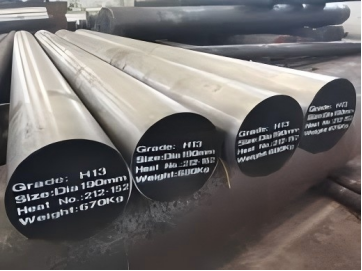
In manufacturing industries such as plastic injection molding, die casting, and forging, molds are subjected to harsh conditions of high temperature, high pressure, strong impact, and frequent hot and cold cycles. If the material selection is inappropriate, problems such as hot cracking, corner collapse, accelerated wear, and dimensional instability can easily occur, leading to shortened mold life, frequent downtime for maintenance, and even the scrapping of batches of products. Therefore, mold materials must not only possess sufficient high-temperature strength and wear resistance, but also maintain good toughness and dimensional stability under repeated thermal cycling to ensure molding accuracy and production continuity. Among various hot work die steels, H13 steel (also known as hot work die steel) has gradually become the industry standard steel for die casting molds, hot forging molds, hot extrusion molds, and high-end injection molds due to its balanced comprehensive performance, high service stability, and strong process adaptability. The following will systematically analyze the advantages of H13 as the preferred material for hot work dies from several key characteristics, including material properties, thermal cycling adaptability, and processing and maintenance characteristics.

1. Excellent High-Temperature Strength and Thermal Fatigue Resistance
Hot-work molds undergo repeated rapid heating and cooling during die casting and high-temperature injection molding. If the material softens significantly at high temperatures or has insufficient resistance to thermal cracking, cracks and thermal fatigue cracks are prone to form on the surface of the mold steel cavity, leading to premature mold failure. H13 exhibits good red hardness and tempering stability, maintaining high strength and hardness even at 500–600℃. Its alloy system effectively inhibits the initiation and propagation of hot cracks, ensuring reliable service life for the mold under long-term thermal cycling conditions.
2. Balanced Toughness and Wear Resistance
Under the pressures of die casting, filling, and forging impact loads, dies must be wear-resistant while preventing chipping and cracking. H13, through the synergistic effect of chromium, molybdenum, and vanadium, achieves a good balance between hardness and toughness, resisting both molten metal erosion and frictional wear while maintaining sufficient fracture resistance under high stress conditions. This comprehensive mechanical property makes it particularly suitable for complex, high-load hot-working dies.
3. Excellent dimensional stability and heat treatment performance
Precision molds require extremely high control over deformation after heat treatment. H13 has good hardenability and uniform microstructure, with minimal differences in internal and external properties after heat treatment. Residual stress can be easily released through multiple tempering processes, effectively reducing the risk of deformation and dimensional drift. During long-term thermal cycling, the cavity accuracy and assembly fit of the mold steel are more likely to remain stable.
4. Good Machinability and Surface Quality
In the annealed or pre-hardened state, H13 exhibits good machinability, making it suitable for deep cavity milling and finishing, which helps improve mold manufacturing efficiency. Simultaneously, its clean microstructure and good polishing properties result in high surface finish, meeting the surface quality requirements of high-gloss injection molded parts and die-casting mold cavities. Furthermore, it is suitable for subsequent surface strengthening treatments such as nitriding and coating.

Conclusion
In summary, the reason H13 has maintained its dominant position in hot-work molds such as die-casting molds, hot forging molds, hot extrusion molds, and high-end injection molds is not due to outstanding performance in a single area, but rather to its highly balanced comprehensive advantages in high-temperature strength, thermal fatigue resistance, toughness, wear resistance, dimensional stability, and machinability. Under harsh conditions of repeated high-temperature impacts and thermal cycling, H13 maintains sufficient hardness and strength to resist thermal softening and hot cracking, while its good toughness prevents brittle cracking and chipping failure, thus significantly extending the overall service life of the mold.
From the perspective of manufacturing and lifecycle costs, H13's stable heat treatment performance and low deformation risk help ensure cavity accuracy and assembly consistency, reducing the number of subsequent mold repairs and rework. Its good machinability and polishing properties help shorten the mold manufacturing cycle and improve surface quality and the appearance of the molded parts. At the same time, H13's good adaptability to surface strengthening processes such as nitriding and coating also provides room for further improvement in the mold's wear resistance and thermal fatigue resistance.
It is precisely because of these comprehensive characteristics of "comprehensive performance, high reliability, and strong process adaptability" that H13 has become the preferred choice for many mold manufacturers when facing requirements of high temperature, high load, and long service life. For companies that pursue stable production, reduce the overall cost of mold use, and improve molding quality, H13 is not only a mature material solution, but also a standardized solution that has been verified by long-term industrial practice.
To learn more about our solutions and services, please contact us for more information.
About ASIATOOLS
ASIATOOLS is an industrial solution provider specializing in tool steels, mold steels, and CNC machining–related products, serving mold manufacturers, die casting companies, and industrial equipment producers worldwide. With extensive experience in hot work tooling applications, we support customers throughout the full lifecycle of mold manufacturing—from material selection and heat treatment guidance to machining feasibility and application optimization.
For hot work tool steels such as H13 (1.2344), ASIATOOLS provides stable material supply and practical technical support aligned with real production conditions. Our expertise covers die casting molds, hot forging dies, hot extrusion tooling, and high-performance injection molds, where resistance to thermal fatigue, dimensional stability, and long-term service reliability are critical.
By integrating material knowledge with manufacturing and process experience, ASIATOOLS helps customers reduce mold failure risks, extend service life, and achieve consistent performance under high-temperature, high-load operating environments.